MasterBrand Inc. (MBC): Customer relationships that shape revenue and risk
MasterBrand manufactures and sells residential cabinetry across North America and monetizes through direct product sales to dealers, retailers and builders, with the retail channel and a cluster of large customers driving a disproportionate share of revenue. The company converts manufacturing scale and a multi-brand portfolio into recurring sales via short payment terms and standing supply frameworks, while retaining pricing and product segmentation power through its broad brand architecture. For deeper relationship-level analysis, see NullExposure’s coverage at https://nullexposure.com/.
Understanding MasterBrand’s customer map is essential for investors: retail giants supply scale and volatility, dealer networks supply breadth and repeat business, and long-tenured builder relationships anchor incremental share in construction cycles.
How MasterBrand actually sells — mechanics that matter to cash flow and margins
MasterBrand’s operating model is straightforward: it sells cabinets and related products (stock, semi-custom and premium cabinetry and vanities) into three primary channels — dealers, retailers and builders — with product shipped on standard commercial payment terms. The company’s public disclosures emphasize several constraints that have material implications for investors:
- Short commercial payment terms (30–90 days) create predictable working capital cycles but also expose the company to retail receivables and channel timing.
- Framework contracts that govern supply-on-order reduce contractual lock-in for buyers while preserving steady flow for MasterBrand when purchase orders are placed.
- Geographic concentration in North America concentrates exposure to U.S./Canadian housing and remodeling cycles rather than international diversification.
- High customer concentration: the ten largest customers generated roughly half of net sales in recent years, creating material counterparty risk if large retail or builder relationships weaken.
- Mature, long-standing relationships with many dealers and builders support stable demand and category management advantages, but also mean incumbency is a key competitive moat rather than frequent rapid expansion.
- Core-product orientation: the business is primarily transactionally oriented around physical goods rather than services, keeping margins sensitive to commodity and logistics cost swings.
- Dealer/distributor scale is large (management cites thousands of dealers), consistent with channel-based selling and meaningful mid-market penetration.
Put together, these characteristics define a capital-light revenue engine with earnings sensitivity to housing cycles, retail inventory dynamics and commodity cost pressures.
Customer-by-customer: the relationships investors should know
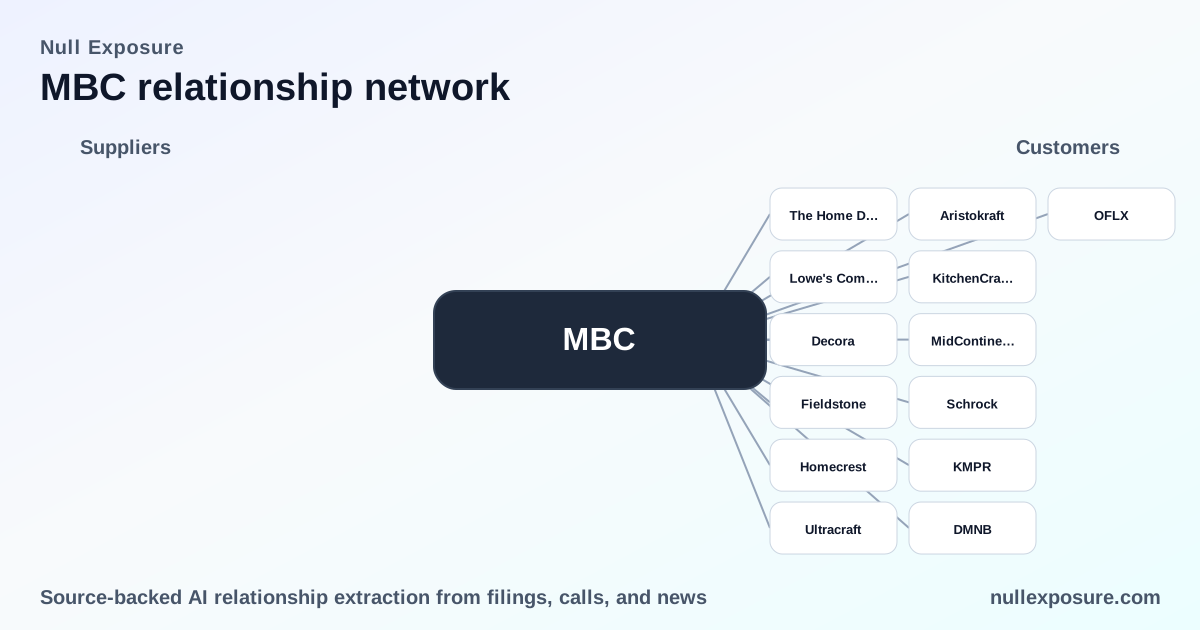
Below is a concise, source-backed summary of every customer relationship surfaced in MasterBrand’s customer records.
-
The Home Depot, Inc. — A material retail customer that accounted for approximately 13% of MasterBrand’s net sales in FY2025, down from 16% in FY2023, reflecting the retailer’s central role in MasterBrand’s retail channel. (According to MasterBrand’s FY2025 Form 10‑K filing.)
-
Lowe’s Companies, Inc. — The single-largest reported retail customer, representing about 20% of net sales in FY2025, underscoring concentrated reliance on a small set of national big-box retailers. (Reported in the FY2025 Form 10‑K.)
-
Decora — One of MasterBrand’s in-portfolio brands used to address a segment of the cabinetry market, cited alongside other portfolio names in industry coverage of MasterBrand’s brand mix. (A March 2026 Kitchen & Bath Design article profiling MasterBrand’s brand portfolio.)
-
Ultracraft — A franchise brand within MasterBrand’s stable, serving a particular design/price point in cabinetry offerings, listed among the company’s branded products in industry reporting. (Kitchen & Bath Design, March 2026.)
-
Aristokraft — A legacy brand within MasterBrand’s portfolio used to target entry-to-mid consumers, identified in coverage of MasterBrand’s brand breadth. (Kitchen & Bath Design, March 2026.)
-
Fieldstone — A brand name carried by MasterBrand to cover additional channel or stylistic niches, included in the company’s publicly noted brand list in trade press. (Kitchen & Bath Design, March 2026.)
-
Homecrest — A portfolio brand MasterBrand leverages for specific market segments or distribution relationships, referenced in the same industry write-up that enumerates MasterBrand’s brands. (Kitchen & Bath Design, March 2026.)
-
KitchenCraft — Another MasterBrand label serving part of its multi-tiered product lineup, cited with sister brands in trade reporting about MasterBrand’s acquisitions and product reach. (Kitchen & Bath Design, March 2026.)
-
MidContinent — A branded offering inside MasterBrand’s product family used to reach regional and national channels, noted by industry media listing the company’s brands. (Kitchen & Bath Design, March 2026.)
-
Schrock — A premium-to-mid brand in MasterBrand’s portfolio that supports channel segmentation, included in the company’s enumerated brand portfolio in trade coverage. (Kitchen & Bath Design, March 2026.)
-
Diamond — Listed among MasterBrand’s portfolio brands in trade reporting, representing additional shelf and channel coverage, as described by industry press covering MasterBrand’s acquisitions and brand strategy. (Kitchen & Bath Design, March 2026.)
-
Omega — Identified by industry reporting as part of MasterBrand’s broad brand architecture, contributing to product breadth across price points and channels. (Kitchen & Bath Design, March 2026.)
-
KMPR / Kemper — Kemper (sometimes referenced with the ticker-style label KMPR in reporting) is cited among MasterBrand’s brand names and reflects the firm’s use of multiple specialized brands to service distinct dealer and retail relationships. (Kitchen & Bath Design, March 2026.)
-
Habitat for Humanity — A nonprofit partner and corporate sponsor relationship: MasterBrand acted as a Platinum Sponsor for the 2026 Carter Work Project, donating cabinetry and design services and coordinating employee volunteer engagement, an extension of the company’s community and CSR activities. (Intellectia.ai coverage of MasterBrand’s FY2026 community activities.)
Each listed relationship is either a direct commercial customer (Home Depot, Lowe’s) or a brand-level relationship that underpins how MasterBrand categorizes and sells product through its channels (Decora, Ultracraft, Aristokraft, Fieldstone, Homecrest, KitchenCraft, MidContinent, Schrock, Diamond, Omega, Kemper/KMPR). The Habitat for Humanity partnership is a non-commercial, reputational relationship that supports community engagement and brand positioning.
What this means for investors: concentration, cash flow and the cycle
- Concentration risk is real and measurable: with the top ten customers generating roughly half of sales, swings at one or two national retailers materially move revenue and working capital.
- Cash flow dynamics are predictable but tight: standard 30–90 day payment terms, combined with framework ordering, support steady receivables turnover but leave MasterBrand exposed to retailer inventory resets and housing-market timing.
- Channel diversification is a strength and a limit: dealer networks and builder contracts provide breadth and stability, while national retailers provide scale—and volatility.
- Brand portfolio is a competitive tool: multiple in-house brands enable price and channel differentiation, giving MasterBrand control over market segmentation without heavy reliance on contract exclusivity.
Where to look next
Monitor MasterBrand’s next quarterly reporting for changes in channel mix (dealer vs. retail), any shifts in the percentage of sales to Lowe’s and Home Depot, and commentary on commodity and freight costs that drive margin pressure. For consolidated coverage and relationship-level signals on MasterBrand and peers, visit NullExposure at https://nullexposure.com/.
Key takeaway: MasterBrand is a manufacturing-led, channel-driven business where a handful of large retail relationships and a broad brand portfolio determine both revenue scale and concentration risk. Investors should focus on retail concentration metrics, working capital trends, and housing/remodel cycle indicators to forecast near-term earnings sensitivity.