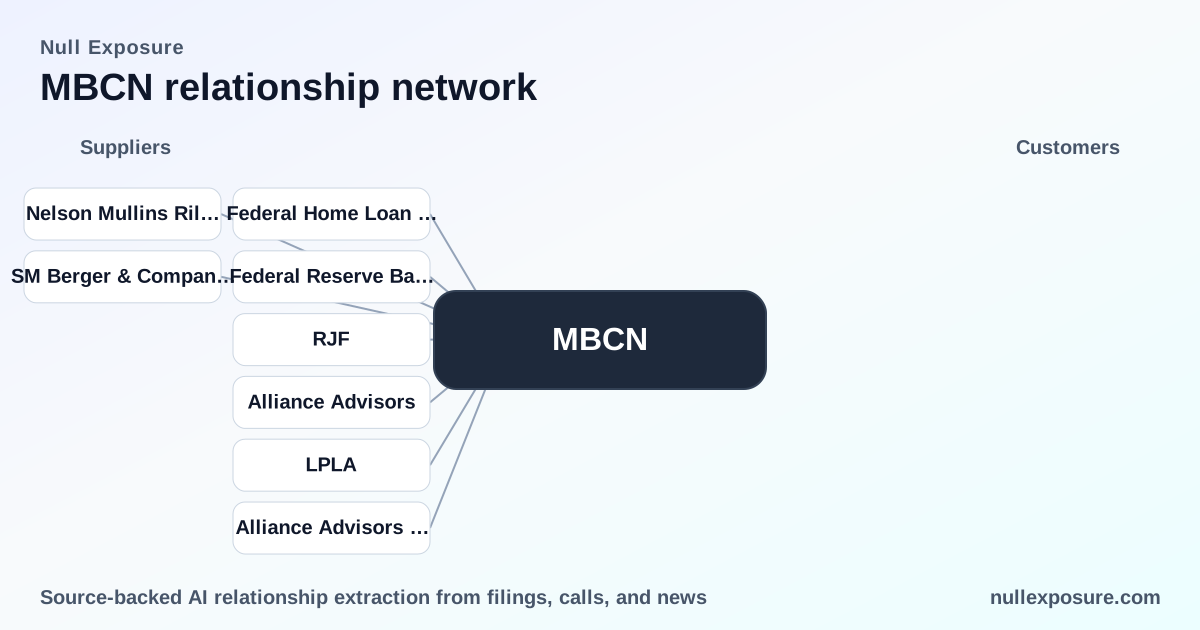
Middlefield Bancorp (MBCN): Customer relationships and operational constraints that matter to investors
Middlefield Bancorp operates a classic regional banking model: it earns net interest income from commercial and consumer lending and funds that lending primarily through customer deposits, while fee income supplements margins through account services and cash management. The company monetizes through interest spread on a loan portfolio concentrated in Ohio commercial real estate, small- and mid-market commercial lending, and retail deposit products. For investors evaluating customer and counterparty exposure, the critical axes are deposit concentration, loan mix, and an ongoing strategic outcome — a proposed sale to Farmers National Banc Corp. For a concise proprietary view of counterparties and operating constraints, visit https://nullexposure.com/.
The corporate event that shapes the customer picture
A January 2026 Morningstar/PR Newswire release reported a proposed sale of Middlefield Bancorp (Nasdaq: MBCN) to Farmers National Banc Corp. (Nasdaq: FMNB). This transaction restructures MBCN’s customer relationships by folding them into FMNB’s franchise and will drive immediate re-evaluation of deposit stewardship, loan retention, and branch rationalization plans. According to that release, the buyer is FMNB and the target is MBCN (PR Newswire, January 2026).
What every counterparty relationship looks like now
Below I cover each counterparty relationship surfaced in available reporting. Each item is a plain-English snapshot with a source note.
- Farmers National Banc Corp. (FMNB): The public filing and press reports list FMNB as the proposed acquirer of Middlefield Bancorp, signaling a change in customer ownership and potential integration of deposit and loan books into FMNB’s network. A Morningstar/PR Newswire release in January 2026 announced the proposed sale of Middlefield Bancorp to Farmers National Banc Corp. (Morningstar/PR Newswire, Jan 2026).
How Middlefield’s business model shapes customer risk and economics
Investors should read the customer list through the lens of Middlefield’s operating constraints and business model characteristics. These company-level signals — drawn from Middlefield’s disclosures — explain why customer relationships behave the way they do and how they will be treated by an acquirer.
-
Short-term contracting posture on credit commitments. Loan commitments “generally have fixed expiration dates within one year of their origination,” which limits long-duration funding exposure from off-balance-sheet commitments and concentrates credit rollover and repricing risk into short windows (company disclosures, FY2024). This keeps the bank nimble but raises cyclical credit sensitivity.
-
Customer mix heavily weighted to regional economic activity. Middlefield’s lending and deposit footprint is concentrated in northeastern, central, and western Ohio — approximately 91% of commercial real estate collateral is Ohio-based, and the lending market centers on a specified set of counties. That geographic concentration creates strong correlation between bank performance and Ohio commercial/real estate cycles (company filings, Dec 31, 2024).
-
Public-sector deposits are a meaningful funding element. Disclosures show public funds comprised $167.9 million, or 11.6% of total deposits at December 31, 2024, up from 9.9% the prior year, indicating material exposure to government and political subdivision cash flows (FY2024 disclosure). Public deposits are stable but politically sensitive and can concentrate redemption risk.
-
Retail and small business relationship base drives product mix. The bank explicitly serves individuals, small businesses, and mid-market commercial borrowers; residential real estate and HELOCs are significant retail loan segments, and commercial & industrial lending to small and medium-sized enterprises forms a major portion of the commercial portfolio (company disclosures, FY2024). This customer composition supports granular deposit sticks but limits scale economics compared with larger regional banks.
-
Deposits are critical funding; customer accounts are strategic. Middlefield states that deposits are its most important source of funds, underscoring that customer relationships are not ancillary — they are the balance-sheet engine. Any acquirer will prioritize deposit retention and re-pricing strategies post-transaction (company disclosures).
-
Services orientation, not narrow product dependence. The bank operates a single bank segment providing a broad range of banking services: checking, savings, money market, time deposits, real estate and commercial loans, and online banking services. This breadth creates diversified fee pathways but ties revenue closely to branch and digital distribution effectiveness.
-
Active and monitored customer relationships. The bank monitors counterparties throughout the relationship for licensing and financial condition and treats customer service as a core operating function — an indication that customer churn is managed proactively, but not eliminated (company disclosures).
Investment implications for buyers, lenders, and analysts
-
Integration risk and opportunity. FMNB’s proposed acquisition immediately elevates integration as the key operational risk: retaining deposit customers and preserving commercial lending relationships will determine near-term funding and credit stability. The buyer will need to execute cross-sell and retention programs to prevent deposit runoff.
-
Regional concentration amplifies local economic exposure. With roughly nine in ten CRE properties tied to Ohio, a localized downturn would have outsized profit-and-loss and credit-cycle consequences. Investors should stress-test loan loss assumptions against Ohio commercial real estate scenarios.
-
Public funds and municipal exposure matter to liquidity planning. The size and growth of public funds mean the bank’s liquidity profile is partially subject to municipal cash-flow timing and political decisions; acquirers will treat these balances as both a strength (sizeable core funding) and a potential source of volatility.
-
Short-lived commitments change capital timing. Short-term loan commitments condense the timeline for capital deployment or repricing, so earnings sensitivity to rate moves and credit decisions is more immediate than for a portfolio with longer standby commitments.
Key takeaways for investors
- A confirmed buyer (FMNB) is the pivotal relationship event — the transaction rewrites customer ownership and strategically repositions deposit and lending books. (Morningstar/PR Newswire, Jan 2026)
- Middlefield’s franchise is deposit-funded, regionally concentrated, and oriented toward individuals and small- to mid-market businesses; these traits define both its strengths and its cyclical vulnerabilities. (Company disclosures, FY2024)
- Retention of public funds and local commercial clients will determine near-term funding stability and credit outcomes under acquirer ownership.
For more structured counterparty intelligence and deal tracking on regional banking dynamics, check our research hub at https://nullexposure.com/.
If you want a tailored briefing on potential credit scenarios for Middlefield’s loan portfolio under FMNB ownership, I can prepare a focused sensitivity analysis and customer-retention playbook.