Merchants Bancorp (MBIN): How its customer relationships shape a mortgage-first regional bank
Merchants Bancorp operates as a diversified bank holding company that monetizes through mortgage origination and sales, mortgage servicing fees, and traditional community banking deposits and lending. The firm combines a national mortgage banking platform—focused on multi‑family and healthcare loans, warehouse lending and loan syndication—with a local retail bank franchise that generates deposit funding and community lending income. This hybrid model produces fee and gain-on-sale income from rapid loan turnover, recurring servicing revenue, and deposit-sourced funding that together drive the company’s profitability profile.
For a concise view of related contacts and commercial positioning, visit the Null Exposure homepage: https://nullexposure.com/
A pair of sponsorship relationships tied to Indiana athletics
Merchants Bank has recently engaged in visible community and brand partnerships in Indiana that reflect both marketing strategy and local market anchoring.
-
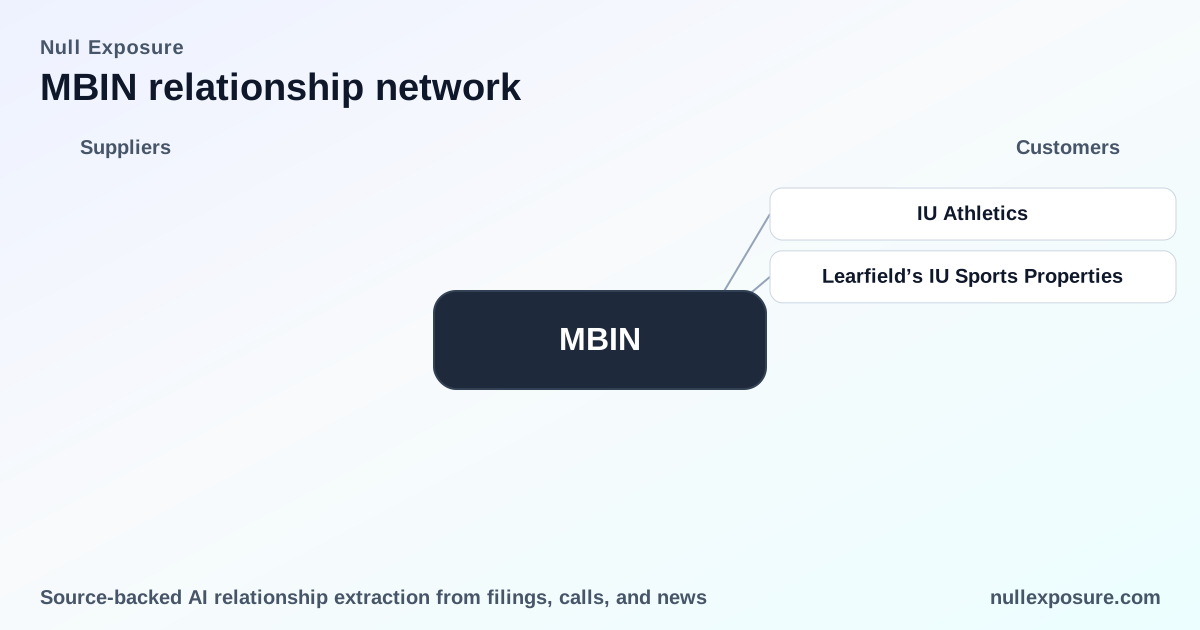
IU Athletics — Merchants Bank announced a comprehensive partnership supporting Indiana University’s Department of Intercollegiate Athletics, positioning the bank as a visible financial partner to student‑athletes and sports programs. This agreement was disclosed in a Learfield press release in August 2025 and reported by Learfield’s IU Sports Properties. (Learfield press release, August 2025.)
-
Learfield’s IU Sports Properties — As part of the deal with IU and Learfield, the playing surface at Memorial Stadium was renamed Merchants Bank Field at Memorial Stadium, delivering naming‑rights exposure and stadium-level brand placement. The naming-rights detail was published in the same August 2025 Learfield announcement. (Learfield press release, August 2025.)
These relationships are targeted marketing and community engagement plays that support deposit product awareness and local brand equity rather than direct lending or servicing contracts.
What the relationship set means for investors
These sponsorship agreements underscore two strategic aims. First, community and brand reinforcement in Indiana supports local deposit and retail growth for the bank’s branch footprint in Carmel and Indianapolis-area counties. Second, the stadium naming-rights and athletic partnership drive high-visibility marketing that complements Merchants’ national mortgage business by increasing consumer awareness in its home market. Investors should view these relationships as customer-facing marketing investments that are incremental to, but distinct from, the firm’s principal mortgage banking and servicing operations.
Operating model constraints you need to track
Merchants’ operational characteristics and commercial posture are evident in its public disclosures and commercial signals. These factors shape counterparty risk, revenue concentration, and contract dynamics:
-
Short-term contracting posture: Merchants sells a substantial portion of originated fixed-rate loans into the secondary market, often within approximately 30 days, which makes gain-on-sale income cyclical and dependent on market access and basis between origination and sale. (Company filings, FY2025–FY2026.)
-
Government counterparty concentration: The servicing portfolio is primarily composed of Ginnie Mae, Fannie Mae and Freddie Mac loans; these agency relationships are a central distribution and servicing channel and a material source of noninterest income and deposits. (Company filings, FY2025–FY2026.)
-
Diverse counterparty mix: The bank services and lends to individuals, small businesses (including SBA programs), and large institutional investors through syndicated funds and warehouse financing, producing a multi‑tier counterparty book that spans retail and institutional counterparties. (Company filings, FY2025–FY2026.)
-
National footprint with local branches: Merchants operates nationally—particularly for multi‑family and healthcare lending—while maintaining a small Indiana branch network for community banking, which yields national scale for mortgage origination and local depth for deposit gathering. (Investor materials and filings, FY2025–FY2026.)
-
Service provider and seller roles are both material: The company both sells loans into the secondary market (seller role) and serves as master/sub‑servicer on substantial pools (service provider role), creating revenue diversification between gains on sale and recurring servicing fees. (Company filings, FY2025–FY2026.)
-
Materiality of servicing income: Servicing and agency-related activity are identified as a significant source of noninterest income and deposit funding, making servicing performance a core earnings driver. (Company filings, FY2025–FY2026.)
-
Scale of commitments: Public disclosures cite commitments to extend credit in the billions (for example, commitments in the range of $4.35 billion), indicating meaningful balance sheet capacity and warehouse exposure that underpins originating and funding mortgage pipelines. (Company filings, FY2025–FY2026.)
Taken together, these signals describe a bank that operates as a transaction-intensive mortgage originator that seeds recurring, agency‑backed servicing economics while relying on local retail deposits for stable funding.
Risks and strategic implications for partners and operators
-
Earnings sensitivity to secondary markets: Because gains on loan sales are earned on rapid loan turnover, earnings volatility tracks secondary market liquidity and the firm’s ability to sell loans at a premium. Funding stress or wider bid-ask spreads in mortgage markets would compress that revenue stream. (Company filings, FY2025–FY2026.)
-
Agency concentration creates policy exposure: Heavy reliance on Ginnie, Fannie and Freddie pipelines ties portions of revenue and deposit inflows to regulatory and programmatic shifts affecting those agencies. Changes in agency requirements or fees would directly affect noninterest income and deposit behaviors. (Company filings, FY2025–FY2026.)
-
Operational complexity from dual roles: Acting as both originator/seller and master/sub‑servicer increases operational demands and counterparty obligations—servicing liabilities can become contingent liquidity and operational risk, particularly on large pools. (Company filings, FY2025–FY2026.)
-
Marketing spend is targeted but ancillary: High‑visibility sponsorships such as the IU agreements improve local brand placement and deposit outreach but do not substitute for scale in mortgage distribution or servicing capabilities. These are complementary investments rather than primary profit centers. (Learfield press release, August 2025.)
Final takeaways and recommended next steps
Merchants Bancorp combines a national mortgage banking engine with a community bank franchise to generate a mix of transactional gains and recurring servicing income. The IU and Learfield partnerships are strategic brand plays that reinforce local market positioning while the firm’s core earnings remain tied to agency markets and active loan sales. Monitor agency relationships, servicing portfolio growth, and secondary market liquidity as primary determinants of short‑to‑medium term earnings.
For a deeper look at counterparty maps and relationship exposure across financials, explore our coverage at Null Exposure: https://nullexposure.com/
Key takeaway: MBIN is a mortgage-centric regional bank with materially agency‑linked servicing economics; local sponsorships add brand value but the investment thesis rests on mortgage market access and servicing execution.