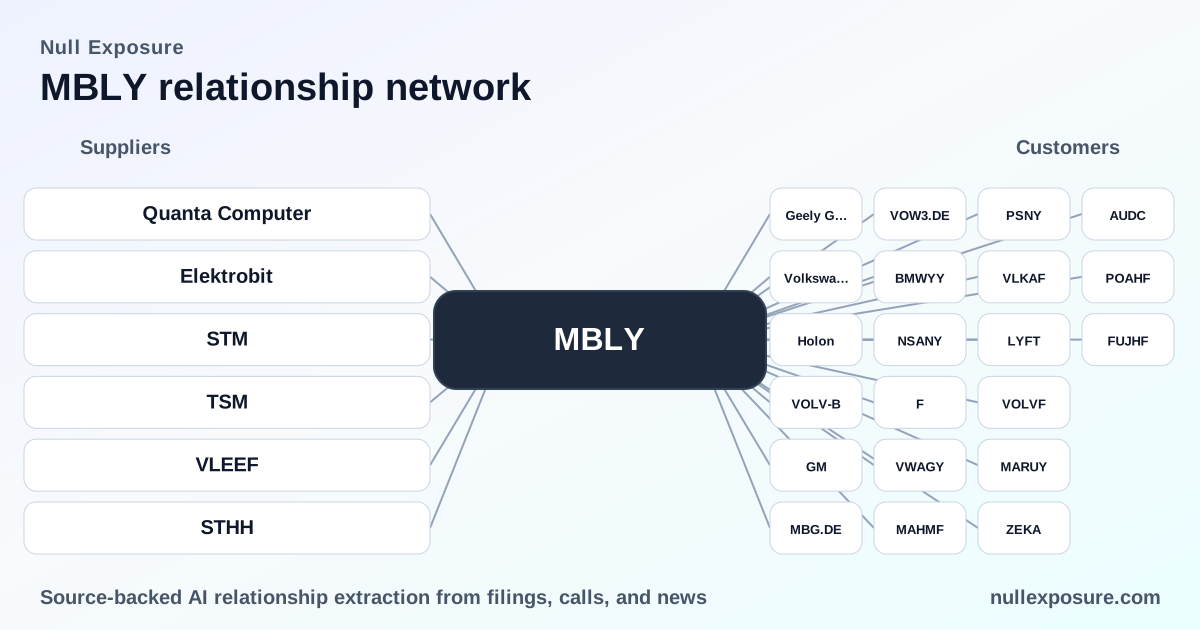
Mobileye (MBLY) — Customer Map and Commercial Implications for Investors
Mobileye builds and sells camera‑first ADAS and autonomous driving systems, monetizing primarily through the sale of EyeQ system‑on‑chips and SuperVision hardware to Tier‑1 suppliers and OEMs, plus software and robotaxi partnerships that create recurring service and platform upside. Revenue is hardware‑heavy today, concentrated among a few large customers, while execution on multi‑year production programs drives near‑term earnings and robotaxi/service initiatives drive long‑term optionality. For deeper coverage and signal tracking visit https://nullexposure.com/.
Quick investor thesis
Mobileye’s business model is hardware‑anchored but software‑levered: EyeQ SoC shipments generate the bulk of current EBIT, while SuperVision and Chauffeur programs convert design wins into multi‑year OEM production revenue and higher margin recurring services. Execution risk centers on program launches, chip inventory cycles and concentration among major Tier‑1/OEM customers.
How Mobileye contracts, scales and where the risks are
Mobileye’s public disclosures and earnings commentary reveal a specific contracting posture and operational profile:
- Contracting posture: short‑term and purchase‑order driven. MBLY sells largely under standard purchase orders and recognizes product revenue at shipment; customers typically are not bound to fixed long‑term volumes except during the chip shortage period when minimum commitments briefly occurred (MBLY 2025 10‑K).
- Spot/ship‑based recognition. EyeQ and SuperVision revenue is recognized at shipment, reinforcing revenue sensitivity to production timing and inventory pulls (MBLY 2025 10‑K).
- Large‑enterprise counterparties and concentration. MBLY depends on a limited set of Tier‑1 suppliers and OEMs for a substantial share of revenue; its three largest Tier‑1 customers accounted for sizeable percentages of revenue in 2025 (MBLY 2025 10‑K).
- Geographic footprint is global with important APAC exposure. China represented ~23% of shipments in 2025, underscoring regional concentration risk alongside global diversification (MBLY 2025 10‑K).
- Customer relationships are critical and mature for core hardware, active for expansion. MBLY derives the majority of revenue from deployed ADAS and EyeQ SoCs (core hardware), while SuperVision and robotaxi initiatives are moving from design wins into execution (MBLY 2025 10‑K, earnings calls).
- Spend scale: material multi‑year programs exceed the $100m+ band for top Tier‑1s. MBLY disclosed that ZF, Valeo and Aptiv together represent material revenue shares—evidence of high spend concentration (MBLY 2025 10‑K).
For ongoing tracking tools and alerts on MBLY customer activity see https://nullexposure.com/.
Customer relationships — concise catalog (each entry with cited source)
Geely Group
Mobileye’s SuperVision first reached series production with Geely’s ZEEKR premium EV brand in 2021, showing early commercial validation in China (MBLY 2025 10‑K).
Volkswagen Group
MBLY reported multiple production program awards and successful software update execution with Volkswagen Group, positioning VW as a major partner on SuperVision and Chauffeur programs (MBLY 2025 10‑K).
Holon (Benteler division)
Earnings commentary in 2025Q3 included Holon among expanding robotaxi engagements, indicating workstreams beyond core OEM programs (MBLY 2025 Q3 earnings call).
GM (General Motors)
External reporting lists GM among Mobileye’s longstanding automaker customers, reflecting a legacy strategic partnership across ADAS initiatives (SiliconANGLE reporting on FY2022).
Nissan Motor Co. Ltd.
News coverage identifies Nissan as one of the automakers partnered with Mobileye on EyeQ‑based ADAS implementations (SiliconANGLE reporting on FY2022).
Volvo
Mobileye added Volvo as a new customer in 2025 and later referenced Volvo in public remarks on RFQ wins, implying both a production program and RFQ success (MBLY 2025 Q3 earnings; Sahm Capital reporting FY2026).
INVZ (MOIA/Autonomous vehicle integration)
An investor earnings call referenced combining a self‑autonomous vehicle with Mobileye systems and the MOIA AV ecosystem, signalling program‑level collaboration (INVZ 2025 Q3 earnings call).
Polestar
Mobileye works with Polestar on ADAS for the Polestar 4, with management noting these programs are relatively small within the overall business but relevant to product breadth (MBLY 2025 Q3 earnings call; MarketBeat summarizing FY2026).
VOLV‑B / VOLVF (Volvo variants in filings)
Multiple items reference Volvo (different listings), reinforcing the company’s recent addition as an OEM customer in 2025 and 2026 commentary (Sahm Capital FY2026; MBLY 2025 Q3 earnings).
ZEEKR
ZEEKR was named explicitly as the launch platform for SuperVision earlier in the decade; MBLY noted SuperVision volumes tracking ahead of expectations and a raised outlook in 2025 commentary (MBLY 2025 10‑K; MBLY 2025 Q3 earnings call).
MAHMF / Mahindra & Mahindra
MBLY announced a SuperVision agreement with Mahindra, positioning Mobileye as a Tier‑1 supplier and opening new geographic markets in India (Sahm Capital reporting FY2026).
VW group / VW group (news coverage)
Multiple 2026 news pieces and earnings remarks tie Mobileye to VW group milestones for EyeQ6H‑based SuperVision and Chauffeur L3 programs, highlighting production ramp narratives (Sahm Capital & press summaries FY2026).
Lyft
Press reporting in early 2025 announced a proposed Mobileye–Lyft robotaxi launch in Dallas for 2026, indicating partnership momentum in mobility services (Globes coverage FY2025).
Marubeni
MBLY’s earnings call referenced Marubeni in the context of the Lyft‑Marubeni value chain, suggesting Marubeni’s role as a commercial or integration partner (MBLY 2025 Q3 earnings call).
ZEKA (ZEEKR label)
Earnings commentary used ZEKA/ZEEKR to report stronger SuperVision volume trajectory and a raised full‑year gross margin outlook, reinforcing production momentum (MBLY 2025 Q3 earnings call).
Cariad (VW software unit)
Market commentary identified Cariad as the software integrator that will play a pivotal role integrating Mobileye technology into VW vehicles, highlighting the importance of software partners in systems integration (TradingView commentary FY2026).
VLKAF / Volkswagen (inventory behavior reporting)
AutobodyNews cited that Volkswagen and Porsche heavily stockpiled chip inventories, with Mobileye naming those Tier‑1 customers, underscoring chip cycle dynamics and customer procurement behavior (AutobodyNews FY2024).
BMW / BMW AG
Historical press coverage recounts Mobileye’s partnerships with BMW on ADAS and EyeQ platforms, demonstrating long‑standing OEM relationships (CNBC reporting FY2022).
Ford
Press coverage lists Ford among early Mobileye ADAS partners, anchoring MBLY’s OEM footprint across legacy automakers (CNBC reporting FY2022).
AUDC / Audi
Mobileye’s historical partnerships include Audi for EyeQ camera and ADAS systems, as reported during the company’s market debut coverage (CNBC FY2022).
GM (duplicate news entry)
Additional news coverage reiterated GM’s inclusion among Mobileye’s major automaker customers, reaffirming the company’s multi‑OEM exposure (CNBC FY2022).
MBG.DE / Mercedes (market expectations)
Market commentary referenced expectations around Mobileye winning contracts with legacy luxury OEMs, including Mercedes, in financing‑market narratives (Globes FY2025).
Porsche / POAHF
News reports indicate Porsche is a customer for Mobileye SuperVision and was named among Tier‑1 OEMs that stockpiled chips, showing MBLY penetration into premium marques (FinancialContent & AutobodyNews FY2024–FY2026).
Subaru
CES and investor commentary in 2026 cited Subaru as a newly added OEM partner following strong RFQ performance in 2025 (Sahm Capital FY2026).
AUDC / AUDI (duplicate)
Financial press reiterated Audi as an early Mobileye partner through EyeQ integrations (CNBC FY2022).
(Entries above correspond to each result row in the supplied dataset; sources include MBLY 2025 10‑K, MBLY 2025 Q3/Q4 earnings calls, and published news URLs cited in MBLY’s relationship results.)
What this customer map implies for investors
- Execution (not demand) is the gating factor. Large OEM design wins convert to revenue only through multi‑year program execution; the company’s move from wins to launches with VW, ZEEKR and others is the core growth lever.
- Concentration equals both leverage and risk. High reliance on a handful of Tier‑1s and OEMs creates upside from successful ramps but places downside risk on any single program delay.
- Hardware sales fund software/service optionality. EyeQ SoC shipments fund SuperVision and robotaxi investments that can create recurring revenue streams if execution scales.
Final read
Mobileye’s commercial footprint spans the industry’s largest OEMs and several new entrants into robotaxi and mobility services. Investors should track production launch milestones, shipment run‑rates and customer procurement behavior as primary drivers of near‑term revenue and as indicators of the company’s transition to software and service monetization.
For continuous monitoring and alerts on Mobileye customer developments visit https://nullexposure.com/.