Medallion Bank PR (MBNKP): Customer Map and Commercial Risk Profile
Medallion Bank (MBNKP) operates as an industrial partner bank, monetizing primarily through consumer and dealer loan originations and interest income from financed portfolios while selling its services to fintech platforms and dealer groups for loan distribution and servicing. The bank’s model is levered to third‑party originators and dealer relationships—Medallion provides capital, underwriting/loan‑origination infrastructure, and distribution channels, and it captures margin through interest and origination fees. For a concise institutional view of customer relationships and headline risks, visit https://nullexposure.com/.
Why customers matter to a preferred investor
Medallion’s customer book is its value engine: partner fintechs and dealer networks supply volume and distribution, while the bank supplies regulated charter, balance sheet capacity, and compliance infrastructure. That operating posture creates both scale opportunity and client concentration risk—growth is correlation-driven (partners bring volume), and underwriting / servicing continuity is critical to earnings stability.
Key financial signals in the public record support that characterization: revenue TTM of roughly $134 million with a high operating margin (0.64) and a reported profit margin (0.461) indicate a capital‑efficient lending franchise that turns partner flow into outsized margin. Book value per preferred share stands at 322.35, and return on equity is a healthy 16.5%—consistent with a profitable, mature specialty bank focused on lending and fee income.
What the customer map shows (top‑line read)
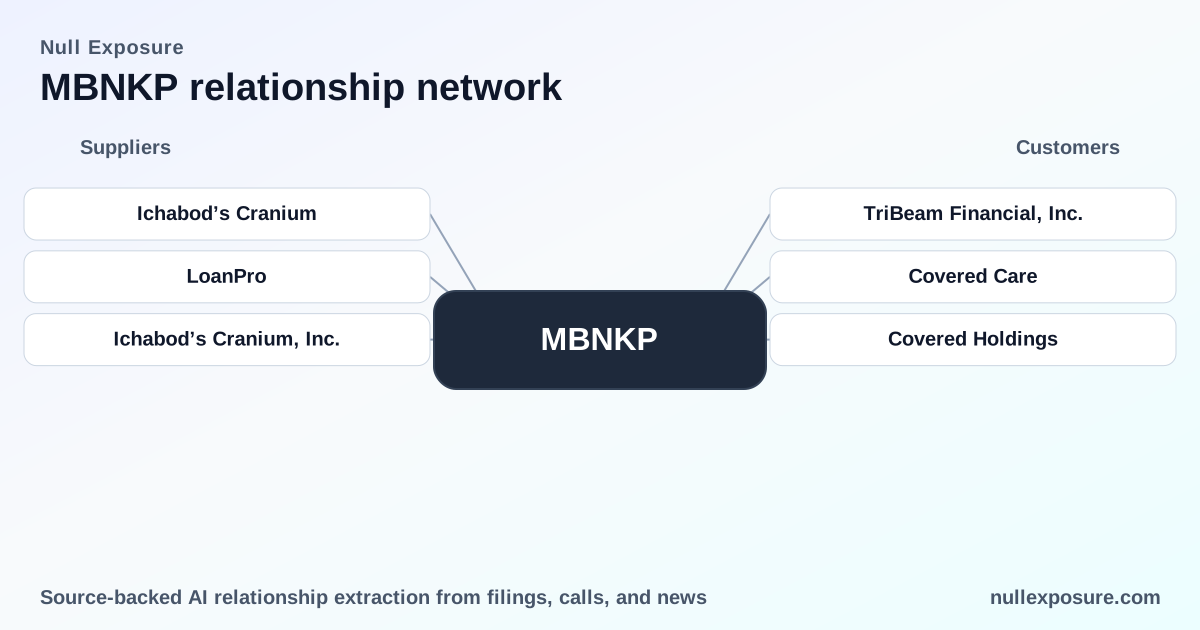
Medallion’s disclosed partner list is concentrated in two buckets: (1) fintech origination partners that route consumer and specialty loans onto Medallion’s balance sheet, and (2) dealer group finance relationships (notably in RV and outdoor vehicles) that supply near‑recourse retail installment contracts. The bank’s announced partnerships and historical transactions underline a strategic emphasis on embedded finance and dealer finance programs.
For a deeper relationship intelligence briefing and to monitor emerging partner deals, consider the full suite of coverage at https://nullexposure.com/.
Relationship breakdown — who buys from Medallion and what they buy
Below are every customer relationship identified in the available results, presented with a concise plain‑English summary and the original source.
TriBeam Financial, Inc.
Medallion entered a definitive partnership to be TriBeam’s finance partner for home solar systems and related products, positioning the bank as the capital and loan‑origination backer for TriBeam’s point‑of‑sale financing. According to a GlobeNewswire announcement (April 11, 2024), the relationship formalizes Medallion’s fintech strategy into distributed consumer energy financing (https://www.globenewswire.com/news-release/2024/04/11/2861855/0/en/Medallion-Bank-Announces-Fintech-Strategic-Partnership-With-TriBeam-Financial.html).
GMS Racing
An SEC disclosure summarized in press reporting shows GMS Racing paid Medallion Financial $19 million in a transaction tied to RPM and charter assets, reflecting Medallion’s historical role as a buyer/partner in specialty sports‑related financing and asset transactions. The Heavy.com report relays details from the SEC filing (December 2, FY2021) that reference the $19 million payment to Medallion Financial (https://heavy.com/sports/nascar/sec-charges-former-rpm-majority-owner/).
ClearGage, LLC
Medallion Bank agreed to provide loan origination services to ClearGage, integrating the bank into ClearGage’s lending pipeline and enabling patient or point‑of‑sale financing on ClearGage’s platform. A FintechFutures press release (May 2026) announced Medallion’s definitive agreement to offer these origination services (https://www.fintechfutures.com/press-releases/medallion-financial-announces-second-fintech-strategic-partnership-at-medallion-bank).
Covered Care
Medallion added Covered Care to its platform to expand patient financing offerings, indicating the bank’s push into healthcare payment solutions via partner clinics and providers. Retail Banker International covered the alliance and Medallion’s intention to grow via companies offering accessible consumer finance technologies (Retail Banker International, coverage of the Covered alliance, FY2022) (https://www.retailbankerinternational.com/news/medallion-bank-covered-fintech-alliance/).
Covered Holdings
Medallion formed an alliance with Covered Holdings to offer loans through the Covered Care patient financing program, reinforcing a strategy of white‑label patient financing through partner platforms. Retail Banker International reported on Medallion’s alliance and its product deployment with Covered Holdings (Retail Banker International, FY2022) (https://www.retailbankerinternational.com/news/medallion-bank-covered-fintech-alliance/).
Camping World (CWH)
Medallion’s dealer group business includes relationships with large retail dealers such as Camping World, indicating participation in RV and specialty vehicle finance programs that drive recurring origination volume. An RV‑Pro profile (40 Under 40, Jordan Moore) cites Camping World among dealer relationships that Medallion has developed (RV‑Pro, FY2024) (https://rv-pro.com/uncategorized/40-under-40-jordan-moore/).
Campers Inn
Campers Inn is named among the dealer partners in Medallion’s dealer group push, reflecting the bank’s distribution footprint in specialty vehicle retail finance. The RV‑Pro profile highlights Campers Inn as part of the dealer network cultivated by Medallion’s business development team (RV‑Pro, FY2024) (https://rv-pro.com/uncategorized/40-under-40-jordan-moore/).
Bish’s RV
Bish’s RV is another dealer in Medallion’s dealer finance portfolio, underscoring concentration in RV retail channels that supply steady installment loan volume. RV‑Pro reporting lists Bish’s RV among dealers in the bank’s dealer program (RV‑Pro, FY2024) (https://rv-pro.com/uncategorized/40-under-40-jordan-moore/).
General RV
General RV is included in Medallion’s dealer group roll‑out and contributes to the bank’s retail installment book and dealer finance relationships. RV‑Pro coverage names General RV as a partner in the company’s dealer network (RV‑Pro, FY2024) (https://rv-pro.com/uncategorized/40-under-40-jordan-moore/).
Operating model constraints and company‑level signals
No explicit relationship‑level constraints were extracted from the reviewed materials; that absence itself is a signal. From a company perspective, the following operational characteristics define Medallion’s risk/reward profile:
- Contracting posture: Medallion operates as a balance‑sheet and originations partner to third parties—contracts are typically partnership or alliance agreements that put underwriting and deposit funding on the bank’s balance sheet while partners supply volume and distribution.
- Concentration: The customer map shows concentration in fintech partners and dealer groups (RV and specialty vehicle dealers). Concentration across verticals increases dependency on a handful of originators and dealer networks for volume.
- Criticality: For partners, Medallion is a critical vendor—its chartered status and funding capacity are not easily substituted. For Medallion, platform continuity with its partners is critical to origination flow and margin capture.
- Maturity and profitability: Public financial metrics show a mature lending business: revenue TTM ~$134M, operating margin of 64%, profit margin 46.1%, and return on equity ~16.5%, consistent with a capital‑efficient specialty bank that converts partner flow into durable profitability.
Investment implications and material risk vectors
- Upside: Fintech partnerships in solar and patient financing expand addressable markets and diversify product mix beyond dealer finance; secured, recurring origination volume supports margin stability.
- Risks: Customer concentration in dealer networks and a small set of fintech partners creates earnings volatility if one or more partners change funding providers or face business stress; regulatory or underwriting shifts could squeeze margins if Medallion must reprice risk or reduce appetite.
- Operational: The bank’s reliance on partner integrations and originations infrastructure underscores the need for robust underwriting and servicing resilience.
For institutional access to ongoing relationship monitoring and a compact intelligence package, visit https://nullexposure.com/.
Bold takeaway: Medallion Bank is a profitable, partner‑centric industrial bank whose valuation and earnings are directly tied to the health and continuity of its fintech and dealer partnerships; investors should size exposure with attention to partner concentration and origination continuity.