Microbot Medical (MBOT): Early Commercial Traction with High Operational Leverage
Microbot Medical develops and commercializes the LIBERTY® Endovascular Robotic System, targeting minimally invasive endovascular procedures. The company monetizes through system sales, recurring consumables and service contracts, and plans to access the U.S. market via a mix of direct sales, distributors and strategic partnerships; it is concurrently pursuing European regulatory clearance to expand addressable markets. For investors, the story is early commercial validation driven by a small cohort of high-profile hospital adopters, balanced against regulatory and concentration risks. Learn more at https://nullexposure.com/.
What the recent customer signals mean for revenue and risk
Microbot completed FDA 510(k) clearance and moved from a limited release into a full market release in the U.S. in 2026, positioning revenue upside through installed-system economics—initial unit sales followed by consumables and service revenue. However, the customer base remains concentrated and nascent, with adoption led by academic medical centers and major health systems, which implies high operational leverage: a small number of placements can drive meaningful revenue but also create single-customer concentration risks. Company disclosures describe a go-to-market posture that is direct + distributor and emphasize commercialization ramping from a largely development-focused history. This is a classic medical-device commercialization profile: early high fixed costs, low installed base today, and material upside if adoption scales.
- Contracting posture: Direct sales with distributor channels and strategic partnerships provide flexibility but require investment in a commercial infrastructure.
- Concentration & criticality: Initial installed base is small and skewed to leading academic centers; LIBERTY’s value proposition is procedural precision for specific endovascular use cases, making each clinical adoption strategically important.
- Maturity: Product is out of limited release and entering full U.S. market release in 2026; European access remains conditional on CE Mark timelines and quality-system certifications.
For more detailed relationship intelligence and source-level signals, visit https://nullexposure.com/.
Customer relationships in the public record
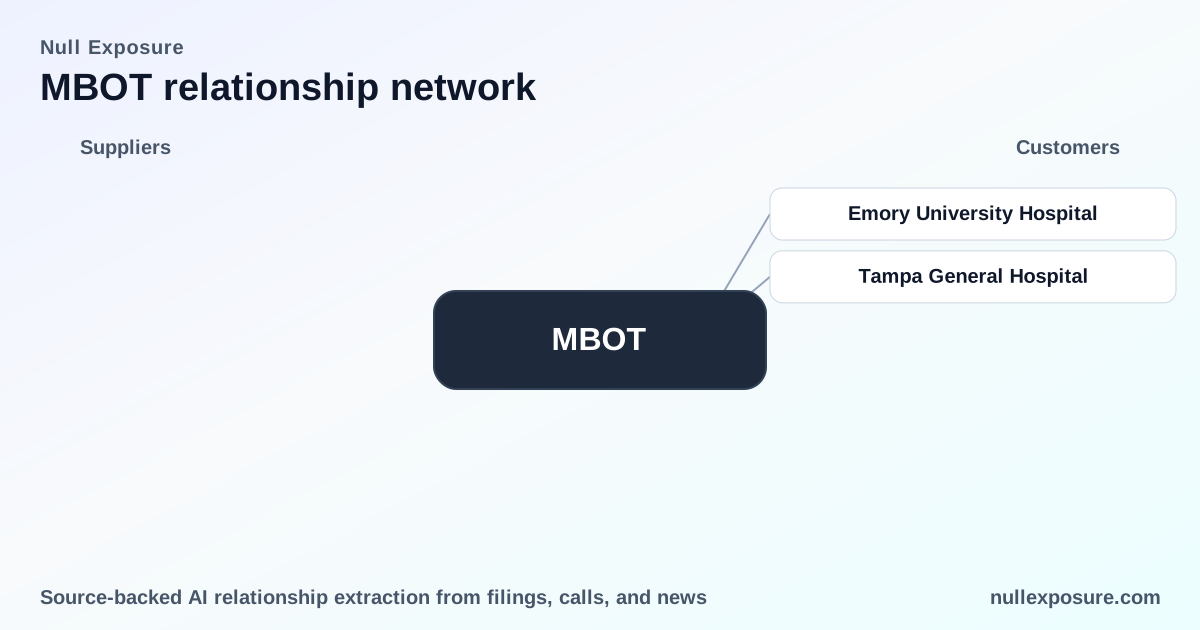
Emory University Hospital — the first hospital adopter
Emory University Hospital in Atlanta was the first hospital to adopt LIBERTY for patient care, a high-profile early win that serves as clinical validation for Microbot’s go-to-market case. According to Microbot’s press release and subsequent reporting, Emory completed early robotic peripheral endovascular procedures with LIBERTY, including the first robotic prostate artery embolization for benign prostatic hyperplasia (reported in late 2025 and reinforced in early 2026 coverage). (Source: Microbot press release via GlobeNewswire, Jan 2026; coverage on Yahoo Finance and RadiologyBusiness, Mar–May 2026.)
Emory Healthcare — system-level adoption and clinical throughput
Beyond the single hospital, Emory Healthcare as a system has adopted LIBERTY, signaling potential for deployment across additional sites in a major academic network and validating procedural workflows at scale. Industry reporting notes Emory Healthcare teams have used LIBERTY for peripheral endovascular procedures as part of the limited-release commercialization phase. (Source: GlobeNewswire/SIR announcement and RadiologyBusiness coverage, Apr–May 2026.)
Tampa General Hospital — first Florida health system adopter
Tampa General Hospital is recorded as the first health system in Florida to adopt the LIBERTY system, marking regional expansion beyond the initial academic center placements and supporting the company’s full market release narrative. Microbot highlighted Tampa General’s adoption in its 2026 press releases tied to FDA clearance and the U.S. rollout. (Source: Microbot press release via GlobeNewswire, Feb–Mar 2026; additional market notices and analyst commentary in May 2026.)
How each relationship informs commercial trajectory
Emory’s early adoption provides clinical and reputational validation, lowering time-to-adoption risk when engaging other academic centers and system purchasers. Tampa General’s system-level purchase demonstrates the company’s ability to sell into large non-academic health systems, an important stepping stone for broader hospital uptake. Collectively, these customers create a credible initial installed base for procedural data, training pathways and service economics that underpin recurrent revenue potential. Relevant press releases and market write-ups document these placements and the company’s move into a broader U.S. rollout (GlobeNewswire, RadiologyBusiness, and financial press, 2025–2026).
Company-level constraints and what they imply for investors
Microbot’s disclosures provide explicit geographic and operating constraints that should frame any investment thesis:
- The company is actively pursuing CE Mark approval for Europe and has engaged a notified body and obtained ISO 13485 certification as part of that effort; it anticipates CE Mark approval in the second half of 2026, but regulatory compliance and timing remain material variables. (Company disclosure excerpts on CE Mark and ISO 13485.)
- U.S. commercialization is the immediate priority: Microbot plans to access U.S. markets via direct sales, distributors and strategic partnerships, and is building its commercial team after a prolonged R&D focus. This contracting posture implies short-term cost pressure as the commercial organization scales, with revenue contingent on new placements converting into consumables and services. (Company filing and disclosure excerpts on U.S. market access.)
- The firm operates a single reportable segment: development of robotic devices for endoluminal surgery, concentrating execution risk on the LIBERTY platform and its regulatory and adoption pathway. (Company segment disclosure.)
- Distributor relationships are part of the operating model and create both reach and quality-control dependencies; Microbot notes that recalls by the company or its distributors are a recognized operational risk. (Company disclosure mentioning distributors.)
These signals define a company with high execution optionality: successful scale in the U.S. and approval in Europe materially expand the addressable market, but the current installed base is small and early adopters are critical to commercial proof.
Investment implications and near-term watch items
- Upside: Early placements at Emory and Tampa General validate LIBERTY’s clinical utility and provide pathways to recurring revenue if consumables and service contracts follow. Positive procedural outcomes and additional system-level contracts will drive re-rating.
- Risk: Regulatory timing in EMEA, commercialization execution, and customer concentration are the primary near-term risks; the company’s shift from R&D to sales increases operating expense and execution demands.
- Catalysts to watch: Quarterly updates on unit placements, consumable/service revenue recognition, additional health system agreements, and CE Mark issuance (targeted H2 2026) will materially affect valuation.
For an investor or operator evaluating Microbot’s customer relationships, the takeaway is straightforward: Microbot has secured early, credible customers that validate clinical use cases; commercial upside is real but concentrated and execution-dependent. For deeper relationship maps and ongoing signal monitoring, see https://nullexposure.com/.