What MasterCraft’s dealer moves tell investors about MCFT’s go-to-market
MasterCraft Boat Holdings (NASDAQ: MCFT) manufactures and sells premium towboats and pontoons primarily through a network of independent dealers and charter partners; it monetizes by selling boats, trailers, parts and accessories to those resellers and capturing aftermarket revenue through parts and service. Recent dealer additions and fleet conversions reinforce a distribution-led model where growth depends on network reach, dealer quality and selective B2B relationships rather than direct retail expansion. For a concise view of these customer relationships and what they imply about concentration, geography and operational posture, read on. If you want continued tracking of dealer-level exposure and partner signals, visit https://nullexposure.com/ for company-specific monitoring.
Dealer additions and regional expansion — why Turks & Caicos matters
MasterCraft added a boutique dealer in a tourism-heavy market and tied that dealer’s sister charter operator to an exclusive MasterCraft fleet. That combination underlines two strategic plays: premium brand placement in high-visibility leisure markets, and supply-to-fleet sales that programmatically seed repeat service and parts demand.
-
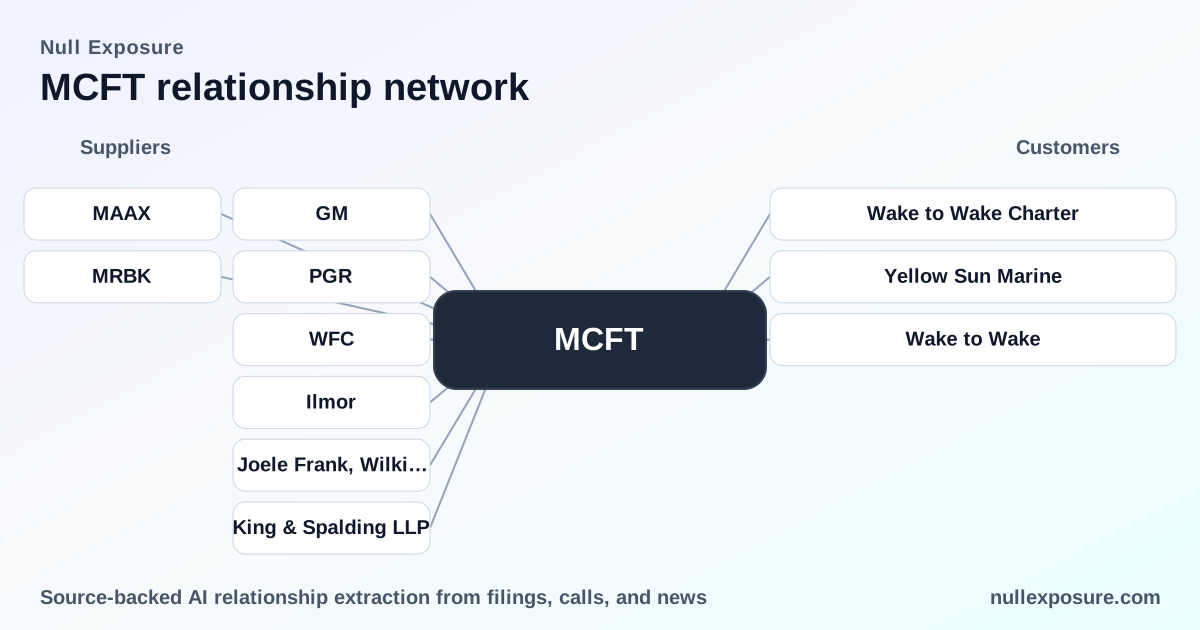
Yellow Sun Marine — MasterCraft named Yellow Sun Marine as an exclusive, authorized MasterCraft dealer in Turks & Caicos, extending its dealer footprint into a leisure-tourism market that supports both retail sales and high-utilization charter operations. According to MasterCraft’s March 4, 2026 GlobeNewswire release, the designation positions MasterCraft as the region’s primary premium towboat provider (https://www.globenewswire.com/news-release/2026/03/04/3249549/0/en/MasterCraft-Names-Yellow-Sun-Marine-as-Exclusive-Authorized-Dealer-in-Turks-Caicos-Wake-to-Wake-Charter-Transitions-to-an-All-MasterCraft-Fleet.html).
-
Wake to Wake / Wake to Wake Charter — Wake to Wake, the sister company to Yellow Sun Marine, committed to transition its charter fleet exclusively to MasterCraft towboats, creating a concentrated source of recurring parts, maintenance and replacement-unit sales for the company in that market. MasterCraft emphasized the fleet conversion in the same GlobeNewswire announcement (March 4, 2026), linking dealer placement to fleet-level conversion economics (https://www.globenewswire.com/news-release/2026/03/04/3249549/0/en/MasterCraft-Names-Yellow-Sun-Marine-as-Exclusive-Authorized-Dealer-in-Turks-Caicos-Wake-to-Wake-Charter-Transitions-to-an-All-MasterCraft-Fleet.html).
These moves received additional press amplification in specialty outlets, including Sail-World and regional coverage during FY2026, confirming market-level visibility for the new relationships (https://www.sail-world.com/news/294051/MasterCraft-expands-to-Turks-and-Caicos).
Domestic dealer density — adding The Boat Shack in Idaho Falls
- The Boat Shack — MasterCraft announced that The Boat Shack joined its dealer network with a new location in Idaho Falls, strengthening domestic distribution in the Mountain West and incrementally improving market coverage for retail and service demand. The Boat Shack’s addition was reported by Boating Industry on March 13, 2026 (https://boatingindustry.com/news/2026/03/13/mastercraft-adds-the-boat-shack-to-dealer-network/).
This is a classic network-fill move: adding domestic franchises in underpenetrated states to smooth seasonal revenue swings and shorten service distances for customers.
Operational and quality standards — why ISO alignment matters for investors
- HZO (ISO / quality standards reference) — In MasterCraft’s FY2025 filings, the company disclosed that its manufacturing facilities operate in alignment with ISO 14001 (Environmental), ISO 9001 (Quality) and OHSAS 18001 (Health & Safety) standards. That disclosure, recorded in the FY2025 10-K referenced as hzo-2025-09-30, signals an institutionalized manufacturing quality posture that supports premium pricing and lowers warranty and recall risk (hzo-2025-09-30).
Conforming to internationally recognized management standards is a company-level operational signal: it reduces operational risk, supports premium segment positioning and makes international dealer onboarding simpler because partners expect certified quality controls.
What the complete set of customer relationships reveals
MasterCraft’s FY2026 customer signals combine boutique dealer additions, fleet conversions and quality-certification disclosures. Taken together they paint a consistent commercial model:
-
Contracting posture: MasterCraft sells through independent dealers and charter partners rather than owning retail distribution. The company’s statements emphasize third-party dealers as the primary sales channel, which means the company’s commercial leverage is concentrated on dealer relationships and brand management rather than direct retail margins.
-
Concentration and revenue impact: MasterCraft reported that its top ten dealers accounted for approximately 34% of net sales in fiscal 2025, with no single dealer exceeding 10%, indicating meaningful concentration but not single-customer dependency. That structure makes dealer retention and performance a material driver of topline stability.
-
Criticality of relationships: Dealers and charter-fleet conversions are critical to both initial unit sales and recurring aftermarket revenue (parts, service, trailers). The Wake to Wake fleet conversion is a high-leverage example: a single operator’s fleet conversion creates continuous service and parts demand beyond the initial sale.
-
Geographic posture and maturity: The company reports a global presence but with a U.S.-centric dealer base (MasterCraft brands had 82 domestic dealers across 129 locations as of June 30, 2025), and international sales represented roughly 10–14% of net sales over recent years. That indicates mature domestic penetration with selective international expansion through authorizations and local partners.
-
Segment exposure: Revenue is driven by core product sales (boats, trailers) and distribution via independent resellers; expansions like The Boat Shack and Yellow Sun Marine are portfolio-fill moves that optimize distribution density.
If you track MCFT exposure at the dealer level, these relationship signals are the most actionable leading indicators for aftermarket revenue and localized demand trends. For continuously updated coverage of dealer-level exposure and partner announcements, see https://nullexposure.com/.
Investment implications: upside opportunities and concentrated execution risk
-
Upside: Fleet conversions and tourism-market dealer placements accelerate recurring revenue streams and brand visibility in high-margin luxury leisure pockets. New domestic locations incrementally reduce service friction and can improve local demand capture.
-
Risk: Dealer concentration (34% within top ten) creates execution risk if multiple large dealers underperform, and an independent-dealer model leaves MasterCraft reliant on third-party inventory management and local marketing execution.
-
Mitigant: Institutional quality certifications (ISO 9001/14001/OHSAS 18001) and continued dealer network expansion reduce operational and brand risk while supporting premium pricing and easier international onboarding.
Bottom line for investors
MasterCraft’s FY2026 customer moves are consistent with a distribution-first premium leisure OEM: targeted dealer additions, selective fleet conversions and documented manufacturing standards that collectively support sustainable aftermarket margins and brand equity. Short-term top-line uplift from specific dealer wins is modest, but the cumulative effect of fleet conversions and higher dealer density is a durable lever for service and parts revenue. Monitor dealer concentration metrics and major fleet conversions as the primary operational KPIs for MCFT’s customer risk profile.