MCGA — Sponsor-dependent SPAC dynamics and a single administrative relationship investors should price in
Yorkville Acquisition Corp. (MCGA) operates as a blank‑check vehicle positioned to complete a business combination; it monetizes through sponsor support and the mechanics of a merger or liquidation rather than operating revenue. MCGA currently carries no operating revenue, negative book equity, and relies on sponsor arrangements for routine administration, leaving investors exposed to transaction execution risk and sponsor counterparty concentration. For a concise company overview and ongoing monitoring, visit https://nullexposure.com/.
Why this matters: MCGA’s value realization will come from identifying and closing a qualifying target or returning capital, so cashflows tied to administrative and sponsor arrangements are material to near-term operating flexibility and burn rate.
Business snapshot investors need to know
- Corporate status: Public shell/SPAC listed on NASDAQ under MCGA, fiscal year end December.
- Financial posture: Reported zero revenue and operating metrics, with book value at -0.286 and market capitalization of roughly $240 million.
- Ownership profile: High institutional ownership at ~83.9%, a small insider stake, and a modest public float (≈12.95 million shares).
These facts frame the risk/reward: upside is binary pending a business combination; downside is concentrated around execution, sponsor support, and arbitrage between trust liquidation rights and post‑deal dilution.
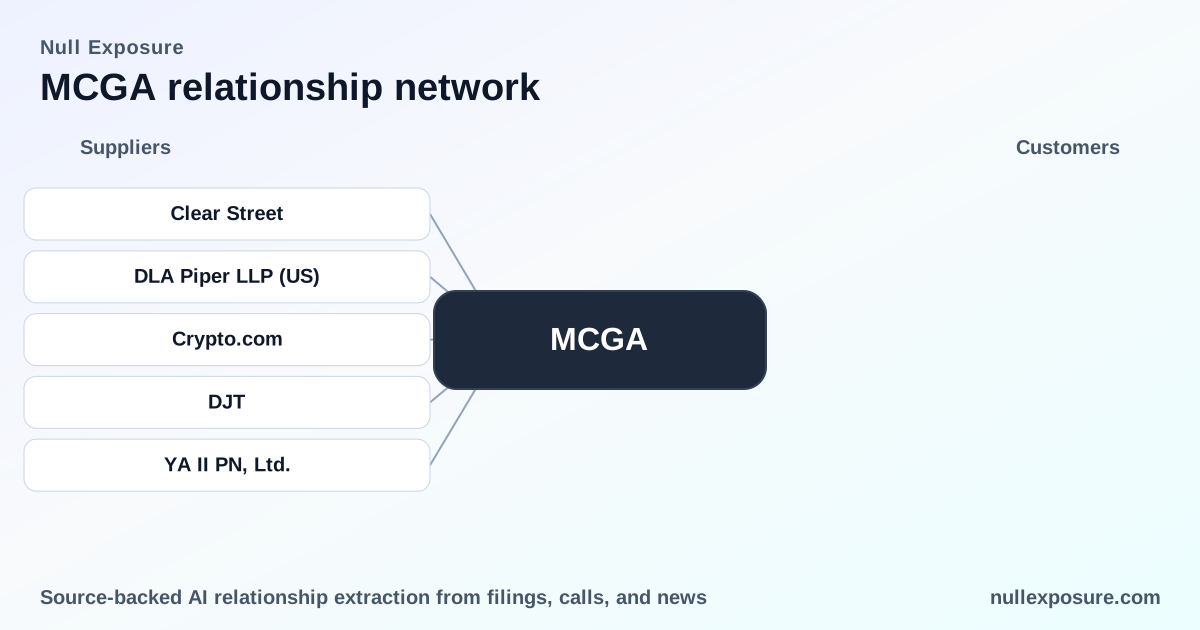
What the single documented customer relationship tells investors MCGA’s disclosed customer‑scope relationship set is narrow: one administrative services arrangement is recorded in the public record for FY2026. Below I summarize that relationship and cite the filing.
MACI (affiliate arrangement covering administrative services)
- MCGA reimburses MCG, an affiliate of the sponsor, $10,000 per month for office space, utilities, secretarial and administrative support, effective June 18, 2024 and continuing until the business combination closes or the SPAC liquidates. According to MCGA’s FY2026 annual report as published on MarketScreener, this is a defined monthly reimbursement tied directly to routine corporate administration.
Source: FY2026 annual report reported on MarketScreener (Form 10‑K) noting the Administrative Services Agreement and the $10,000 monthly reimbursement, first effective June 18, 2024.
Interpreting the MCGA–MCG arrangement for investors The administrative services agreement is short‑term, sponsor‑centric and non‑strategic in commercial terms, but it is operationally important for a SPAC with no employees or revenue. Key takeaways for valuation and risk modeling:
- Contracting posture — short, predictable cash outflow. The $10,000 monthly reimbursement is a firm, recurring expense until combination or wind‑down, which makes near‑term cash forecasting straightforward for the administrative line item.
- Concentration — single affiliate counterparty. The company relies on an affiliate (MCG) for core administrative functions rather than maintaining internal staff or third‑party commercial vendors; this raises governance and related‑party risk that investors should price into tight margin scenarios or diligence on transaction negotiations.
- Criticality — administrative services are essential. For a SPAC, these services are immaterial industrially but critical operationally; interruption would impede regulatory filings and deal execution timelines.
- Maturity — pre‑combination, pre‑revenue profile. MCGA’s public profile shows zero operating revenue and negative equity, reinforcing that the firm is not yet a revenue‑generating franchise and that sponsor arrangements are a stopgap to maintain corporate continuity.
Risk and sensitivity considerations for investors and operators
- Execution risk dominates valuation. With no operating revenue and primary obligations to sponsor affiliates, the path to value is through identifying and closing an attractive combination; underperformance or delay compresses optionality and raises the likelihood of liquidation or sponsor recapitalization.
- Related‑party governance should be reviewed closely. Institutional investors hold the lion’s share of the float; active investors and operators should scrutinize the contract terms, any escalation clauses, and whether reimbursements are capped or subject to amendment. The $10,000 monthly fee is small in absolute terms relative to market cap, but governance standards scale with deal sensitivity.
- Liquidity and market behavior. Shares trade in a narrow band historically (52‑week high/low roughly $11.00 / $10.09) and moving averages signal limited volatility; investors allocating to MCGA are effectively making a bet on the SPAC lifecycle rather than on operating performance.
Where to look next and how to act For research teams and portfolio managers, prioritize the following: confirm the administrative agreement terms in the live Form 10‑K or 8‑K filings, track any amendments that change duration or cost, and monitor deal‑pipeline disclosures from management. For transaction operators, ensure counterparty readiness (service continuity clauses, substitution rights) is documented to limit disruption in the event of sponsor changes.
If you want a centralized feed of filings and relationship summaries for MCGA and comparable vehicles, see https://nullexposure.com/ for curated coverage and tracking tools.
Bottom line: MCGA is a classic SPAC profile where value is binary and tied to deal execution; the disclosed administrative relationship to a sponsor affiliate is low dollar but high governance relevance and should be factored into any diligence or valuation model.