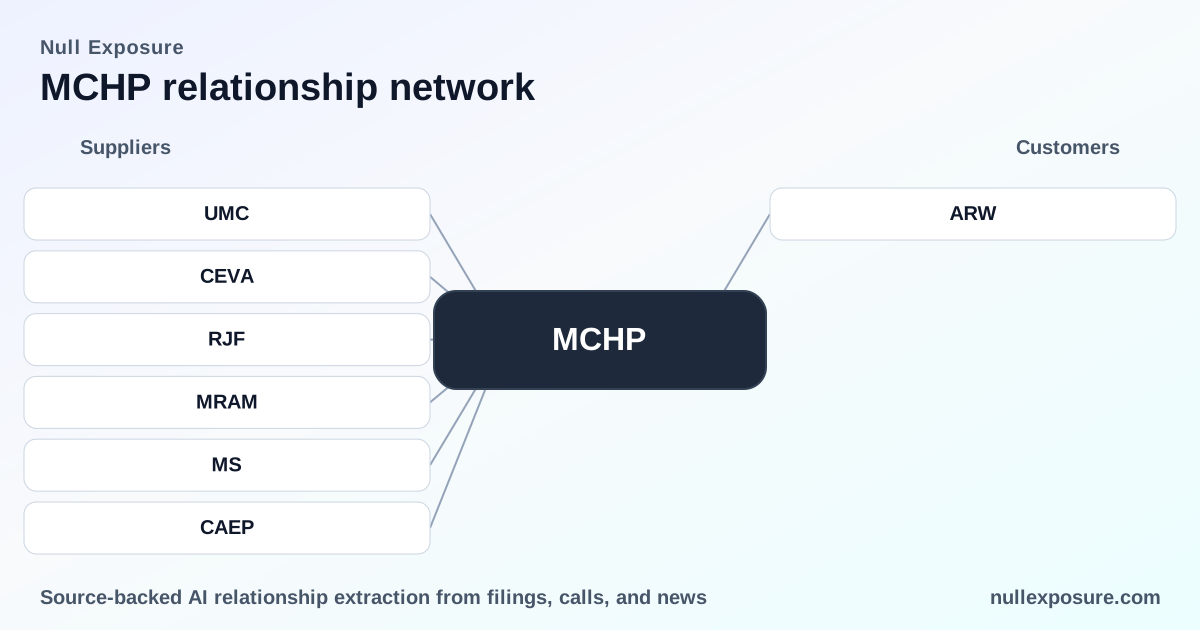
Microchip Technology (MCHP): Customer Relationships and What They Mean for Revenue and Supply Risk
Microchip manufactures microcontrollers, mixed-signal, analog and Flash-IP integrated circuits and monetizes primarily through product sales to distributors and direct OEM customers, plus licensing of embedded flash technologies. The business combines high-volume hardware sales with recurring distributor channels (roughly 45% of FY2025 net sales through distributors) and significant geographic concentration in Asia, producing a mix of steady channel-driven revenue and enterprise OEM exposures that shape both cash flow visibility and supply-chain sensitivity. For a concise, security‑focused look at counterparty exposure and relationship concentration, see our home page: https://nullexposure.com/.
Why these customer ties matter to investors
Microchip’s customer map is not a loose set of spot transactions — it’s a mix of long-term supply commitments, large distributor dependency and targeted strategic manufacturing partnerships that alter revenue predictability and operational risk. The following relationships, drawn from company filings and contemporaneous news, illustrate both the sources of recurring sales and the strategic moves that adjust Microchip’s fab utilization and product mix.
The relationship roster — each partner and the takeaway
Everspin Technologies, Inc. (MRAM)
Everspin and Microchip signed a long-term manufacturing pact to establish an MRAM production line inside Microchip’s Oregon fab under a 10‑year agreement, with Everspin retaining control over its IP and process while leveraging Microchip’s onshore capacity. This arrangement expands Microchip’s specialty foundry services and supports defense and mil/aero MRAM programs. Source: Everspin Q1 FY2026 earnings call transcripts reported on InsiderMonkey and The Globe and Mail (May 2026) and StorageNewsletter (May 1, 2026).
MRAM (as an explicit product/customer thread)
Microchip is now the onshore manufacturing partner for MRAM and TMR sensor products shifted from Everspin’s Chandler line to Microchip’s Oregon fab, creating a second domestic source of supply for customers in these niches. This operational role positions Microchip as both product supplier and contract manufacturer for specialty memory and sensors. Source: Motley Fool/The Globe and Mail earnings transcript coverage and related press reports (May 2026).
Everspin (short-name coverage in market reports)
Market commentary emphasized that the Everspin manufacturing agreement gives Microchip multi-year foundry revenue and deeper ties to defense-related programs, which analysts flagged when discussing recent contract awards. Source: TS2.tech and StocksToTrade coverage of the April–May 2026 Everspin–Microchip announcement.
Arrow Electronics (ARW) — distributor and design partner
Microchip’s FY2025 10‑K identifies Arrow Electronics as the company’s largest distributor, accounting for about 10% of net sales in fiscal 2025 (10% in 2025, 12% in 2024), highlighting a material single‑counterparty concentration in distribution. Separately, Arrow has been involved with reference designs that incorporate Microchip PHY components, underscoring channel and co‑engineering interactions. Source: Microchip 2025 Form 10‑K (fiscal 2025) and embedded.com reference design coverage (May 2, 2026).
ARW (ticker form referenced in filings and press)
Institutional and market references use the ARW ticker when describing the distributor relationship and its revenue share, reinforcing that distribution concentration is a measurable and recurring revenue factor for Microchip. Source: Microchip 2025 10‑K (filed FY2025).
SIDU (Sidus Space / platform integrator)
Sidus Space’s Fortis platform integrates Microchip’s PolarFire FPGAs and high‑reliability networking components, demonstrating Microchip’s role as a supplier into secure, edge-processing systems for contested environments and mission-critical applications. This is evidence of Microchip’s parts being embedded into higher‑value defense and space systems. Source: Intellectia.ai reporting on Sidus Space (May 2026).
Sunny Smartlead (automotive SerDes alliance presence)
A collaboration reported in April 2026 positions Microchip’s VS700 serializer devices inside the Automotive SerDes Alliance ecosystem for ADAS camera modules, anchoring Microchip in the automotive camera supply chain and validating its SerDes content wins for advanced driver assistance systems. Source: StocksToTrade news summary (April 23, 2026).
Operating-model constraints and what they signal for investors
-
Long-term contracting posture. Microchip uses long-term supply agreements and LTSAs (typically three to five years) that provide upfront deposits and assured supply windows, indicating contractual revenue visibility and commitment-driven capacity planning as a core operating characteristic. Evidence: company disclosures on LTSAs in the FY2025 filing.
-
Geographic concentration and market exposure. Asia accounted for roughly 50% of net sales in FY2025, with Europe around 20% and the Americas near 30%, so revenue growth and supply allocation are tightly coupled to Asian OEM and distributor demand. This concentration raises geopolitical and logistics sensitivity for revenue continuity. Evidence: sales-by-geography excerpts in FY2025 disclosures.
-
Distributor-driven revenue model with single-party concentration. Distributors accounted for approximately 45% of net sales in FY2025, and Arrow Electronics alone represented about 10% of net sales—an identifiable concentration that affects negotiation leverage and collections risk. Evidence: FY2025 10‑K sales breakdown and Arrow-specific disclosure.
-
Mixed product/segment exposure. Microchip sells hardware, software and services bundles (TSS), but the core is hardware semiconductors; investor focus should be on how services and licensing (SuperFlash IP licensees) complement product sales rather than replace them. Evidence: company segment descriptions in filings.
-
Relationship maturity and criticality. Several relationships involve strategic manufacturing or design partnerships (e.g., Everspin MRAM pact, automotive SerDes alliances, defense integrators), which are high‑criticality, capital‑intensive, multi‑year engagements that shift fab utilization and enhance sticky revenue streams.
Investment implications — what to watch next
- Track contract roll‑outs and fab utilization tied to the Everspin MRAM line and other foundry-style work; these deals convert idle capacity into specialized revenue but require monitoring of pricing and margin mix.
- Monitor distributor concentration and terms with Arrow and other large distributors; a shift in distributor mix would materially change working capital and gross margin dynamics.
- Watch regional demand trends in Asia and EMEA since roughly half of sales are Asia‑based and Europe represents a steady mid‑teens share, making revenue sensitive to regional OEM cycles.
For an in‑depth counterparty exposure dashboard and weekly relationship signals, visit https://nullexposure.com/ to see how corporate filings and market reports translate into actionable customer‑level risk metrics.
Bold takeaways: Microchip’s revenue is channel-heavy and regionally concentrated; strategic foundry and design partnerships are increasing sticky, multi‑year revenue; Arrow remains the single largest distributor exposure to monitor.