Microchip Technology (MCHPP): Customer Map and Commercial Implications for Investors
Microchip monetizes through the sale of embedded control semiconductors (microcontrollers, analog, mixed-signal) and through selective technology licensing, distributing broadly via global distributors and direct OEM engagements. Revenue is driven by a hybrid go-to-market: large distributor relationships and direct OEM long-term supply agreements (LTSAs) for strategic programs, while most distributor sales remain cancellable and short-term. For investors, the critical questions are concentration (who buys what share of revenue), contract tenor (how much predictable backlog exists), and end-market criticality (automotive and power systems are higher-margin, higher-stability segments). Learn more at https://nullexposure.com/.
How Microchip’s customer shape influences valuation
Microchip’s operating model blends scale distribution with targeted long-term commitments. The company reports that distributors accounted for roughly 45% of net sales in FY2025, while a single distributor — Arrow Electronics — represented about 10% of net sales. The company also uses long-term supply agreements for key customers (LTSAs with upfront deposits and minimum purchase commitments typically spanning three to five years) while most distributor relationships are contractual but cancellable on short notice. These characteristics create a mix of predictable pockets of revenue and a broader, more flexible but less visible top line.
Key operating constraints and signals investors should internalize:
- Contracting posture: There is a dual structure — LTSAs provide multi-year visibility for select customers, but most distributor relationships are effectively short-term and cancellable. (Company disclosures, FY2025 10-K.)
- Customer concentration: Moderate concentration with one distributor at ~10% of net sales; beyond that, no other customer exceeded 10% in FY2025. (FY2025 10-K.)
- Geographic exposure: Asia represents roughly half of revenue, with China and Taiwan each material contributors; Europe and the Americas represent the balance. This regional mix implies revenue sensitivity to APAC industrial cycles. (FY2025 10-K.)
- Channel mix and roles: About 45% of net sales flow through distributors, and the remainder through OEMs and direct accounts; Microchip also licenses IP (SuperFlash) and sells to contract manufacturers. (FY2025 10-K.)
- Spend scale: At least one partner sits in the >$100 million annual spend band given the 10% share of consolidated sales. (FY2025 10-K.)
Why automotive and power-system wins change the risk/reward profile
Automotive and advanced power systems are high-growth, high-stability segments for Microchip because design wins create multiyear content in vehicle platforms and defense programs. These wins move Microchip toward sticky revenue and justify higher R&D and capital allocation for test/qualification infrastructure. Recent public collaborations show Microchip is executing along that vector, lifting the company’s end-market criticality and pricing power in targeted product categories.
Track more customer relationships and signals at https://nullexposure.com/.
On-the-record customer relationships you should know
Below are each of the customer relationships surfaced in the public record. Each entry is a concise one- to two-sentence plain-English summary with a source note.
NVIDIA (inferred symbol: NVDA) — FY2022
Microchip’s automotive PCIe switches were qualified for use within NVIDIA’s DRIVE platform, with NVIDIA highlighting Microchip’s switch flexibility and programmability for high-speed SoC and GPU connectivity. According to a news report quoting Michael Truog of NVIDIA, that qualification reflects direct collaboration on automotive connectivity requirements (industry press, May 3, 2026).
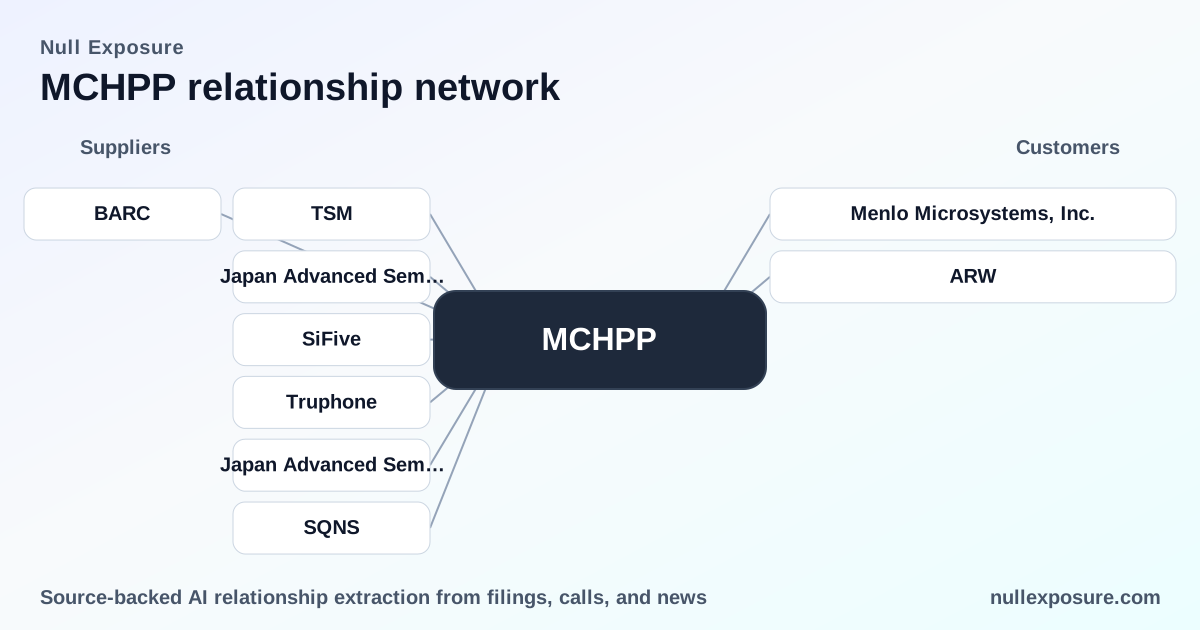
Menlo Microsystems, Inc. — FY2026
Microchip hosted validation testing for a MEMS-based 1000V/500A hot-switched power relay panel developed with Menlo Micro and completed the hot-switching phase at Microchip’s advanced power test facilities, positioning Microchip as a test and validation partner for high-voltage circuit protection systems potentially targeted at naval applications. The announcement was made in a joint press release (Courier-Journal press release, March 10, 2026).
Hyundai Motor Group — FY2026
Hyundai and Microchip are collaborating to integrate Microchip’s 10BASE-T1S single-pair Ethernet solutions into future vehicle platforms, focusing on EVs, autonomous driving, and smart mobility applications where single-pair Ethernet reduces wiring complexity and supports in-vehicle networks. The partnership was disclosed in a corporate release describing joint integration efforts (GlobeNewswire, February 5, 2026).
Arrow Electronics (inferred symbol: ARW) — FY2025
Microchip’s FY2025 10‑K identifies Arrow Electronics as the company’s largest distributor, accounting for 10% of net sales in FY2025 (and higher in prior years), underscoring a meaningful single-distributor exposure within a broadly diversified customer base. This concentration is explicitly disclosed in Microchip’s FY2025 10‑K filing.
ARW — FY2025 (duplicate entry)
The relationship entry labeled ARW duplicates the Arrow Electronics disclosure in Microchip’s FY2025 10‑K, again noting Arrow/ARW accounted for roughly 10% of net sales in fiscal 2025 and was the largest single distributor. The same 10‑K filing provides this data.
Investment implications: what to watch and where upside lives
- Revenue visibility is mixed. LTSAs provide multi-year assurance for select programs (company-level signal), but the bulk of distributor relationships remain cancellable, meaning near-term demand swings in distribution and APAC markets will show up quickly in reported sales.
- Concentration is material but manageable. Arrow’s ~10% share is meaningful; however, the remainder of revenue is fragmented across a very large installed customer base (approximately 109,000 unique customers), reducing single-counterparty execution risk beyond the top distributor.
- Automotive and defense design wins are high value. Qualification by tier-one platforms (e.g., NVIDIA DRIVE) and integration work with OEM groups like Hyundai elevate Microchip’s content-per-vehicle and support long-term pricing and margin expansion in target product lines.
- Geographic exposure raises macro sensitivity. With roughly 50% of sales in Asia, semiconductor demand cycles in China and Taiwan will disproportionately affect Microchip’s topline, making regional demand and inventory dynamics critical inputs to near-term earnings forecasts.
- Operational leverage in test and validation infrastructure is a differentiator. Hosting validation for advanced power components (Menlo) signals Microchip’s capacity to be more than a parts supplier; this raises the company’s strategic value to customers seeking system-level partners.
Bottom line: a distributor-heavy revenue base with selective strategic stickiness
Microchip presents a hybrid commercial profile: broad, distributor-driven volume with pockets of strategic, long-term OEM and defense engagements that increase revenue stickiness and raise the company’s addressable value per design win. For investors, the focus should be on tracking automotive qualifications, distributor order patterns (especially Arrow), and regional demand in APAC, which together will drive near-term volatility and medium-term earnings power. For ongoing monitoring and deeper customer-signal coverage, visit https://nullexposure.com/.