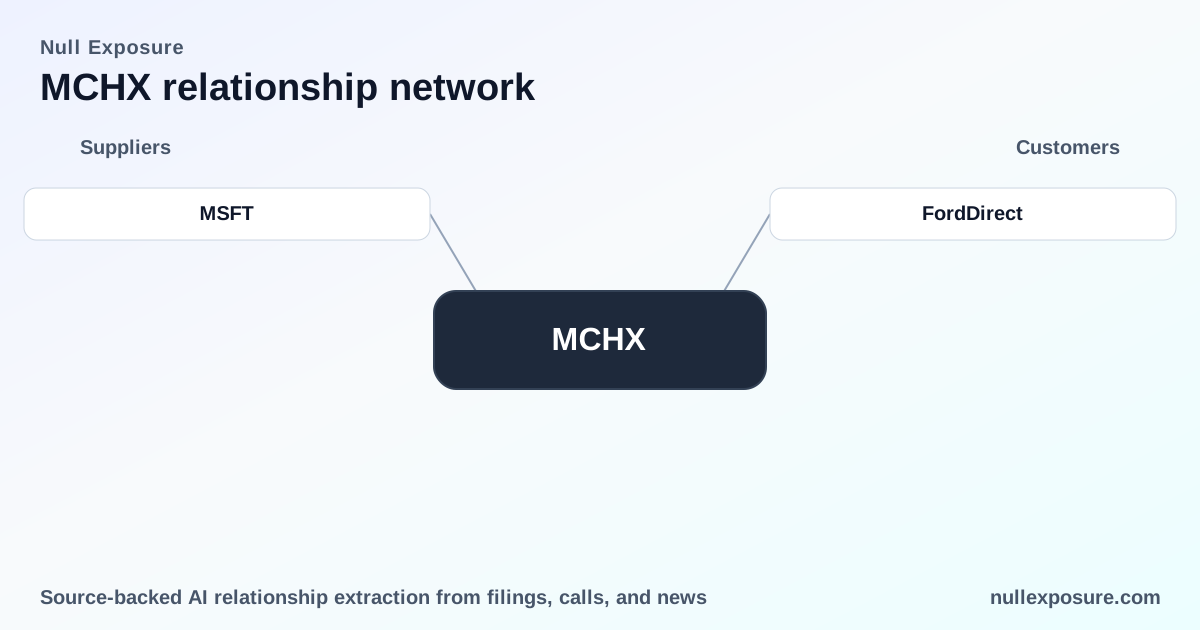
Marchex (MCHX) — customer relationships and what they mean for investors
Marchex operates conversational analytics and call‑tracking software that monetizes by charging customers for the conversations it processes — calls and texts — and by selling dealer- and enterprise-facing solutions that convert inbound interactions into measurable sales outcomes. The firm packages those services for both large distributed enterprises and a broad set of local dealers; recent corporate communications highlight an expanded, multi‑year dealer channel relationship that increases Marchex’s addressable dealer footprint. For more customer intelligence on Marchex visit https://nullexposure.com/.
Business model in one line: conversation volume sold as measurable sales outcomes
Marchex’s revenue model is usage‑driven: the company generally charges based on the number of conversations it processes for customers, whether by call or by text. That billing posture creates high revenue elasticity to volume — when call/text volumes fall, revenue follows quickly. Contracts are frequently short‑term or expire in the near term, which compounds top‑line volatility because buyers can reduce or stop spend with limited notice. The business focuses on the U.S. market and serves both large enterprises with distributed footprints and very large numbers of small local businesses, a mix that supports scale but increases sales and credit complexity.
Key operating characteristics to watch:
- Usage‑based pricing and short contract tenor produce variable monthly receipts and require constant engagement to sustain volumes.
- Customer concentration is material: management reports ~33% of revenue from the five largest customers and at least one customer that contributes over 10% of consolidated revenue, signaling outsized exposure to a small set of counterparties.
- The company is effectively a software / conversational analytics provider selling into B2B2C verticals; success depends on distribution partnerships and dealer/reseller relationships that amplify reach.
- Geographic focus is domestic U.S., limiting near‑term diversification but concentrating operational and regulatory risk.
These characteristics drive both leverage and fragility: Marchex can scale quickly through dealer and OEM channels, but usage sensitivity, short contracts, and customer concentration create an elevated execution bar.
Customer relationships you need on your radar
Marchex’s disclosed customer footprint emphasizes dealer networks and enterprise channels. The data returned for MCHX’s customer relationships identifies a notable expansion with a major dealer channel partner.
FordDirect — expanded dealer channel access and multi‑year terms
Marchex announced an expanded partnership with FordDirect for its Engage for Sales and Service product, granting multi‑year access to more than 3,000 franchised dealers for Marchex’s dealer‑facing products. This arrangement increases Marchex’s distribution reach into OEM dealer networks and formalizes a channel that can lift recurring usage across dealer service and sales interactions. (Source: Marchex second‑quarter 2025 results released via BizWire/FinancialContent, reported in August 2025.)
Why the FordDirect relationship matters for valuation
The FordDirect expansion is a strategic distribution win because it directly addresses Marchex’s need for scalable, repeatable usage across many local endpoints. Multi‑year access to 3,000+ dealers should reduce monthly volatility for the dealer channel by locking in a timeframe for monetization and by creating a predictable pool of conversational volume to convert. For investors, the deal is important for two reasons:
- It increases potential volume stability in the dealer segment, which is core to Marchex’s receivables and concentration profile.
- It leverages Marchex’s product differentiation — conversational AI that ties calls and texts to sales outcomes — into an OEM channel that can accelerate adoption if dealer economics are favorable.
Financial and concentration signals investors must weigh
Marchex reported roughly $45.4M revenue (TTM) and $28.7M gross profit (TTM) alongside a small negative EBITDA and an EPS loss; market capitalization sits around $76.6M. These headline figures combined with customer concentration disclosures and the company’s usage‑based contract posture create a clear trade‑off: growth can be rapid when conversation volumes and dealer adoption accelerate, but margins and free cash flow are exposed to volume swings and customer churn.
Important risk and structural factors:
- Customer concentration is material: roughly one third of revenue from the five largest customers; one customer >10% of revenue. That creates outsized counterparty risk that requires active account management and diversified new wins to de‑risk the book.
- Short contract tenor and usage pricing create revenue variability that makes forecasting earnings and cash flow more difficult than for fixed‑fee SaaS peers.
- The company serves both large enterprises and many small local businesses; that mix requires two go‑to‑market motions — enterprise sales for scale and high volume, plus high‑efficiency acquisition for small business customers.
- There is evidence of a reseller / dealer network concentration in receivables, which elevates credit and collections risk across networks of independent dealerships.
Strategic implications for operators and investors
Operators should prioritize dealer activation economics and account retention strategies that stabilize call volumes across dealers. Investors should focus on three measurable outcomes from the FordDirect expansion and similar partnerships:
- Rate of dealer on‑boarding and product activation across the 3,000+ dealer base.
- Per‑dealer conversation volumes and year‑over‑year growth in dealer‑sourced sessions.
- Churn and renewal rates for large enterprise accounts that constitute the top revenue buckets.
If activation converts into persistent usage, Marchex can convert the distribution into predictable, higher‑margin recurring revenue. If dealers remain intermittent users, the underlying usage model will continue to produce volatile revenues.
For a deeper map of customer relationships and constraint signals for Marchex, see the Null Exposure research hub at https://nullexposure.com/.
Bottom line: channel reach reduces but does not eliminate concentration risk
The FordDirect multi‑year dealer access is a material distribution improvement for Marchex and supports a path to scaled conversational volumes. However, the company’s usage‑based billing, short contract tenors, U.S. concentration, and material customer concentration keep the stock exposed to swings in dealer and enterprise call activity. Investors should treat new channel wins as conditional value drivers that require demonstrable activation and retention to translate into stable cash flows.