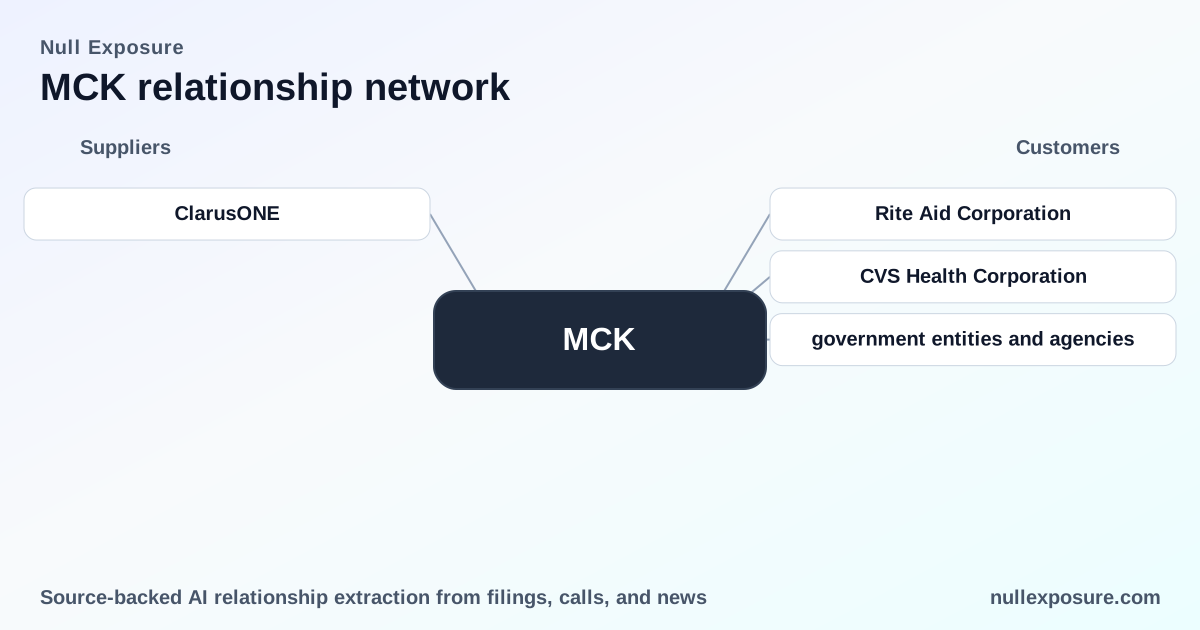
McKesson (MCK): Distribution scale, concentrated customers, and embedded service relationships
McKesson operates as an end-to-end pharmaceutical and medical supplies distributor that monetizes through high-volume product distribution, logistics services, and ancillary technology and care-management offerings to pharmacies, hospitals, physician practices, and government purchasers. Revenue derives from commodity and specialty drug flows, logistics and automation services, and recurring contracts with large institutional buyers—a model that produces predictable gross throughput but concentrates counterparty and credit risk. For deeper visibility into counterparties and contractual positioning, visit https://nullexposure.com/.
The core thesis for investors
McKesson’s business converts scale and logistics into margin by owning distribution relationships and value-added services that are critical to healthcare supply chains. That concentration of volume into a small set of large buyers creates both durable revenue and elevated counterparty exposure; credit events or contract shifts among top customers have outsized effects on cash flow and receivables.
What the filings and market reports show — each relationship in plain English
Rite Aid Corporation
McKesson recognized a $725 million provision for bad debts tied to Rite Aid’s Chapter 11 bankruptcy, reflecting direct credit exposure from a retail customer’s reorganization and the financial impact on trade receivables. This figure and the bankruptcy disclosure are taken from McKesson’s FY2025 10‑K filing (filed March 31, 2025).
CVS Health Corporation
CVS accounted for approximately 24% of McKesson’s consolidated revenues in fiscal 2025, and represented about 23% of trade receivables at March 31, 2025, signaling a single‑customer materiality that drives pricing leverage and counterparty concentration. This is reported in McKesson’s FY2025 10‑K.
Government entities and agencies (and GPOs)
McKesson holds agreements with group purchasing organizations (GPOs) and government entities that act as purchasing agents for hospitals, pharmacies and other providers, embedding McKesson into public and institutional supply channels and contributing to recurring institutional volumes. This relationship is described in the company’s FY2025 10‑K.
COR (competitor filing referencing McKesson)
A competitor’s FY2025 10‑K (COR’s filing dated September 30, 2025) explicitly lists McKesson as a primary competitor alongside Cardinal Health and UPS Logistics, underscoring McKesson’s market position in distribution and logistics. This is sourced from COR’s FY2025 10‑K.
SCLXW (contracting with major distributors)
SCLXW reported in its FY2024 filing that it contracts with multiple U.S. pharmaceutical distributors, including McKesson, which confirms McKesson’s ongoing role as a go‑to channel partner for manufacturers and specialty suppliers. (SCLXW 10‑K, FY2024.)
PUMA Biotechnology (PBYI) and institutional distribution channels
A 2026 market report noted that five specialty distributors—including McKesson—supply academic and community hospitals, physician practices, and government facilities (including VA and DOD), demonstrating McKesson’s institutional reach on specialty products. This observation is from an Investing.com company news item covering FY2026 activities.
Citius Oncology (CTXR) distribution agreement
Citius Oncology announced a U.S. distribution agreement with McKesson to support the commercial launch of Lymphir, indicating McKesson’s role as a launch partner for biopharma commercialization in the U.S. market. That announcement is captured in a Marketscreener report (2025–2026).
naturemary (retail distribution in Canada)
MarketBeat coverage reported that McKesson Canada secured a national distribution agreement with naturemary, expanding retail reach into thousands of pharmacies and illustrating McKesson’s international retail distribution capability. (MarketBeat, FY2026.)
Florida Cancer Specialists & Research Institute (FCS) and U.S. Oncology Network
Industry reporting noted that FCS, while remaining independently owned, joined McKesson’s U.S. Oncology Network, gaining access to McKesson’s oncology products and services and strengthening McKesson’s position in oncology care delivery. This is reported by MDM (FY2026).
HROW (product availability via distributors)
A 2024 product launch notice documented that VEVYE is available via wholesale distributors including McKesson, Cardinal, and Cencora, highlighting McKesson’s role in downstream product availability for ophthalmology and specialty therapies. (Glance / EyesOnEyecare report, 2024.)
SRXH (implementation and automation costs)
A 2024 press release referenced one‑time expenses that include items such as “McKesson automation,” indicating vendor‑facing implementation or automation services sold or integrated by McKesson in support of lab and clinical operations. (GlobeNewswire, FY2024.)
What these relationships collectively imply about McKesson’s operating model
- Concentrated counterparty exposure: The top‑customer dynamics are material—McKesson disclosed that its ten largest customers accounted for roughly 72% of consolidated revenues in FY2025, establishing a concentrated revenue base that amplifies credit and negotiation risk. This company-level figure is disclosed in the FY2025 10‑K.
- Criticality to institutional channels: Agreements with GPOs and government entities position McKesson as a critical purchasing conduit to hospitals and public facilities, raising strategic importance and potential pricing stability for those channels (company 10‑K).
- Distributor and service provider posture: McKesson operates both as a high-volume distributor and as a service vendor (automation, leased equipment, Rx technology services), combining transactional volume with higher-margin service revenue streams (company 10‑K descriptions of U.S. Pharmaceutical, Medical‑Surgical, and RxTS segments).
- Geographic focus and segment maturity: The core U.S. Pharmaceutical distribution business drives scale in North America and shows mature, low‑beta revenue characteristics, while international and specialty services add diversification but remain subordinate to U.S. volumes (segment disclosures in FY2025 10‑K).
- Counterparty mix includes government and institutional entities: Company disclosures identify government entities and GPOs as distinct counterparty types, which affects contracting terms, procurement cycles, and payment patterns (company 10‑K).
Key investment takeaways
- Scale and embeddedness are McKesson’s competitive moats—distribution breadth and integrated services create durable demand from manufacturers and institutional buyers.
- Concentration is the principal risk: With CVS representing roughly a quarter of revenue and the top ten customers driving the majority of sales, credit and contract concentration pose meaningful volatility to working capital and margins.
- Service revenue cushions but does not eliminate counterparty risk: Technology, automation, and specialty services improve margin mix, yet the underlying cash flow remains tied to a small set of large purchasers.
For a precise map of customer exposures and to translate these relationship signals into portfolio risk scores, explore our platform at https://nullexposure.com/.
Final note on monitoring
Investors should monitor quarterly receivable trajectories, provisions for bad debts, and any contract renewals or losses among the top customers—these are the immediate drivers of cash and valuation sensitivity in McKesson’s model. Key public sources referenced above include McKesson’s FY2025 10‑K (filed March 31, 2025), competitor filings and multiple industry news reports from 2024–2026.