Moody’s Corporation (MCO) — Customer Relationships Brief
Moody’s operates a two‑pronged information and services franchise: Moody’s Investors Service (credit ratings) and Moody’s Analytics (subscription software, data and models). The company monetizes through rating fees for debt issuance and recurring multi‑year subscription revenue for analytics and cloud‑based risk tools, producing high margin, predictable cashflow and significant exposure to global capital markets.
For a concise commercial view of Moody’s customer footprint and contract posture, see the full offering at https://nullexposure.com/.
What the customer map tells investors — headline thesis
Moody’s customer relationships skew toward institutional borrowers, large corporates, sovereigns and financial institutions, and are structured to produce recurring cash flow via subscriptions and long‑dated rating engagements. The commercial model is highly scalable, globally diversified, and mission‑critical for capital markets participants, which supports pricing power but creates concentration risk around issuance cycles and regulatory scrutiny.
The relationships — one‑line takeaways with sources
- ACR-P-C: Class A CLO notes were rated Aaa(sf) by Moody’s on a $1.0bn commercial mortgage CLO (PR Newswire, March 2026).
- RC: Moody’s assigned ratings from Aaa to A3 across tranche classes on Ready Capital issuance referenced in American Banker (FY2022 / reported 2026).
- ACR-P-C (Longbridge): Notes included Moody’s ratings and SOFR‑linked coupons; Moody’s served as rating provider (Longbridge news, Mar 2026).
- AMH-P-G: American Homes 4 Rent holds investment‑grade ratings from Moody’s and S&P, per a corporate disclosure (Ad‑Hoc News, Mar 2026).
- FPH: In Sep 2025 Moody’s upgraded senior notes to B2/B2 and issued initial ratings from other agencies (ADVFN, 2025 report cited 2026).
- WSFS: Notes were assigned Baa2 by Moody’s on a proposed senior note offering (TradingView, FY2025).
- HTH: Company maintains investment‑grade ratings (Baa2/BBB+) with stable outlooks from Moody’s and Fitch (Bitget/TradingView, FY2026).
- OMAB: Mexican emissions received AAA.mx / AAA(mex) national scale ratings including Moody’s Local (Reuters/TradingView, FY2025).
- BSAC: Banco Santander Chile holds an A2 Moody’s rating among other regional ratings (GlobeNewswire, FY2024–2025).
- GNL-P-D: Global Net Lease referenced Moody’s implied investment‑grade methodology for tenant guarantors (press release, FY2026).
- SLRC: SLR Investment is investment‑grade rated by Moody’s; rating cited as material to capital structure (earnings transcript, FY2026).
- PBR-A: Moody’s changed Petrobras’ global rating outlook to stable, per company notice (BrazilEnergyInsight, FY2025).
- LADR: Ladder Capital received a Moody’s upgrade to Baa3 (investment grade), enabling unsecured issuance at tighter spreads (insider transcripts & reports, FY2025–2026).
- VEL: Velocity Financial noted Moody’s ratings across its unsecured debt issuance (earnings materials, FY2026).
- SUPV: Moody’s Local Argentina assigned short‑term foreign currency ratings to Supervielle obligations (InvertirOnline, FY2024).
- GSL: Global Ship Lease reaffirmed ratings with stable outlooks from Moody’s and peers (Container‑News, FY2025).
- HR: Healthcare Realty highlighted Moody’s affirmation of its Baa2 rating with a stable outlook in its investor materials (Globe and Mail, FY2026).
- CMTG: Moody’s lowered Claros Mortgage Trust ratings to B2 in a 2025 action (Investing.com, FY2025).
- KIM-P-M: Kimco Realty’s senior unsecured rating upgraded to A3 by Moody’s, cited in company releases (Investing.com, FY2026).
- TRIN: Trinity Capital was assigned a new investment‑grade rating (Baa3) by Moody’s (PR Newswire, FY2025).
- FRHC: Freedom Bank Kazakhstan received a long‑term deposit rating of Ba3 (stable) from Moody’s (NorfolkDailyNews, FY2026).
- ACP-P-A: Abrdn Income Credit Strategies Fund preferred shares were rated A2 by Moody’s (SahmCapital, FY2025).
- SAFE: Safehold is rated A3 by Moody’s among other agencies, per company results (Finviz, FY2026).
- CPSS: CPS securitization notes were rated by Moody’s based on structure and servicer performance (Yahoo Finance / GlobeNewswire, FY2026).
- LeaseCrunch LLC: LeaseCrunch acquired Finagraph from Moody’s, a divestiture of Moody’s Analytics assets (SimplyWallSt, Dec 2025).
- MSCI: MSCI licensed Moody’s credit risk models for application to MSCI’s private credit database (TradingView, Q3 2025 disclosure).
- BHFAL / BHF: Brighthouse entities hold A3 Moody’s insurance financial strength ratings as affirmed in 2022 filings (SmartAsset / Yahoo Finance, FY2021–2022).
- HTGC: Hercules Capital’s institutional notes initially assigned Baa2 by Moody’s (Yahoo/NatLawReview, FY2026).
- EGP: EastGroup Properties had its issuer rating upgraded by Moody’s to Baa1 (SahmCapital / PR Newswire, Feb 2026).
- AMX: América Móvil received AAA.mx local ratings from Moody’s (LexLatin, FY2025).
- PDM: Piedmont Office is investment‑grade at Baa3 from Moody’s as disclosed in earnings materials (FinancialContent / GlobeNewswire, FY2025).
- FSK: FSK saw analyst estimate adjustments after a Moody’s downgrade that affected funding costs (Investing.com, FY2026).
- FBIZ: First Business referenced Moody’s macro forecasts in capital planning discussions on an earnings call (Investing.com / SahmCapital, FY2026).
- UDR: UDR’s commercial paper and debt carry Baa1/P‑2 Moody’s ratings in public filings (QuantisNow, FY2026).
- SPNT: SiriusPoint operating companies hold A3 financial strength from Moody’s (Yahoo Finance, FY2026).
- NSA: National Storage Affiliates assigned Baa3 by Moody’s with commentary on asset base and leverage (SimplyWallSt, FY2025).
- ABBV: AbbVie’s debt confirmed at A2 (stable) by Moody’s in transaction reporting (TS2 Tech / news, FY2026).
- KOF: Coca‑Cola FEMSA local MX issues received AAA.mx from Moody’s Mexico (BBVA press, FY2022).
- BANR: Banner Corporation uses Moody’s for interest‑rate forecasting noted in an earnings transcript (InsiderMonkey, FY2026).
- HWC: Hancock Whitney’s credit profile reflects Baa3 from Moody’s in corporate presentations (Investing.com, FY2025).
- FHN-P-F: First Horizon uses Moody’s Analytics for seasonal modelling and macro scenarios (Investing.com, FY2025).
- MT: ArcelorMittal/other MT references show Moody’s upgrades to Baa2 and S&P upgrades in 2025 (local press, FY2026).
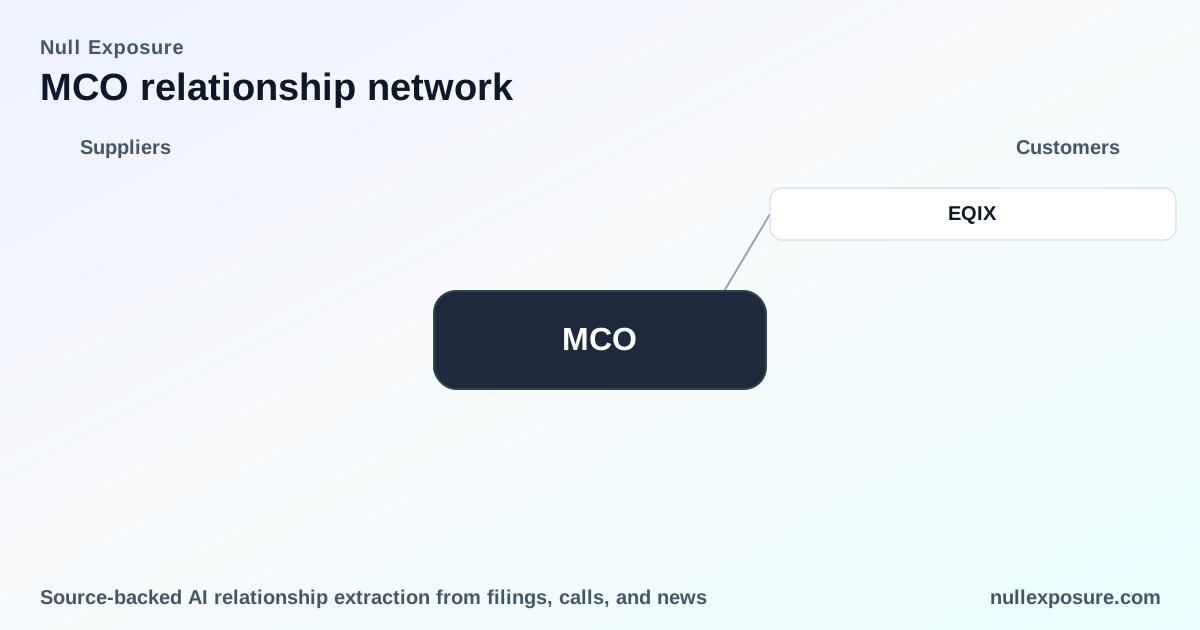
- EQIX / Equinix, Inc.: Moody’s upgraded Equinix senior unsecured to Baa1 in early 2026, referenced across press releases (PR Newswire / Yahoo, FY2026).
- PPL Capital Funding / PPL / Narragansett Electric: Moody’s upgraded PPL and related capital funding ratings after acquisition activity (DailyEnergyInsider, FY2026).
- GRP-U: Granite REIT obtained a Moody’s post‑issuance opinion on its green bond use‑of‑proceeds report (Globe and Mail, FY2026).
- INTR: Banco Inter’s local ratings were reaffirmed/upgraded by Moody’s Local BR in Oct 2025 (The Globe and Mail, FY2025).
- BUR: Burford Capital benefited from credit rating upgrades that cite Moody’s actions in 2025 (TradingView, FY2026).
- TRST: TrustCo Bank continues to employ Moody’s baseline forecasts in stress and planning (SahmCapital / Benzinga, FY2026).
- SIX: Six Flags offerings rated Caa1 by Moody’s in 2026 reporting on high credit risk (Journal Record, FY2026).
- FGN: FGN reports that ~90% of its private origination fixed income portfolio is rated by Moody’s and other top agencies (earnings call, 2025Q4).
- Anthropic: Moody’s deployed risk intelligence tools into Anthropic’s Claude environment to enhance credit workflows (Investing.com, FY2026).
(Every relationship above is drawn from the news and earnings sources captured in the March–May 2026 reporting cycle; individual source links are documented in underlying press reports and filings.)
What the relationships collectively imply about Moody’s operating model
- Contracting posture: Moody’s commercial profile is subscription‑heavy with long‑dated obligations, supporting predictable revenue and high renewal value; evidence shows recurring multi‑year hosted and installed subscription arrangements across MA products.
- Concentration and scale: Customer coverage is global and diversified across sectors and geographies (EMEA, APAC, Americas), reducing single‑counterparty revenue risk while concentrating exposure to the capital‑markets cycle.
- Criticality and stickiness: Moody’s services are mission‑critical for issuers, investors and banks—ratings and scenario models are embedded in funding costs and regulatory frameworks, producing high switching costs.
- Maturity and product mix: The business combines mature rating franchises (transaction fees) with growing SaaS analytics (software subscriptions and cloud delivery), creating margin expansion potential but also execution demands on product development and data infrastructure.
Risks and investor considerations
- Cyclicality of issuance: Ratings revenue fluctuates with issuance volumes; however, subscription growth acts as a stabilizer.
- Regulatory and reputational risk: As a ratings authority, Moody’s faces regulatory oversight and reputational sensitivity that can influence fee structures and litigation exposure.
- Customer mix: Large institutional and government counterparties dominate the customer base; this strengthens pricing power but creates concentration of economic impact during market stress.
For a structured view of Moody’s customer relationships and how they drive recurring revenue, explore Moody’s customer signals at https://nullexposure.com/.
Bottom line
Moody’s combines a durable, high‑margin ratings franchise with expanding analytics subscriptions to generate predictable free cash flow and strong returns on capital. The customer footprint documented across issuer ratings, securitizations and analytics licensing underscores global reach, mission criticality and subscription durability, while keeping investors focused on cyclical issuance and regulatory exposures.