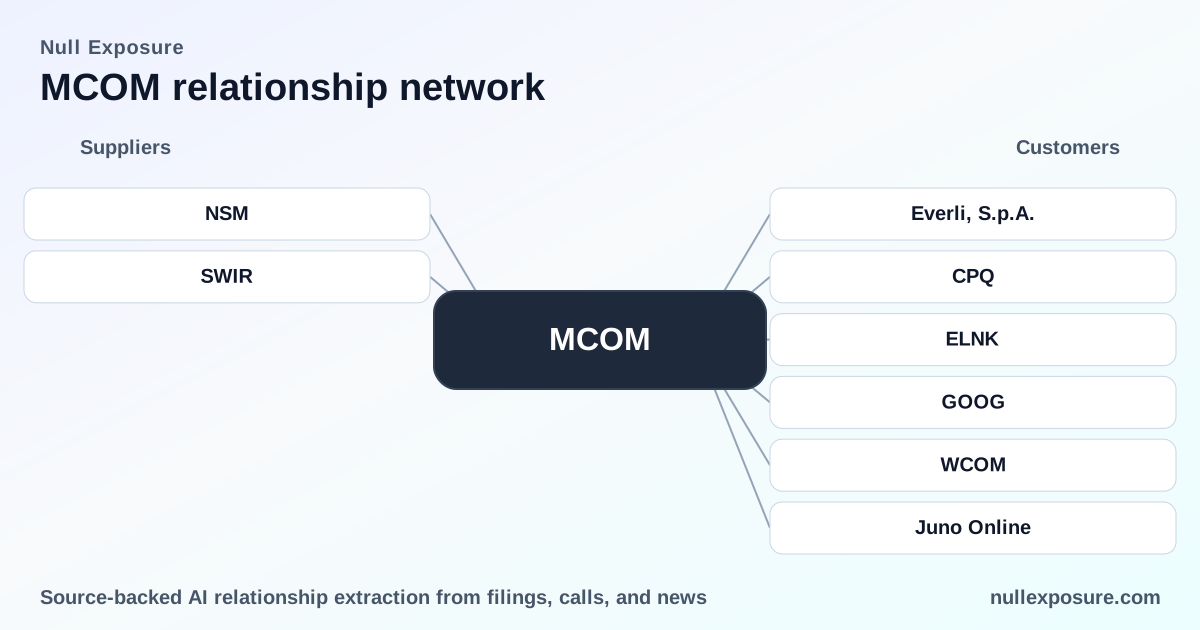
MCOM: A one-client services story with platform ambitions
Micromobility.com Inc. operates as a technology-first mobility and software services business that currently monetizes through software development, platform licensing and related IT services sold mainly to one counterparty. In FY2024 the company generated about $1.4 million of revenue from a related-party client, and its public filings and operational notes show a combination of exclusive platform licensing and active software-development engagements as the primary revenue engine.
For background intelligence and deeper relationship mapping, visit https://nullexposure.com/.
What the Everli relationship actually is — concentration and structure
The company’s customer picture is dominated by Everli S.p.A., a related party controlled by Micromobility.com’s majority shareholder. According to the company’s FY2024 Form 10‑K, Everli was the company’s only client in 2024 and generated approximately $1.4 million of revenue for the year; the filings also identify Micromobility.com (and its Helbiz Media/Helbiz Doo subsidiaries) as the service provider. The 10‑K documents a Service Agreement executed November 11, 2024 that grants Everli exclusive rights to use the Helbiz Media platform from December 1, 2024 through November 30, 2029, and records active invoicing and payment activity for software-development work performed in Serbia. (Source: Micromobility.com FY2024 Form 10‑K, 2024 filing.)
Key takeaway: Everli is not a peripheral customer — it is the company’s primary revenue source, tied to both an exclusive long-term platform arrangement and active IT services delivered through subsidiaries.
All relationships found in public records (each entry covered)
Everli, S.p.A.
Micromobility.com reported that Everli was its only client in 2024 and generated roughly $1.4 million of revenue, with services delivered as software development and platform access; a November 2024 Service Agreement grants Everli exclusive platform use through late 2029. (Source: Micromobility.com FY2024 10‑K, filing mcom-2024-12-31.)
Compaq Computer (CPQ)
An EE Times article covering the 2019 shutdown of Metricom’s Ricochet wireless network listed Compaq as one of the resellers impacted, showing historical reseller exposure to network changes; this article is unrelated to Micromobility.com’s FY2024 customer base but appears in the news-sentiment results. (Source: EE Times, article on Metricom shutdown, FY2019.)
Earthlink (ELNK)
The same 2019 EE Times piece names Earthlink among Ricochet resellers affected by Metricom’s shutdown; Earthlink’s mention is a historical industry reference surfaced in the news-sentiment crawl rather than a current Micromobility.com customer relationship. (Source: EE Times, article on Metricom shutdown, FY2019.)
ELNK (duplicate entry)
This record duplicates Earthlink’s inclusion in the EE Times coverage of Ricochet’s closure; the underlying text is identical to the Earthlink mention in that article. (Source: EE Times, article on Metricom shutdown, FY2019.)
Google (GOOG)
An Insurance Journal report from 2012 referenced Google’s $12.5 billion acquisition of Motorola Mobility, which concluded after regulatory approvals; this historical corporate transaction surfaced in the news-sentiment results but is not tied to Micromobility.com’s documented customers. (Source: Insurance Journal, May 2012.)
GOOG (duplicate entry)
This entry duplicates the Insurance Journal reference to Google’s acquisition of Motorola Mobility and is present as a separate news-sentiment hit in the results. (Source: Insurance Journal, May 2012.)
Worldcom (WCOM)
The EE Times Ricochet article lists Worldcom among companies impacted by the Ricochet wireless network shutdown in 2019; this mention is a legacy news hit and not a recorded customer relationship in the company’s 2024 filings. (Source: EE Times, article on Metricom shutdown, FY2019.)
Juno Online
The EE Times piece also names Juno Online as a reseller affected by the Ricochet shutdown; like the other news hits, this is historical context surfaced by the news-sentiment feed and does not appear in Micromobility.com’s 2024 customer disclosures. (Source: EE Times, article on Metricom shutdown, FY2019.)
How the constraints shape the operating model and business signals
The relationship and constraints data form a consistent picture of a services-first, platform-licensed company with high customer concentration and mixed contracting tenors:
-
The November 11, 2024 Service Agreement with Everli—which explicitly grants exclusive platform rights from Dec 1, 2024 to Nov 30, 2029—is an explicit signal that Micromobility.com has secured a multi-year exclusive commercial arrangement with its primary client (company-filed evidence). This supports the claim of long-term monetization through platform licensing for that client.
-
The company also documents active software-development engagements performed by its Serbian subsidiary (Helbiz Doo) under a Business Cooperation Agreement with Everli; these entries are recorded as IT services revenues in the 2024 accounts and are classified as active, service-provider relationships (company filings).
-
Separately, the filings record a short-term termination clause in another agreement—no fixed term, terminable on 30 days’ notice—which is a company-level signal that not all contracts are locked long and that Micromobility.com operates a mix of firm multi-year platform deals and shorter, cancellable services contracts (company filing excerpts).
-
Geographic revenue recognition centers on Europe/EMEA, with Serbia explicitly cited as the development location; this indicates operational delivery and cost base concentration in EMEA even as the company describes operations in multiple markets (company filings).
-
Spend-band evidence is mixed: FY2024 revenue from Everli sits in the $1m–$10m band, whereas individual invoices recorded in Serbia are sub‑$100k; this suggests revenue concentration at the client level but smaller discrete invoices for specific development deliverables (company filings).
Collectively, these constraints point to a small, concentrated revenue base with a combination of recurring platform licensing and episodic development work.
Visit https://nullexposure.com/ for relationship-level screening and continuous monitoring.
Investment implications—where the risk and optionality sit
Micromobility.com is a micro‑cap, highly concentrated services business with a compact balance of platform and services revenue. The company reports modest trailing revenue (roughly $2.0 million TTM) and a negative EBITDA of about $437k, while insider ownership exceeds 50% and institutional ownership is effectively nil (company financial snapshot). Those facts create a clear set of investment signals:
-
Concentration risk is material. A single related-party client produced the majority of FY2024 revenue; any change in that relationship would materially affect top line and cash flow (10‑K disclosure).
-
Related‑party governance is a live factor. The primary customer is controlled by the majority shareholder, which raises conflict-of-interest and minority-shareholder governance considerations that investors must price.
-
Contract mix limits predictability. The coexistence of a long‑dated exclusive license with short‑notice cancellable services implies revenue volatility at the micro level even if the platform agreement stabilizes some flows.
-
Scale and liquidity constraints. With a market capitalization in the low hundreds of thousands and minimal institutional ownership, the stock has limited public-market liquidity and elevated execution risk for larger investors.
-
Operational optionality exists. The explicit platform license and software services capability create a pathway to replicate the Everli engagement with additional customers; however, execution is unproven at scale and would require marketing, sales and likely more robust governance to avoid related-party dependency.
Bottom line
Micromobility.com is a small, EMEA‑oriented software and platform provider whose 2024 economics are dominated by a single related-party client, Everli. The company combines a long-term exclusive platform license with active service delivery from a Serbian development hub, but the firm’s size, governance structure and client concentration present meaningful downside risk alongside any upside from platform-rollout expansion. Investors evaluating MCOM should prioritize verification of contract terms, governance safeguards, and pathway-to-diversification before allocating meaningful capital.
For a structured relationship briefing and ongoing signal monitoring, see https://nullexposure.com/.