Micropolis (MCRP): Customer relationships that define an early commercial robotics play
Micropolis develops and sells autonomous mobile robots (AMRs) and AI-enabled mobility platforms, monetizing through direct sales, multi-year distribution agreements, engineering and manufacturing contracts, and pilot-to-supply conversions with government and logistics operators across the Middle East, Africa, and select international ports. Revenue today is nascent; the company is scaling by signing distribution deals and large letters-of-intent (LOIs) that convert pilots into standing orders, a go-to-market pattern that trades short-term revenue scarcity for long-term, partner-driven commercialization. For a concise view of Micropolis’ relationship footprint and how it informs commercial risk and upside, visit https://nullexposure.com/.
What investors should read first: a disciplined recap of the model
Micropolis operates as a product-and-partner company: it engineers AMR platforms in Dubai, runs tactical pilots with sovereign and enterprise customers, and then converts those pilots into purchase orders, supply agreements or multi-year distribution relationships. Key monetization channels are equipment sales, structured distribution agreements, and bespoke engineering/manufacturing work for large logistics operators. The balance sheet and operating figures indicate an early-stage commercialization profile (Revenue TTM: $156k; EBITDA: -$20.4M), so revenue growth will depend on converting current LOIs and distribution contracts into paid deliveries.
Customer relationships — direct summaries with sources
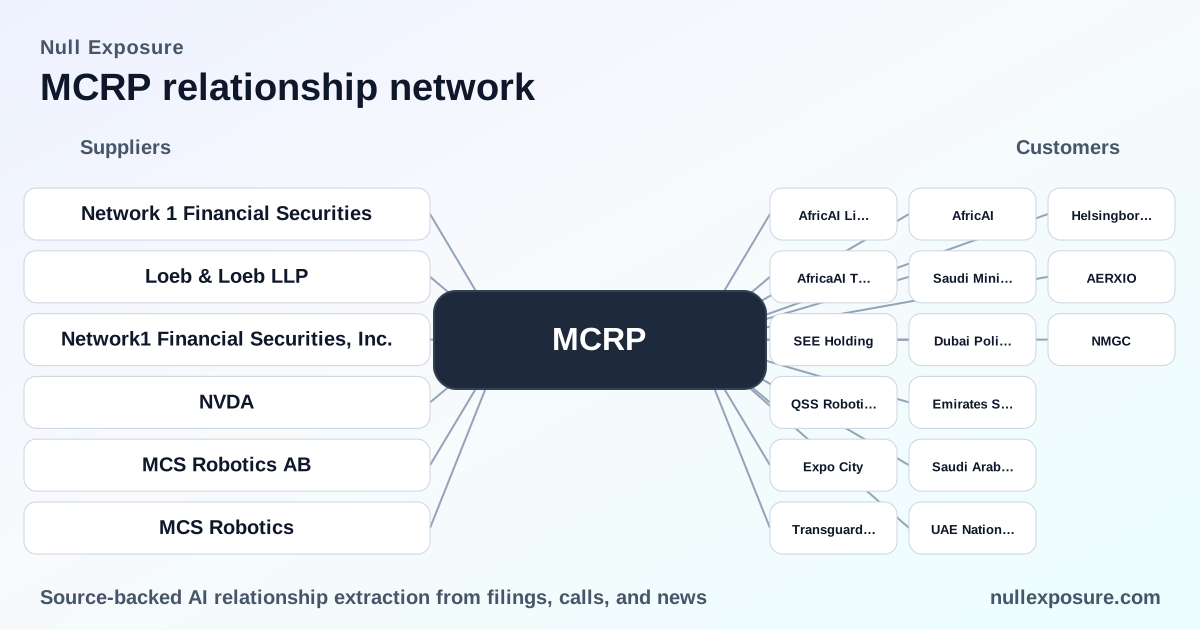
Below I catalog every named customer/partner reported in the public record and provide a short, source-linked summary of each relationship.
-
AfricAI Limited — Micropolis signed a $9.3 million commercial development and multi-year distribution agreement with AfricAI to expand its autonomous vehicles across Africa, including development of three customized models and regional distribution rights. According to a GlobeNewswire press release in March 2026, the deal includes a three-year distribution arrangement through AfricAI’s regional subsidiary. (GlobeNewswire, Mar 2026)
-
AfricaAI Technology FZ LLC — As the regional subsidiary used in the AfricAI deal, AfricaAI Technology FZ LLC will purchase, market and distribute Micropolis platforms (M-Patrol and customized systems) under the multi-year agreement. The GlobeNewswire announcement describes AfricaAI Technology FZ LLC as the distribution vehicle for the continent-focused rollout. (GlobeNewswire, Mar 2026)
-
QSS Robotics — QSS issued a non-binding LOI to procure an initial 500 robots and subsequently indicated an additional 270-robot order, bringing total indicated demand to 770 units, tied to pilot success in Saudi Arabia. Micropolis reported the expanded LOI following a successful pilot with the Saudi Ministry of Interior. (GlobeNewswire; Finviz, Jan–Mar 2026)
-
Saudi Ministry of Interior — Micropolis completed a one-month pilot across two strategic Saudi sites (an ARAMCO refinery and the Riyadh national power station) for surveillance and perimeter applications; the pilot underpinned QSS Robotics’ commercial LOIs. The pilot completion and operational validation were described in Micropolis’ press release in January 2026. (GlobeNewswire, Jan 2026)
-
DP World — Micropolis signed an engineering and manufacturing agreement with DP World to support a container ascending system and other intelligent-automation integrations across selected DP World operations, positioning Micropolis as a manufacturing and system partner for a global logistics operator. Micropolis announced the agreement in April 2026. (GlobeNewswire, Apr 2026; earlier coverage May 2025)
-
EDGE Group (and TII/SteerAI collaboration) — Micropolis joined an industry consortium with EDGE Group and TII to industrialize an Autonomous Logistics Platform (ALP) and pilot it in EDGE’s industrial areas, creating a production and piloting framework for logistics automation. The consortium framework was announced in January 2026. (GlobeNewswire, Jan 2026)
-
SEE Holding — Micropolis tested its AI and robotics infrastructure in “The Sustainable City 2.0” project with SEE Holding, expanding urban and smart-city use cases beyond security into decentralized logistics and residential services. Robotics & Automation News covered the pilot and testing activities in 2025. (Robotics & Automation News, Feb–May 2025)
-
Emirates Steel — Micropolis signed a Memorandum of Understanding with Emirates Steel to explore integration of robotic mobility solutions into industrial operations, marking the start of an industrial-commercial evaluation in heavy industry. The MoU was disclosed at a May 2025 industry event. (GlobeNewswire, May 2025)
-
Dubai Police — Micropolis deployed autonomous patrol units at Dubai Global Village as the Emirate’s first official autonomous patrol implementation, establishing a high-profile public-safety reference customer for the M-Patrol platform. Local reporting documented the deployment in October 2025. (CityBuzz, Oct 2025)
-
UAE National Guard — Micropolis presented advanced border-control robots to the UAE National Guard as part of pilot initiatives aimed at national border protection capabilities. The presentation and pilot initiative were reported during 2025 airport and defense shows. (Sahm Capital / show coverage, May 2025)
-
Expo City and Transguard Group — Expo City and Transguard joined Micropolis as strategic partners in its early growth pipeline, targeting urban-development, energy and residential sector deployments through joint initiatives and demonstrations. The strategic partnership was discussed in an October 2025 company release. (Markets.FinancialContent / ABNewswire, Oct 2025)
-
Expo City (separate mention) — Expo City appears across Micropolis’ corporate releases as a strategic engagement venue and partner, used to showcase urban and commercial pilots that support downstream sales. (Markets.FinancialContent / ABNewswire, Oct 2025)
-
Helsingborgs Hamn AB — Micropolis partnered with Sweden’s Helsingborgs Hamn AB and MCS Robotics AB to co-develop and test the “Box Cleaner,” an autonomous port-cleaning system built on the M2 platform — a clear move into European port operations and maritime use cases. (Barchart story referencing the October 2025 announcement)
-
AERXIO — A distribution agreement with AERXIO opened access to Egypt and North Africa, extending Micropolis’ channel coverage for border, port security and infrastructure modernization opportunities. The AERXIO arrangement was reported in coverage of Micropolis’ distribution expansion. (Barchart, 2025)
-
NMGC / Neom — Micropolis reported pilots with Neom for logistics and utility functions, and those engagements were cited alongside other strategic pilots in coverage of its post-IPO growth plans; NMGC is the inferred symbol referenced in reporting on those engagements. (Robotics & Automation News, May 2025)
-
Transguard Group — As a strategic partner, Transguard supports security and operations pilots and potentially provides a channel into private security and facility services markets. The partnership was noted in company announcements in late 2025. (Markets.FinancialContent / ABNewswire, Oct 2025)
What these relationships collectively reveal about commercial posture
- Government and heavy-industry orientation. The relationship set is heavily weighted toward sovereign customers, national security organizations, ports, and large logistics providers (Dubai Police, UAE National Guard, Saudi MOI, DP World, Helsingborgs Hamn). That profile signals high criticality use cases (security, port logistics) but also long procurement cycles and heavy compliance requirements.
- Channel-driven roll-out. Distribution agreements with AfricAI/AfricaAI and AERXIO show Micropolis scaling geographically via partners rather than direct field sales, creating leverage but making revenue conversion dependent on third-party execution.
- Pilot-to-order commercialization pattern. Multiple LOIs and MoUs (QSS Robotics’ 770-unit indication, Emirates Steel MoU, DP World engineering contract) demonstrate a two-step model: pilots → LOIs/MoUs → firm orders and manufacturing engagements.
- Early-stage financial posture. Company filings show minimal revenue (TTM $156k) and substantial operating losses (EBITDA -$20.4M), so partner conversions and order fulfillment are gating variables for positive cash flow.
- Ownership and governance signal. Insider ownership is high (roughly 76%) with very low institutional ownership (~1%), which implies centralized control and potential illiquidity pressures if large insider share blocks move.
Investment implications: risks and upside
- Upside comes from converting the current pipeline (distribution contracts and LOIs) into manufacturing backlog with DP World, QSS and AfricAI, and from scaling recurring maintenance and software services once units are deployed. Successful conversions would translate pilots into material revenue and margin expansion.
- Primary risks are conversion failure, long procurement timelines with sovereign customers, execution and manufacturing scale-up, and the company’s current capital absorption given negative EBITDA and tiny revenue base.
Bottom line and next steps
Micropolis is a textbook early commercial robotics company: strong partner endorsements and high-profile pilots, but still pre-revenue scale and reliant on converting LOIs and distribution deals into deliveries. For investors evaluating customer quality and revenue convertibility, the most important near-term datapoints are DP World engineering milestones, QSS firm orders from the Saudi program, and initial distribution sales through AfricAI/AfricaAI. Learn more about coverage and relationship tracking at https://nullexposure.com/.
If you want a focused briefing on which deals are most likely to convert to firm orders next quarter, I can produce a prioritized run-rate model and supplier risk assessment.