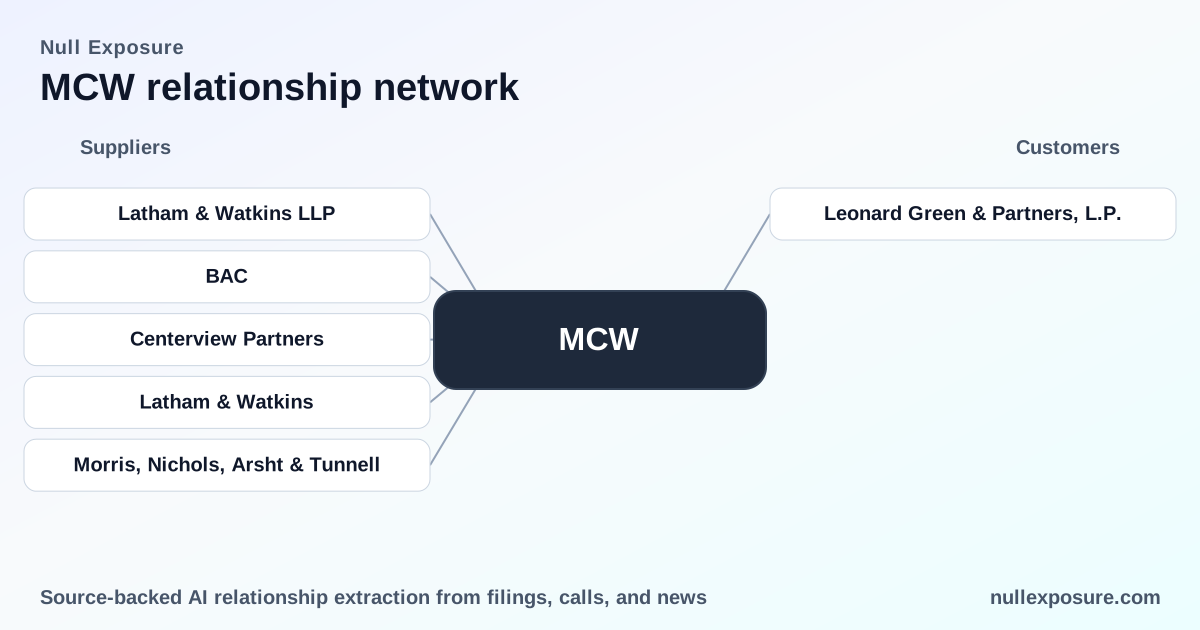
Mister Car Wash (MCW): Subscription economics under a Leonard Green takeover
Mister Car Wash operates and monetizes a large national network of exterior car wash and light vehicle services through a dual revenue model: a monthly Unlimited Wash Club (UWC) subscription that supplies recurring, predictable cash flow, and spot, pay-as-you-go transactions that generate immediate point-of-service revenue. The business is fundamentally a services seller and operator: the firm collects subscription fees to deliver an ongoing service obligation while supplementing margins with one-off washes and retail items. Recent developments — a $7.00-per-share acquisition offer from Leonard Green & Partners and attendant shareholder litigation — materially change the near-term capital and governance context for those revenue streams. For background on relationship-level intelligence and deal tracking, visit https://nullexposure.com/.
The economic spine: why customers are the moat
Mister Car Wash’s operating economics are driven by scale in recurring consumer relationships. With over 2.1 million UWC members as of December 31, 2024 and 514 locations in 21 states, the company converts a large base of individual retail customers into monthly subscribers who purchase the same service repeatedly. That conversion creates predictable top-line cadence and higher lifetime value versus purely spot-dependent operators.
- The UWC product is cancelable at any time but remains the main revenue stabilizer because it shifts revenue from lumpy, weather-dependent washes to a steady monthly stream.
- Spot transactions are recognized at the point of service and provide important margin upside during peak demand, but they do not replace the underwriting value of subscription economics.
- Prepaid products such as gift cards are not material to reported financials, emphasizing that the business is built on active memberships and same-store performance rather than large one-off prepayments.
How contracts translate into cash and operational risk
Mister Car Wash’s contracting posture is mixed but subscription-forward. The company explicitly recognizes wash sales at the point-in-time of service while the Unlimited Wash Club creates an ongoing performance obligation that the firm services monthly. That structure yields three practical implications for investors and operators:
- Revenue predictability: Subscription receipts smooth revenue and support and/or leverage fixed costs across sites.
- Churn sensitivity: Because UWC is cancelable, membership retention is operationally critical; pricing and service consistency will drive margin stability.
- Local demand correlation: Spot wash revenue remains exposed to weather, gas prices, and local consumer activity, making geographic diversification of sites a risk mitigation lever.
For more granular relationship tracking around the corporate ownership transition and its consequences for member economics, see our coverage at https://nullexposure.com/.
Leonard Green takeover and related filings — every reported relationship
This section covers each relationship result in the public feed. All three items reference Leonard Green & Partners, L.P. in the context of the same transaction and subsequent investor legal activity.
Leonard Green & Partners — Halper Sadeh investigation (Mar 10, 2026)
Halper Sadeh LLC announced an investigation into whether Mister Car Wash shareholders are receiving a fair price for the proposed sale of MCW to Leonard Green at $7.00 per share in cash. According to a March 10, 2026 report on aijourn.com, the inquiry targets valuation adequacy tied to the deal terms. (Source: aijourn.com, March 10, 2026.)
Leonard Green & Partners — Merger agreement flagged by public notice (Feb 23, 2026)
A GlobeNewswire release on February 23, 2026 stated that Mister Car Wash entered a definitive merger agreement under which investment funds managed by Leonard Green would purchase outstanding common shares not already owned by LGP affiliates for $7.00 per share, described in the release as roughly a 20% discount to MCW’s 52-week high. (Source: GlobeNewswire press release, February 23, 2026.)
Leonard Green & Partners — Stock notification and additional law-firm outreach (Apr 17, 2026)
A GlobeNewswire stock-notification release on April 17, 2026 reiterated that MCW agreed to be acquired by Leonard Green for $7.00 per share (the agreement date referenced was February 18, 2026) and documented continuing law-firm outreach to shareholders challenging the transaction price. (Source: GlobeNewswire press release, April 17, 2026.)
What the takeover and legal activity mean for customer relationships
The Leonard Green transaction reframes several company-level signals that matter to buyers and operators:
- Contracting posture: Company-level signals indicate a hybrid model with subscription contracts (UWC) and spot sales; the private-equity purchase is unlikely to change the subscription product quickly because UWC is core to cash flow generation.
- Concentration and geography: The business is geographically diversified across the U.S. (514 locations in 21 states), lowering single-market concentration risk but keeping exposure to national consumer trends.
- Counterparty type and criticality: The customer base is primarily individual retail consumers and UWC members; this retail concentration makes loyalty programs and experience delivery critical to sustaining margins.
- Maturity and materiality: The company reports one operating segment (services) and treats prepaid products as immaterial, signaling a mature operational focus on routine service delivery rather than financial engineering via material prepayments.
- Relationship posture and lifecycle: Public disclosures identify Mister Car Wash as both a seller and service provider with an active membership base (2.1 million UWC members as of year-end 2024), which underpins recurring revenue but requires continued site-level investment.
Together, these signals mean that an acquirer focused on operational improvements would likely prioritize retention, process standardization, and local marketing to protect the subscription economics rather than dramatic product redesign.
Investor implications and operating actions to watch
- Valuation compression is immediate: The $7.00-per-share deal price — reported as a near 20% discount to the 52-week high — is the immediate valuation anchor and the focal point of shareholder litigation; investors should monitor whether legal challenges alter deal timing or price. (See GlobeNewswire, Feb–Apr 2026.)
- Retention metrics are the leading indicator: Membership counts, churn rate, and average revenue per member will indicate whether the business can sustain cash flow under private ownership.
- Operational leverage post-close: The acquirer’s success will depend on extracting site-level efficiency and increasing cross-sell to UWC members without eroding retention.
Bold takeaway: The core investment thesis remains the UWC subscription engine; ownership change raises near-term corporate governance and valuation questions but does not invalidate the subscription-driven cash-flow model.
Key relationships and legal developments are moving quickly; for ongoing relationship intelligence and to track how this transaction affects counterparty exposures, consult our coverage at https://nullexposure.com/.