Spectral AI (MDAI): Government R&D Lifts Near-Term Revenue, Commercialization Is the Value Inflection
Spectral AI generates revenue today primarily by contracting research and development services with U.S. government agencies while it develops DeepView®, an integrated imaging device and AI diagnostic platform that the company expects to monetize later via a hardware sale plus subscription (SaMD/SaaS) model. The current business is funded and de-risked by large, multi-year government awards, and the path to recurring commercial revenue depends on FDA clearance, device manufacturing scale, and software licensing adoption.
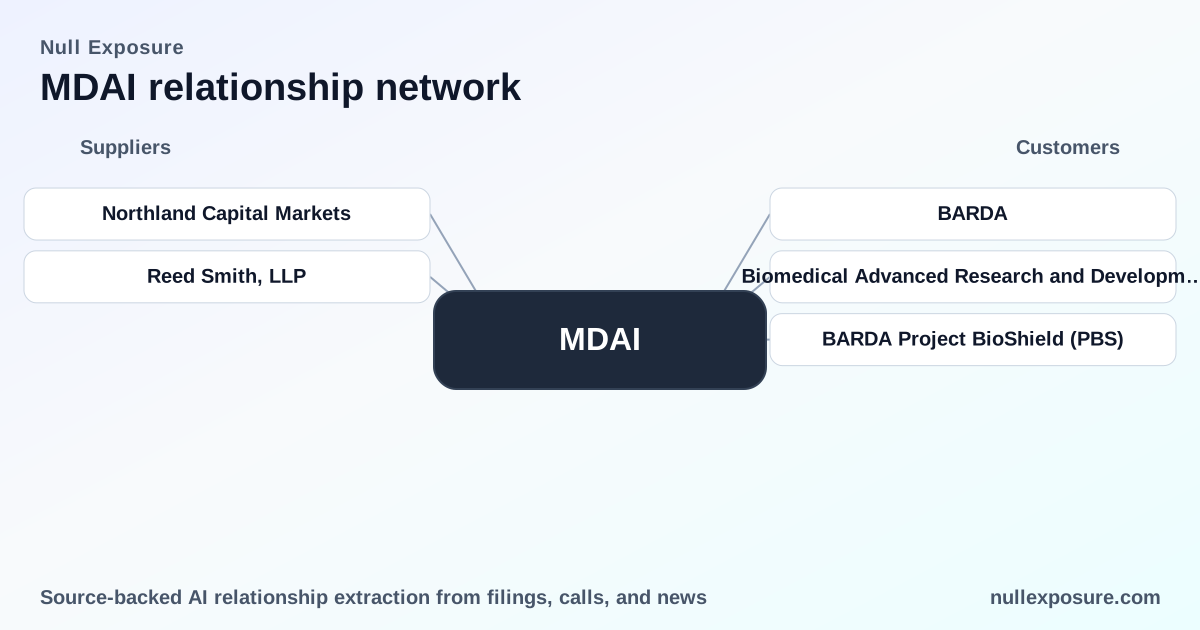
If you want a concise view of counterparties and how they shape MDAI’s risk/reward profile, see the customer breakdown below and visit the Null Exposure hub for more deal-level intelligence: https://nullexposure.com/.
Why government contracts are the commercial fulcrum
Spectral AI’s economics today are dominated by government reimbursements that fund clinical validation and regulatory work for DeepView. BARDA and related U.S. defense and health agencies account for the overwhelming majority of recognized R&D revenue, providing both cash runway and an implicit endorsement for a clinical use case focused on burn assessment and battlefield triage. That funding concentration is a positive for cash flow today but creates a single-counterparty concentration risk until commercial revenue ramps.
Customer relationships: line-by-line
BARDA (Biomedical Advanced Research and Development Authority)
Spectral AI has an active, multi‑year Project BioShield (PBS) contract with BARDA that funded clinical validation and the company’s De Novo FDA submission; the company reported a decline in R&D revenue after the De Novo submission as reimbursable study activity wound down. According to the company’s Q3 2025 financial release (reported March 2026), R&D revenue tied to the BARDA contract fell 54% sequentially to $3.8 million following the June 2025 FDA submission (Quiver Quant, Mar 2026: https://www.quiverquant.com/news/Spectral+AI%2C+Inc.+Reports+Q3+2025+Financial+Results+and+Advances+in+FDA+Submission+with+Strong+Cash+Position).
Biomedical Advanced Research and Development Authority (BARDA) — local reporting
Local press coverage highlighted the size of the BARDA award and its strategic purpose: the company was awarded a contract valued at up to $149 million to develop battlefield burn assessment tools, underpinning the company’s DeepView clinical program (Dallas Innovates, FY2024 reporting: https://dallasinnovates.com/dallas-spectral-ai-is-developing-a-battlefield-burn-assessment-tool/).
BARDA (FY2024 revenue disclosure)
Public summaries of fiscal 2024 results show BARDA-sourced revenues of $7.6 million as the primary driver of contract revenues in that year, reinforcing the materiality of the BARDA relationship to revenue generation (Zacks narrative on FY2024, referenced in company reporting: https://scr.zacks.com/news/news-details/2024/MDAI-December-Topline-Expected-article/default.aspx).
Medical Technology Enterprise Consortium (MTEC)
MTEC represents a secondary government funding channel for Spectral AI, contributing modestly to total government contract receipts (approximately $606,000 in FY2024), and serves as a complementary engineering and development partner to accelerate device and trial activities (Zacks FY2024 overview: https://scr.zacks.com/news/news-details/2024/MDAI-December-Topline-Expected-article/default.aspx).
BARDA Project BioShield (PBS)
The Project BioShield program is the specific BARDA vehicle that underwrites the PBS BARDA Contract; Spectral AI explicitly referenced ongoing commitment to their PBS award while pursuing commercialization and broader product offerings (company offering announcement, Mar 2026: https://www.quiverquant.com/news/Spectral+AI%2C+Inc.+Announces+%247.6+Million+Offering+to+Support+Expansion+of+DeepView%C2%AE+System).
Defense Health Agency
Spectral AI has an awarded contract with the Defense Health Agency for development of a handheld DeepView system (March 2024), reflecting defense-sector interest in a field‑deployable imaging device and offering a non‑BARDA government avenue for adoption in military medical workflows (FY2024 reporting cited in market commentary: https://scr.zacks.com/news/news-details/2024/MDAI-December-Topline-Expected-article/default.aspx).
GSAT (10‑K excerpt referencing satellite procurement agreements)
One result set includes a GSAT filing that discusses satellite procurement agreements and equipment procurement; this entry appears to come from an external 10‑K referencing MDA and satellite purchases and is not part of Spectral AI’s core healthcare relationships, but it is present in the record returned for MDAI and should be noted for completeness (10‑K excerpt: gsat-2024-12-31, as listed in the results).
How the customer mix defines the operating model and constraints
Spectral AI’s counterparty profile is dominated by U.S. government agencies, and the company-level signals are clear:
- Contracting posture — long-term, government-funded: The company executed a multi‑year Project BioShield contract in September 2023 valued up to approximately $150 million, which establishes a long-term development timeline and committed funding for clinical validation and regulatory submission. This is explicitly tied to BARDA in company filings (constraint evidence: September 2023 PBS BARDA Contract).
- Concentration — extremely high near-term concentration: One U.S. government customer accounted for 94% of recognized R&D revenue in 2024, indicating acute revenue concentration that compresses diversification until commercialization proceeds.
- Criticality — material and functionally critical to near-term operations: Government reimbursements are the primary source of R&D revenue today, a company-level characteristic noted in filings that positions these contracts as critical to cash flow and trial completion.
- Maturity and stage — active, development-stage relationships: Contract language and reported award balances indicate active, multi-year engagements with remaining funding under the initial awards as of year-end 2024.
- Segment mix — services today, hardware and software commercial tomorrow: The company currently records research and development revenue (services), while the planned commercialization model combines a hardware imaging device and SaMD/SaaS software licensing for recurring revenue once regulatory clearance and manufacturing are in place.
- Spend scale — program-level funding is large: Since 2013, government funding directed to the company totals roughly $281.9 million, primarily from BARDA, placing Spectral AI in a >$100 million program funding band overall.
Investment implications and what to watch
- Near-term stability is linked to BARDA payments; any delay or re-scoping in government funding will materially affect revenue and R&D cadence.
- Regulatory milestones are the inflection points that convert government-funded validation into commercial revenue opportunity; the De Novo submission in June 2025 is a pivotal event that reduced reimbursable activity but advanced the company toward market access.
- Concentration risk is real but quantifiable — the company’s financial runway and valuation upside depend on converting a government‑backed clinical program into recurring SaaS plus device sales.
For deal teams tracking counterparties and payment timing, Null Exposure keeps running coverage and collateral on contract structure and cash flow timing — visit https://nullexposure.com/ for deeper, deal-level context.
Conclusion: Spectral AI is a development‑stage medical device firm operating with government financing as the principal near‑term revenue source, a high‑value BARDA contract that materially de-risks clinical development, and a clear but execution‑dependent path to recurring revenue via a hardware-plus‑SaMD model. Investors should weigh the security of government funding against the single‑customer concentration and the execution risk of scaling manufacturing and software commercialization.