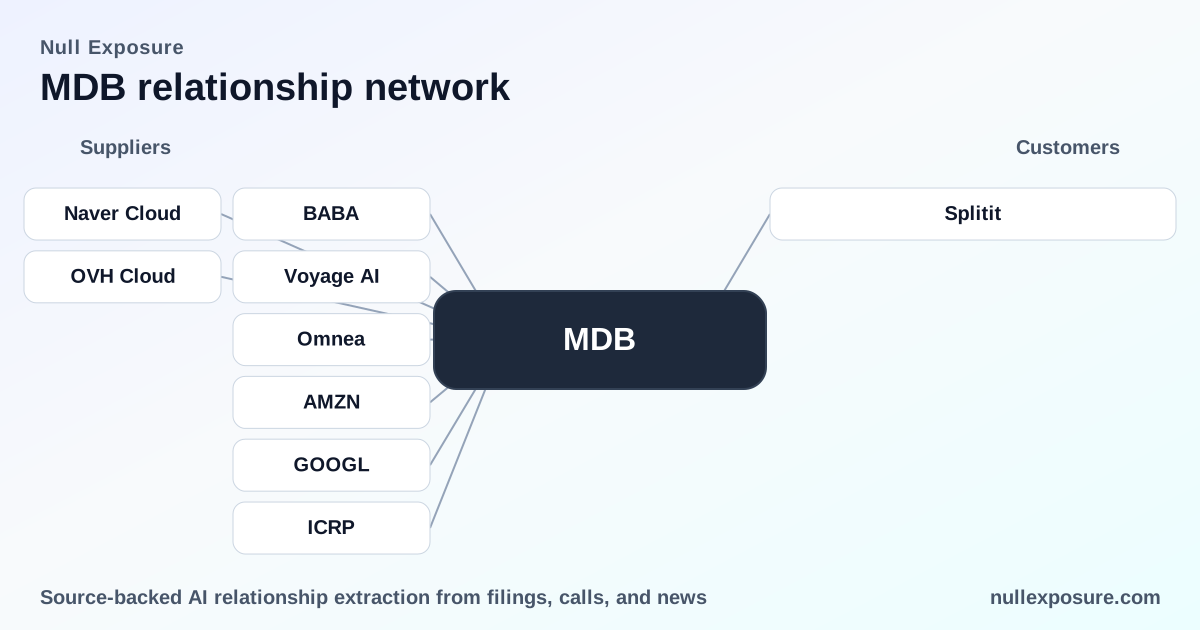
MongoDB (MDB): Customer Map and Commercial Posture — what investors and operators need to know
MongoDB sells a global general-purpose database platform and monetizes primarily through subscription licensing and usage-priced cloud services (MongoDB Atlas), with professional services making up a small residual. The company reported roughly $2.46B in trailing revenue and is publicly cited as serving more than 65,200 customers worldwide, including large enterprise and strategic accounts that underpin its commercial motion. For deeper signals on customer relationships, visit https://nullexposure.com/.
Business model and contract posture — subscription-led, usage-priced, enterprise-skewed
MongoDB’s revenue profile is defined by subscription economics combined with significant usage-based billing. Company disclosures show that subscriptions accounted for roughly 97% of revenue in the most recent years, while MongoDB Atlas — the hosted DBaaS — is recognized primarily on a usage basis, billed monthly in arrears. The firm reports that the majority of subscription contracts are one year in duration, while remaining performance obligations include multi-year contracts and deferred revenue from advance payments.
- Commercial mix: Subscription and usage revenues dominate; professional services are modest (around 3% of revenue in recent years).
- Contracting posture: Predominantly short-term subscription contracts (one year) with pockets of multi-year committed business reflected in remaining performance obligations.
- Customer base and geography: MongoDB operates globally (customers in 100+ countries) with North America accounting for ~54% of revenue; EMEA and APAC are formal geographic market categories.
- Counterparty profile and concentration: The company targets large enterprises while retaining a broad customer base; no single customer exceeded 10% of revenue in FY2025, indicating diversification.
These signals imply renewal-driven growth dynamics and revenue variability tied to usage and customer expansion, with a relatively low single-customer concentration but material exposure to North American demand. For context on customer-level signals and relationships, see more at https://nullexposure.com/.
Customer map — notable relationships and what they signal
Below are the specific customer relationships identified in recent coverage. Each entry is a concise, plain-English takeaway and the source that reported it.
Anthropic
MongoDB lists Anthropic among its customers, indicating adoption by leading AI-focused organizations in the company’s roster of cloud and enterprise clients. This appearance is noted in a Sahm Capital news summary covering MongoDB’s FY2026 commentary and expansion (Apr 23, 2026).
Decathlon
Decathlon is included in MongoDB’s cited customer list, reflecting penetration into global retail and product-focused enterprises that leverage modern data platforms. The mention comes from the same Sahm Capital coverage of MongoDB’s Ireland expansion (Apr 23, 2026).
Eleven Labs
Eleven Labs appears on MongoDB’s customer list, demonstrating adoption by providers of advanced developer or media tooling and reinforcing MongoDB’s position in developer-led adoption channels. Source: Sahm Capital summary of MongoDB’s FY2026 announcements (Apr 23, 2026).
Financial Times
The Financial Times is named among MongoDB’s customers, suggesting media and publishing use-cases for the platform across content, personalization, or analytics workloads. Source: Sahm Capital reporting on MongoDB’s FY2026 update (Apr 23, 2026).
Lombard Odier
Lombard Odier, a wealth management / financial services firm, is listed as a MongoDB client, which signals traction within regulated financial workflows that require scalable database infrastructure. Source: Sahm Capital coverage of MongoDB’s FY2026 disclosures (Apr 23, 2026).
Vodafone (VOD)
Vodafone is cited as a MongoDB customer, illustrating enterprise telecom adoption and usage of the platform for large-scale, global operational data or customer-facing services. This is recorded in Sahm Capital’s April 23, 2026 summary (listed with inferred symbol VOD).
Splitit (FY2020)
Splitit was identified as an early preview user of MongoDB Atlas Online Archive, showing an example of a FinTech/merchant payments customer leveraging Atlas features; this relationship was reported in TechTarget coverage of Atlas Online Archive (article covering the preview use, FY2020 reporting).
Volvo Connect
Volvo Connect is included on MongoDB’s customer list, reflecting usage among automotive/connected-vehicle platforms and demonstrating the platform’s applicability to IoT and telematics workloads. Source: Sahm Capital report summarizing MongoDB’s FY2026 customer roster (Apr 23, 2026).
L’Oréal Groupe (OR.PA)
L’Oréal Groupe is named among MongoDB’s customers, indicating penetration into large consumer goods firms that require global, multilingual, and high-scale data architectures. Source: Sahm Capital coverage of MongoDB’s FY2026 updates (Apr 23, 2026).
TUI
TUI appears on the customer list, representing travel and booking platforms that adopt MongoDB for customer data, inventory, and personalization use cases. Source: Sahm Capital coverage of MongoDB’s FY2026 announcement (Apr 23, 2026).
What these relationships collectively tell operators and allocators
The set of named customers spans AI platforms, media, finance, telecom, retail, consumer goods, automotive, and travel — a cross-section that supports MongoDB’s claim of broad industry adoption and an enterprise sales focus. The mix reinforces two structural points:
- Breadth over concentration: The company reports a very large customer base (54,500+ in Jan 2025; more than 65,200 customers cited in FY2026 coverage), and no single customer >10% of revenue, which limits customer-specific revenue risk even as some customers are high profile.
- Product-led plus enterprise motion: Presence of both developer-led adopters (e.g., Eleven Labs, Splitit) and large enterprise accounts (Vodafone, L’Oréal, Lombard Odier) validates a hybrid GTM where self-serve Atlas growth combines with targeted enterprise sales and multi-year contracts.
Concentration, risk and margin context
Key financial and operating metrics to keep in view as part of due diligence:
- Revenue scale and valuation context: Trailing revenue ~$2.46B, market cap ~$21.27B, and a forward P/E in public estimates consistent with high-growth software peers (analyst target price noted around $347.1).
- Margin and profitability posture: Recent EBITDA and EPS figures show the company operating with investment-weighted profitability metrics (negative EBITDA and diluted EPS), while operating margins have been moving toward leverage as subscription and Atlas mix evolve.
- Revenue variability drivers: Usage-based Atlas billing introduces callability to growth (expansion from existing customers increases revenue), while one-year subscription contracts concentrate renewal cycles and pricing power.
Investment implications — monitoring checklist for allocators and operators
- Track Atlas usage growth and dollar-based net retention, as these drive top-line acceleration.
- Monitor renewal rates for one-year contracts and the conversion of self-serve customers into larger enterprise commitments.
- Watch regional mix: North America contributes ~54% of revenue, so macro softness or tech spending changes in that market have disproportionate impact.
- Evaluate margin trajectory versus continued R&D and sales investments; professional services remain small (~3% of revenue), so product revenue must sustain margin expansion.
Conclusion
MongoDB’s customer roster and disclosures portray a subscription-first, usage-augmented commercial engine serving a broad set of industries and large enterprises, with limited single-customer concentration and meaningful geographic exposure to North America. The commercial model rewards expansion within accounts but requires disciplined execution around renewals and Atlas monetization to justify current valuation multiples.
For a deeper look at customer relationship signals and how they inform credit and revenue risk models, visit https://nullexposure.com/.