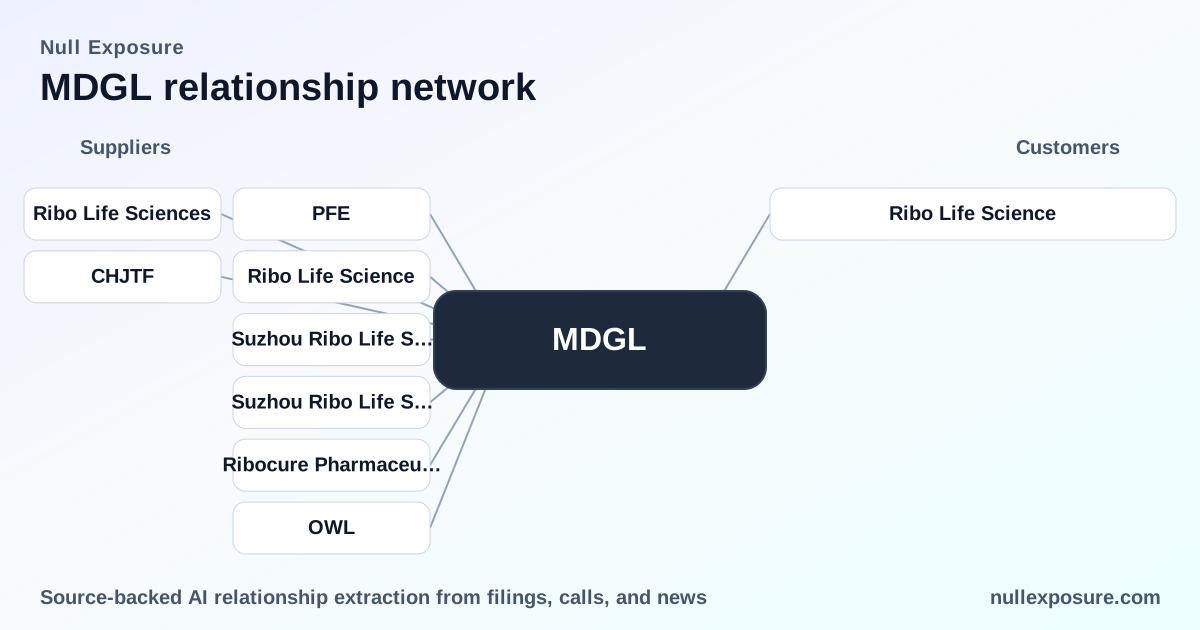
Madrigal Pharmaceuticals (MDGL): Customer relationships, distribution risks, and the Ribo Life Science tie‑in
Madrigal Pharmaceuticals monetizes primarily through the commercial sale of its lead product Rezdiffra (resmetirom) and advances value via pipeline collaborations that expand indications and candidate assets. The company recognizes product revenue at a point in time (upon delivery), sells into a highly concentrated network of specialty pharmacies and distributors in North America, and supplements its commercial trajectory with targeted R&D and licensing arrangements to build out its MASH pipeline. Investors should weight commercial concentration and distribution dependency alongside pipeline partnership upside when modeling revenue durability and partner risk.
For further background on how we parse partner links and client exposure, visit the Null Exposure homepage: https://nullexposure.com/
How Madrigal makes money and where the cash flow comes from
Madrigal transitioned from pure clinical-stage to commercial revenues following accelerated FDA approval of Rezdiffra on March 14, 2024, with U.S. commercial availability beginning in April 2024. The company recognizes revenue when a customer obtains control of product—typically at delivery—so sales are recorded on a point‑in‑time basis tied to shipments to specialty pharmacies and distributors. According to recent company disclosures, Madrigal reported roughly $958.4 million in trailing twelve‑month revenue with gross profit of about $902.3 million, reflecting high gross margins on product sales during the commercial launch period.
Distribution and customer structure — concentration is the dominant risk
Madrigal’s commercial model is deliberately narrow: sales flow through a limited number of specialty pharmacies and specialty distributors that account for essentially all Rezdiffra revenue. Company filings for the year ended December 31, 2024 show that four customers represented meaningful shares of gross product revenue (Customer A 39%, Customer B 21%, Customer C 14%, Customer D 12%), which makes counterparty concentration a primary driver of near‑term cash flow volatility. Because distribution is routed through these specialty pharmacies, loss of one or more distribution partners would have a material, immediate impact on revenue collection and product availability.
The single recorded customer relationship: Ribo Life Science
A March 10, 2026 industry report described a deal between Madrigal and Ribo Life Science as part of Madrigal’s efforts to expand its MASH pipeline. This is an R&D/collaboration style relationship reported in FY2026 and presented as strategic pipeline expansion rather than core commercial revenue generation. (Report: Citeline, March 10, 2026.)
What the Ribo Life Science link means for investors
The Ribo arrangement supports Madrigal’s mid‑ to long‑term pipeline strategy by adding capability or rights that strengthen the company’s MASH portfolio; it does not replace the immediate commercial dynamics driven by Rezdiffra distribution. The Citeline notice in March 2026 signals Madrigal is actively pursuing external partnerships to accelerate clinical or preclinical programs and thereby derisk future revenue streams beyond product sales.
Company-level operating constraints and what they imply for partner stability
Below are the operational and business model signals drawn from Madrigal’s public disclosures; these are presented as company‑level characteristics, not as attributes of any single partner unless explicitly named.
- Contracting posture — spot transactions: Revenues are recognized at a point in time upon delivery, indicating a spot sale model for product shipments rather than long‑term take‑or‑pay contracts. This creates revenue sensitivity to shipment timing and inventory flow.
- Counterparty profile — large enterprise counterparties: The company reports revenue concentration with a small number of large, reputable customers, implying negotiating strength resides with large specialty pharmacy networks and institutional distributors.
- Geographic concentration — North America dominant: As of December 31, 2024, Madrigal had no material revenue or assets outside the U.S., making top‑line performance tied to U.S. reimbursement, distribution logistics, and formulary access.
- Materiality — revenue concentration is material: Four customers each accounted for double‑digit shares of gross product revenue for 2024, a structural source of concentration risk that affects forecasting and working capital.
- Relationship roles — distributor and seller dynamics: The company both sells product into, and relies on, specialty pharmacies and specialty distributors; those partners are essential to reaching end patients and to revenue capture.
- Lifecycle stage — active commercial stage: Rezdiffra became commercially available in April 2024, so the company is in early commercial rollout while simultaneously pursuing pipeline expansion.
- Product focus — core product driving revenue: Rezdiffra is the core revenue driver; pipeline collaborations (like Ribo) are strategic for future growth but do not materially diversify current sales in the short term.
These constraints together produce a business model that is commercially concentrated, distribution‑dependent, U.S.‑centric, and early in its commercialization maturity cycle—important qualifiers for underwriting partner risk and revenue durability.
Financial and valuation context investors should not ignore
Madrigal trades with significant premium multiples reflective of the company’s commercial launch, pipeline potential, and small public float dynamics. Market capitalization and valuation metrics show investor willingness to pay for growth while current profitability metrics remain negative: trailing EPS and EBITDA are loss‑making, whereas Price/Revenue and Price/Book imply a growth‑weighted valuation. Use the concentration and distributor dependency signals above to stress‑test revenue durability under different uptake and distribution scenarios.
Risk versus opportunity — a practical framing
- Opportunity: Pipeline partnerships like the Ribo Life Science arrangement add technical breadth to MASH efforts and can unlock future revenue streams that materially diversify reliance on specialty pharmacies.
- Risk: Near‑term top‑line volatility is dominated by a small number of distributors that account for the majority of revenue; any disruption in those relationships, or in U.S. specialty pharmacy access, will directly affect receipts and cadence of reported revenue.
Closing investor takeaways
- Primary commercial engine: Rezdiffra sales routed through a handful of specialty pharmacies drive current revenue and gross margin.
- Concentration is material: Four customers accounted for a majority of gross product revenue in 2024, creating single‑counterparty exposure that must be modeled explicitly.
- Distribution dependency: Specialty pharmacy/distributor relationships are critical operational chokepoints—monitor contract terms, stock availability, and payer access closely.
- Pipeline partnerships matter for long‑term upside: Deals such as the Ribo Life Science collaboration expand the MASH pipeline and improve optionality beyond the current core product.
For investors assessing MDGL customer and partner exposure in detail, Null Exposure provides structured analysis and ongoing updates; learn more at https://nullexposure.com/