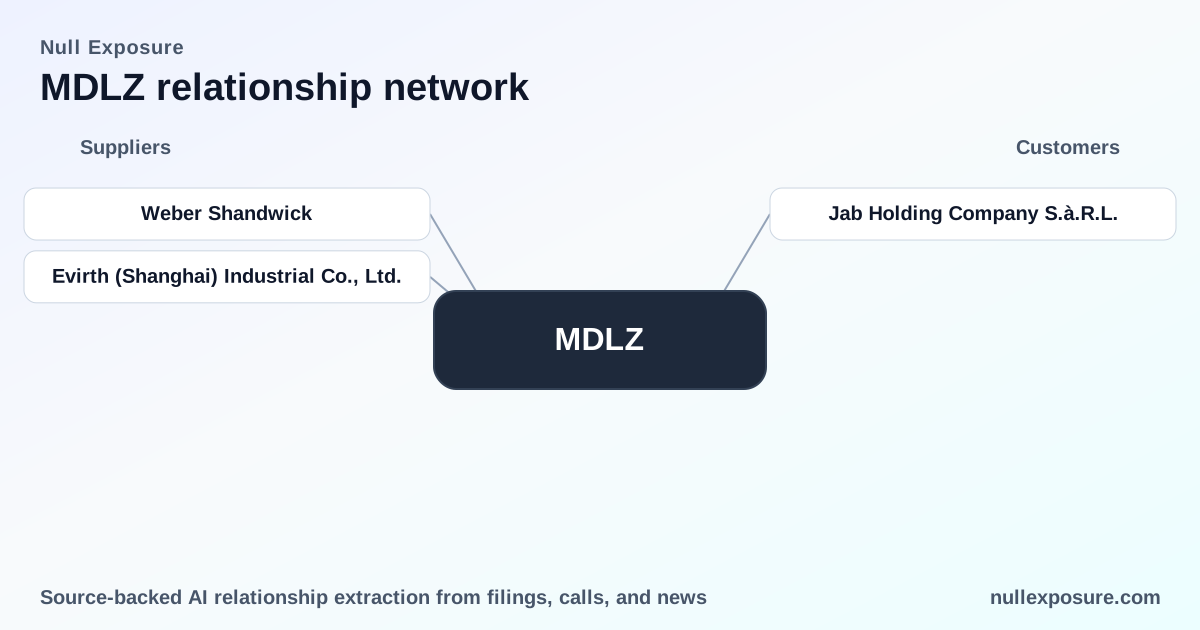
Mondelez (MDLZ) — customer relationships that shape a stable snacking franchise
Mondelez International operates a global branded snacking and confectionery business, manufacturing and marketing chocolate, biscuits, baked snacks and adjacent categories (gum & candy, cheese & grocery, powdered beverages). The company monetizes through large-scale retail distribution, licensing and co‑branding arrangements, and occasional portfolio transactions that reallocate product lines and distribution rights; revenue is driven by retail sell‑through and long-standing trade relationships with supermarkets, wholesalers and distributors. With trailing revenue near $39.3B and an operating margin around 9.3% (TTM), Mondelez is a mature, cash-generative consumer staples platform whose value derives from brand depth, global scale and consistent retail placement.
For a deeper look at customer exposures and partner dynamics, visit https://nullexposure.com/.
How the reported relationships fit the investor picture
The universe of customer-relationship hits in the provided results is small but informative: they reflect portfolio transactions, supplier recognition, and co‑brand merchandising partnerships. Each relationship below is summarized in plain language with source context.
Jab Holding Company S.à.R.L. — strategic portfolio buyer
Jab agreed to acquire a 17.66% stake in JDE Peet’s that Mondelez was selling, in a €2.2 billion transaction tied to Mondelez’s divestiture activity in the coffee/coffee‑adjacent space, reflecting how Mondelez monetizes non-core assets and repositions distribution rights. According to a March 10, 2026 Simply Wall St. news summary, the stake sale was executed as part of the broader JDE Peet’s transaction involving Mondelez.
SW — supplier recognized by Mondelez
An unnamed supplier identified as “SW” reported winning Mondelez Supplier of the Year, highlighting Mondelez’s use of strategic third‑party suppliers for packaging and related services and the company’s supplier quality expectations. This recognition appears in the supplier’s FY2024 filing and reflects Mondelez’s procurement relationships with specialized packaging firms (SW 10‑K / FY2024 disclosure filed February 2026).
DNUT (Krispy Kreme) — co‑brand product partner using Oreo
Krispy Kreme launched a limited‑time doughnut collection co‑branded with Oreo, demonstrating Mondelez’s licensing and co‑branding approach to extend Oreo into foodservice and quick‑service restaurant channels. MarketScreener covered the partnership on February 4, 2026, underscoring Mondelez’s strategy of leveraging iconic brands through promotional retail and foodservice tie‑ins.
What the relationship set implies for revenue and risk
These three items illustrate three recurring monetization levers for Mondelez:
- Portfolio transactions (Jab/JDE Peet’s) show how the company realizes value from non‑core assets and reshapes its product footprint through strategic sales. Such deals generate cash and can change channel exposure quickly.
- Supplier recognition (SW) signals the importance of a high‑quality packaging and supplier ecosystem to protect margins and shelf presence.
- Co‑branding and licensing (Krispy Kreme + Oreo) demonstrate incremental revenue and brand extension tactics that drive promotionally‑led sell‑through without large capital outlays.
Key takeaway: Mondelez balances scale retail distribution with targeted partnerships and periodic asset sales to sustain revenue and margin profile.
Visit https://nullexposure.com/ for a mapped view of these partner relationships and their potential P&L implications.
Operating constraints and what they tell investors
The constraints surfaced in the company material provide investor‑relevant signals about contracting posture, concentration, criticality and maturity.
- Contracting posture — short‑term distributor agreements exist as a company tool for transition and carve‑outs (evidence: the company disclosed that short‑term distributor agreements executed with the sale of the developed market gum business ended in Q1 2024). That phrasing indicates Mondelez uses finite distribution contracts when divesting lines, which reduces long‑term lock‑ins for certain channels and enables quicker portfolio reconfiguration.
- Geographic reach and channel diversification — global footprint is explicit: Mondelez sells in over 150 countries with operations in about 80, and reporting is organized into Latin America, AMEA, Europe and North America segments. This global reach dilutes single‑market shocks and reduces customer concentration risk.
- Customer concentration — immaterial single‑customer risk: the company reports no single customer accounted for 10% or more of net revenues in 2025, signaling low revenue concentration and broad retail diversification.
- Role and sales motion — Mondelez is predominantly a seller of branded packaged goods to supermarkets, wholesalers, mass merchandisers and distributors, while also transacting as a purchaser of packaging and services; the firm’s go‑to‑market is retail and distributor centric rather than direct manufacturing for industrial buyers.
- Product portfolio maturity — The firm’s business is core snack categories plus adjacent local products, indicating a mature consumer staples franchise with stable demand, modest revenue growth but predictable cash flows. Supporting metrics include a ~3.2% dividend yield, low beta (~0.40) and high institutional ownership (~88%), consistent with a defensive, mature equity profile.
- Relationship maturity and stage — Many customer relationships are active and ongoing in routine retail channels, while some (like distributor agreements tied to divestitures) are explicitly short‑term and transitional.
Investor implication: The combination of global distribution, low customer concentration and mature brand economics supports stable revenue and cash flow, while short‑term distributor contracts around divestitures introduce episodic transitional revenue dynamics that investors should monitor.
Risks and what to watch in the next 12–24 months
- Divestiture rollout and transitional contracts. Transactions that spin out product lines and employ short‑term distribution agreements can temporarily depress or shift reported revenue and operating results in the quarter of transition.
- Execution of co‑brand partnerships. Promotional tie‑ins (for example Oreo in foodservice) lift sell‑through but can compress margin if promotional intensity is high; track gross margin and promotional spend trends in quarterly results.
- Supply chain and supplier concentration. Supplier awards like Mondelez Supplier of the Year imply reliance on specialized packaging partners; any packaging disruption could affect SKU availability and in‑store presence.
Bottom line for investors
Mondelez runs a scaled, low‑concentration consumer staples engine that monetizes brands through retail sales, licensing and periodic portfolio transactions. The relationships surfaced here—portfolio buyers, recognized suppliers and co‑brand partners—are consistent with a company optimizing brand reach and operational efficiency while preserving predictable cash generation. Monitor divestiture terms and short‑term distributor contracts for transitory P&L effects; otherwise, the business thesis remains centered on durable brand monetization and global retail distribution.
For a consolidated view of Mondelez’s partner landscape and to track customer‑level exposures, explore the coverage at https://nullexposure.com/.