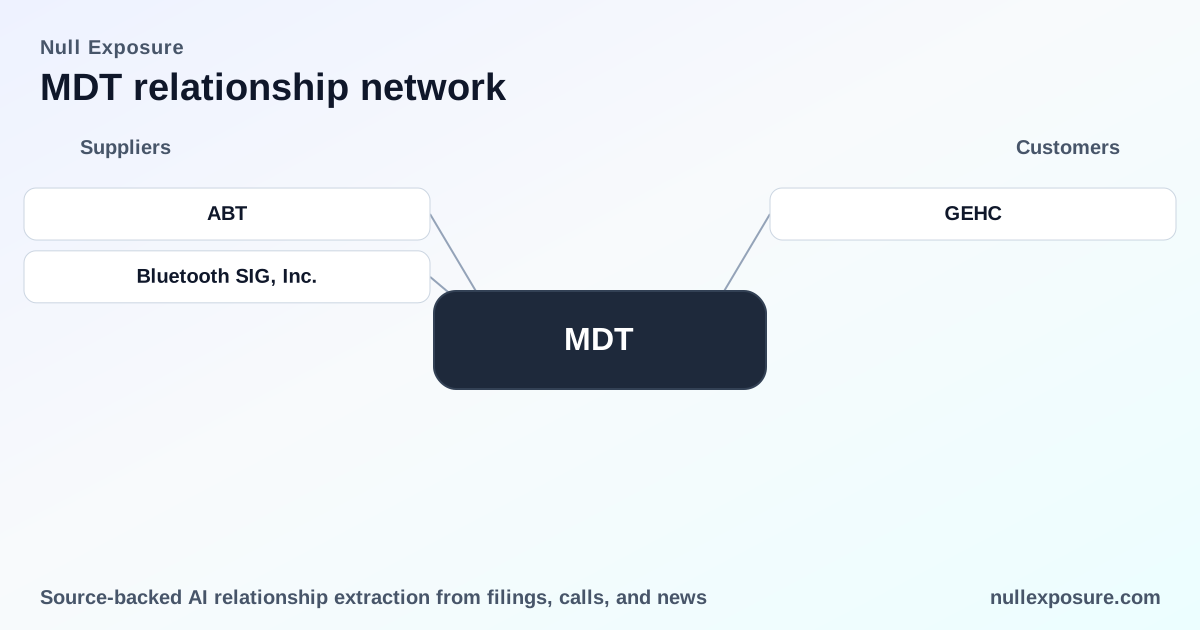
Medtronic (MDT): Customer Relationships Signal a Global, Product-Plus-Services Franchise with Strategic Alliances
Medtronic operates as a global medical-device manufacturer that monetizes through product sales, recurring consumables, lease-and-service arrangements, and strategic distribution partnerships. Revenue flows come from direct sales to hospitals and health systems, sales through distributors and GPO/IDN framework contracts, and from co-owned or joint-venture vehicles for specific therapy areas. For investors, the customer map shows a large, diversified end-market footprint with targeted alliances that both protect installed-base economics and accelerate new-therapy adoption. Learn more at https://nullexposure.com/.
What the customer map reveals about how Medtronic sells and contracts
Medtronic’s public relationship disclosures and recent press reporting describe a company that sells hardware and services through a mix of direct and intermediary channels and that deliberately builds strategic ties with large healthcare platforms.
- Contracting posture — framework agreements and distributor arrangements. Medtronic routinely negotiates with group purchasing organizations (GPOs) and integrated delivery networks (IDNs), and accounts for distributor chargebacks and sell-through in its revenue recognition, indicating standardized supply frameworks that prioritize predictable volume and channel control.
- Counterparty mix — governments, large enterprises, and individuals. The company serves national healthcare systems and large hospital networks while also addressing clinicians and patients directly, giving Medtronic a multi-tiered customer base that blends contractual scale with point-of-care touchpoints.
- Geographic footprint — truly global, with APAC and EMEA exposure. Medtronic lists the U.S., Western Europe, China and Japan as its largest markets; China is material enough to be called out in its risk disclosures, implying both growth opportunity and regulatory exposure.
- Concentration and materiality — diversified revenue base. Management states no single customer accounts for more than 10% of net sales, signaling low single-counterparty concentration despite dependence on a set of large institutional buyers.
- Product and service mix — hardware plus recurring services. Reportable segments cover device-based therapy portfolios and diabetes care, and Medtronic recognizes income from sales-type leases, implying recurring consumable and service economics around installed equipment.
- Maturity and criticality — established incumbent with strategic R&D partnerships. The firm combines large-scale commercialization with selective development collaborations to accelerate next-generation and leadless therapies.
Relationship inventory — the items investors should track now
Below are the company-level customer and partner mentions surfaced in public reporting and media; each item is summarized in plain English with a concise source reference.
Merit Medical Systems (MMSI) — exclusive distribution for ViaVerte (Investing.com, May 3, 2026)
Merit Medical entered an exclusive distribution agreement with Medtronic to offer the ViaVerte system, an FDA‑cleared therapy for chronic lower‑back pain, positioning Merit as the channel for that product in targeted markets. Investing.com reported the deal on May 3, 2026.
GE HealthCare — expanded multiyear global strategic alliance (Medtronic press release, Mar 2026)
Medtronic expanded a multiyear global alliance with GE HealthCare to adopt next‑generation Medtronic technologies across GEHC’s Patient Care Solutions, including wireless wearables and anesthesia airway visualization—an adoption pathway that embeds Medtronic tech into GEHC platforms. Medtronic announced the expansion in March 2026.
DaVita (DVA) — sale and joint-venture creation for kidney-care device business (MDT 10‑Q via stocktitan.net, Mar 2026)
Medtronic sold assets as part of an agreement with DaVita to form Mozarc Medical, a new independent kidney‑care device company with equal equity ownership between the parties, signaling a strategic carve‑out and long‑term commercial alignment. The 10‑Q referenced this structure in March 2026.
Merit Medical Systems (MMSI) — Piper Sandler coverage note referencing the same distribution deal (Investing.com, May 3, 2026)
Analyst notes reported by Investing.com reiterated that Merit will exclusively distribute the ViaVerte system following FDA clearance, an endorsement of the commercial route Medtronic selected for market access. The analyst coverage ran on May 3, 2026.
GE HealthCare — industry reporting on partnership expansion (MPO‑Mag, Mar 2026)
Trade press coverage described the longstanding Medtronic–GEHC alliance targeting outpatient platforms and adoption of Medtronic tech across GEHC patient‑care offerings, underlining commercial integration beyond point solutions. MPO‑Magazine covered this development in March 2026.
Orchestra BioMed (OBIO) — expanded development pathway for AVIM-enabled leadless pacemakers (Finviz, Mar 10, 2026)
Orchestra BioMed expanded its relationship with Medtronic to establish a development pathway for AVIM Therapy‑enabled leadless pacemakers, positioning Medtronic as a development partner for next‑generation rhythm-management solutions. Finviz reported on March 10, 2026.
Orchestra BioMed (OBIO) — Medtronic support for the BACKBEAT pivotal study (DICardiology, Mar 2026)
Under a collaboration, Medtronic provided development, clinical, and regulatory support for Orchestra BioMed’s BACKBEAT global pivotal study, indicating Medtronic’s active role in advancing external clinical programs it views as strategically linked. DICardiology covered this item on March 10, 2026.
GE HealthCare — duplicate press coverage of the strategic expansion (Medtronic press release, Mar 2026)
Multiple outlets cited Medtronic’s March 2026 press release describing the same expansion of strategic collaboration with GE HealthCare, reinforcing that Medtronic is executing a coordinated alliance narrative across channels. Medtronic’s own news release served as the source.
Merit Medical Systems (MMSI) — Canaccord investor note reiterating distribution arrangement (Investing.com, May 3, 2026)
Canaccord research referenced Merit’s exclusive distribution agreement for ViaVerte with Medtronic in investor notes, repeating the commercial significance in sell‑side models and public reporting. Investing.com published the Canaccord excerpt on May 3, 2026.
GE HealthCare — collaboration focused on ASCs and Office Based Labs (DICardiology, Mar 2026)
An earlier announcement described Medtronic–GEHC collaboration tailored to Ambulatory Surgery Centers and Office Based Labs, with Medtronic supplying a broad product portfolio that targets shifting care settings. DICardiology reported this ASCs/OBLs focus in March 2026.
(For source detail on each entry, see the cited press and analyst coverage in March–May 2026.)
Investment implications and risk posture
- Strategic alliances are a feature, not an exception. Relationships with GE HealthCare and DaVita illustrate Medtronic’s strategy of embedding technology into larger platforms and spinning co‑owned ventures where scale or specialized channels matter; this supports durable installed‑base economics and payor/provider access.
- Channel and contract design reduce single‑customer risk. Public disclosures state no single customer exceeds 10% of sales and Medtronic uses framework agreements with GPOs/IDNs, which lowers counterparty concentration while locking in institutional procurement routes.
- Geographic and regulatory exposure requires monitoring. With meaningful revenue in China and broad EMEA exposure, investors should track regulatory and trade developments that could alter market access or procurement practices.
- Product mix creates recurring revenue optionality. Hardware sales plus leased equipment and consumables create an earnings stream where device placements are monetized over time through follow‑on sales and service.
- M&A and JV activity are part of the growth toolbox. The Mozarc Medical carve‑out and co‑development deals with Orchestra BioMed show Medtronic will use both acquisitions and partnerships to accelerate therapy roadmaps while sharing development risk.
Bottom line
Medtronic’s customer relationships reflect an established, diversified commercial model that combines global scale, framework contracting through GPOs/IDNs, and selective strategic alliances to advance new therapies and embed Medtronic technology in partner platforms. These relationship dynamics support a stable revenue base with clear pathways for innovation commercialization. For a deeper read into how these partnership patterns affect counterparty exposure and revenue durability, visit https://nullexposure.com/.
Bold takeaway: Medtronic’s customer architecture balances low counterparty concentration with high strategic integration—an investor‑friendly mix that preserves scale while enabling targeted growth initiatives.