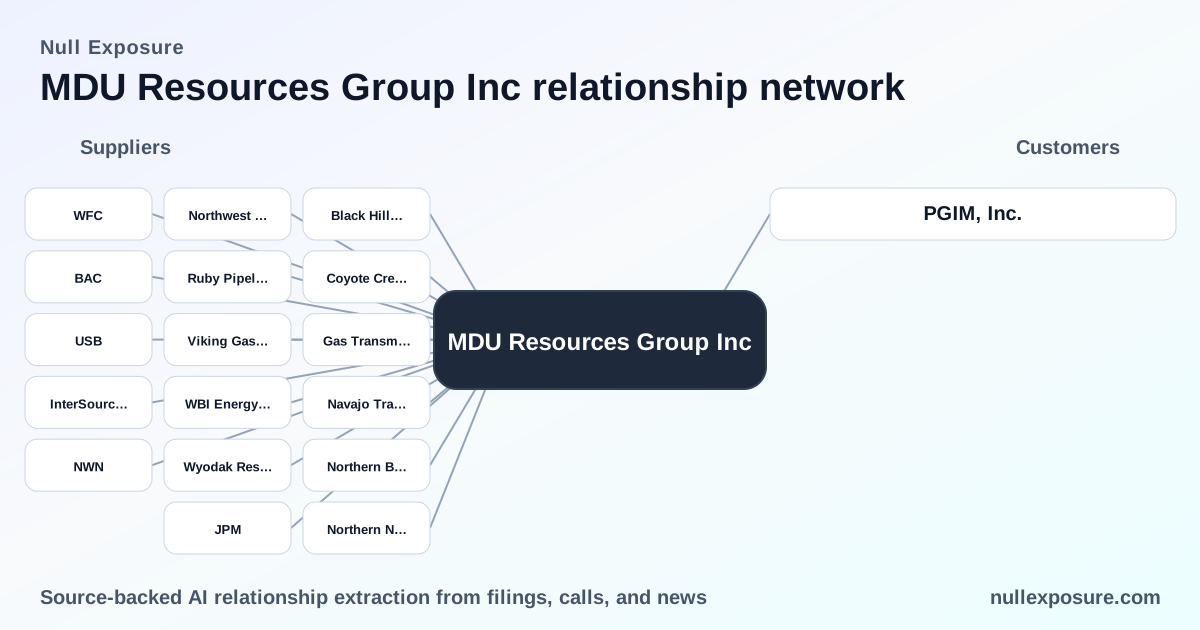
MDU Resources: customer relationships drive regulated cash flow and project-backed financing
MDU Resources Group is a diversified utilities and infrastructure operator that monetizes through regulated electricity and gas distribution, pipeline services, and construction materials and services. The business combines stable, rate-regulated retail margins with project-level financing and commercial off-take contracts; MDU reports roughly $1.88 billion in trailing revenue and a $4.61 billion market capitalization, with EBITDA near $498 million, underscoring a capital-intensive utility profile that funds growth through both operating cash flow and occasional balance-sheet financing.
For a concise view of MDU’s commercial counterparties and credit dynamics, see https://nullexposure.com/ — the platform that aggregates these relationship signals for market participants.
How MDU’s customer relationships shape the economics
MDU operates as a seller of energy and related services across regulated and contracted markets. Revenue recognition is performance-obligation driven, and the company discloses meaningful remaining performance obligations ($606.5 million at year-end), giving visibility into medium-term revenue. The mix of retail residential customers, municipal and industrial off-takers, and large commercial counterparties produces a hybrid cash flow profile: stable base load from residential and municipal accounts plus episodic, project-scale receipts tied to pipelines and wholesale arrangements.
Key operating model characteristics:
- Contracting posture: Predominantly seller-facing under rate-regulated tariffs and long-term transportation/storage agreements, with periodic project-level financing supported by note and shelf facilities.
- Concentration: Geographic concentration is material — a majority of electric retail revenues are in North Dakota (65% in 2024), with Montana, Wyoming and South Dakota together accounting for the remainder — creating regulatory and load-concentration exposure.
- Counterparty mix and criticality: The customer base ranges from individuals (residential retail) to municipal and very large enterprise off-takers; MDU’s generation portfolio can be materially impacted by a single large customer (MDU disclosed a hypothetical 180 MW data-center load equal to about 28% of generation capacity).
- Maturity and commitments: The company carries notable longer-dated performance obligations (roughly $443 million beyond 25 months), reflecting multi-year contracts and infrastructure commitments.
- Spend scale: External operating revenue line items and disclosed program totals imply project and contract spend at the $100m+ band for large transactions.
These signals combine to produce predictable regulated earnings with episodic financing and counterparty risk tied to major off-takes and regional regulation.
One named counterparty in market coverage: PGIM, Inc.
- WBI Energy Transmission extended a private shelf note agreement with PGIM, Inc., preserving the right to issue up to $350 million of senior unsecured shelf notes through December 22, 2028; this is a project-level financing option available to an indirect MDU subsidiary. A Globe and Mail press release reported the amendment on March 10, 2026 (source: press release coverage on The Globe and Mail).
Source: Globe and Mail press release summarizing the amendment involving WBI Energy Transmission and PGIM (March 10, 2026): https://www.theglobeandmail.com/investing/markets/stocks/MDU/pressreleases/37099696/mdu-resources-extends-wbi-energy-senior-notes-shelf-facility/
This press release documents a direct financing relationship between an MDU subsidiary and a large institutional purchaser, illustrating how MDU leverages capital markets for project funding without necessarily increasing equity issuance.
What the relationship map implies for credit and operational risk
The PGIM shelf extension is emblematic of MDU’s balanced funding approach: use long-dated private note capacity to finance pipeline and transmission infrastructure while leaving regulated rate base intact. For investors evaluating counterparty risk and revenue durability, three takeaways matter:
- Funding optionality reduces near-term liquidity strain. The private-shelf capacity for up to $350 million at WBI Energy provides capital to execute infrastructure projects or refinance nearer-term maturities without immediate public issuance.
- Concentration of load and jurisdictional exposure increases regulatory sensitivity. With roughly two-thirds of electric retail revenue in North Dakota and substantial residential retail scale, regulatory decisions in core states will directly influence cash flow and allowed returns.
- Counterparty heterogeneity creates mixed credit exposure. A high proportion of residential customers supports stability, but very large enterprise off-takes—such as the hypothetical 180 MW data center requirement—can shift generation utilization and power-marketing economics materially.
Institutional ownership is high (about 97.9%), underscoring that the stock’s investor base prioritizes income and regulated cash flows rather than speculative growth.
Practical investor checklist: monitoring signals and catalysts
Investors assessing MDU should track the following signals for changes in counterparty and financing dynamics:
- New or executed shelf and note issuances at WBI Energy or other subsidiaries, which indicate active project funding and potential leverage moves.
- Recognition pattern of remaining performance obligations, especially the schedule of $82.1M (next 12 months), $81.5M (13–24 months) and $442.9M (25+ months) disclosed at year-end, as that will reveal near-term revenue convertibility.
- Large commercial off-taker developments, including data center or industrial loads that would materially alter generation utilization across the company’s primary states.
- Regulatory rate cases and state-level decisions in North Dakota and Montana, given the high revenue concentration.
- Credit pricing on private-shelf notes and comparable market spreads for regulated-utility issuers, which will reflect the market’s assessment of operational and regulatory risk.
For additional context and a consolidated view of these relationship signals, visit https://nullexposure.com/.
Bottom line
MDU combines regulated utility stability with capital-market-backed project financing; the PGIM shelf extension is a tactical financing tool that preserves execution optionality for WBI Energy Transmission, while the company’s geographic concentration and mix of residential, municipal and very large enterprise customers define both its strength and primary risk vectors. Investors should treat MDU as a cash-flow-oriented utility with project-financing activity that can alter short- to medium-term leverage and credit exposure, and monitor financing moves, regulatory outcomes, and any material changes in large off-take contracts as the primary drivers of valuation change.