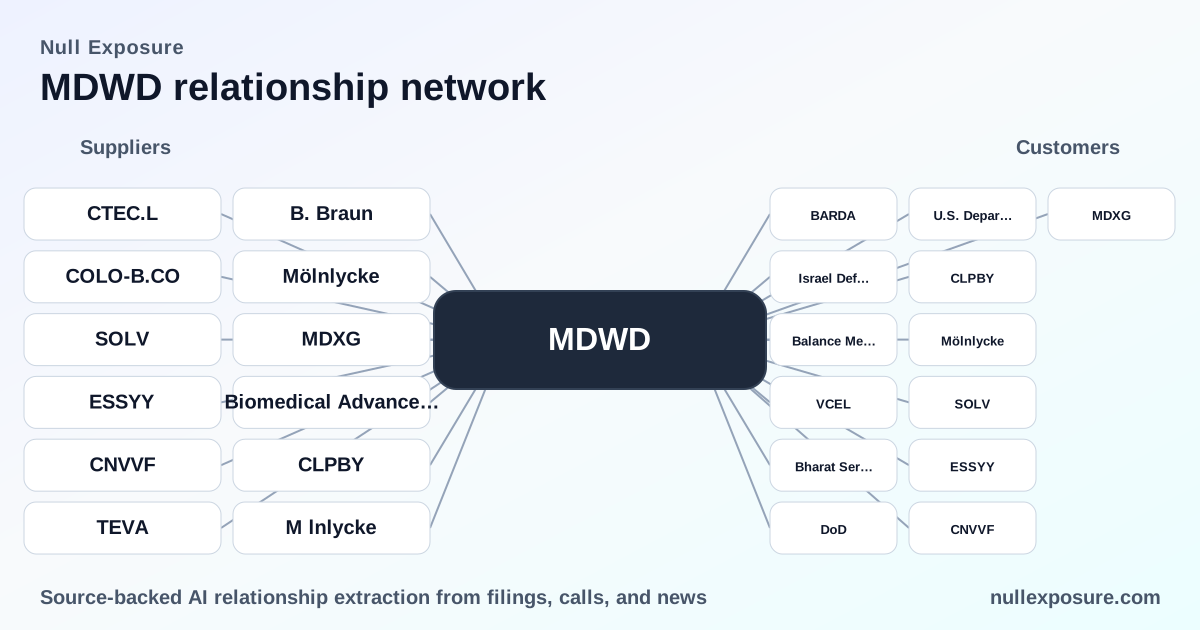
MediWound (MDWD) — Customer Map and Commercial Levers for Investors
MediWound operates as a hybrid biopharma-commercial company: it develops and manufactures enzymatic therapeutics (NexoBrid) and licenses distribution rights, while monetizing through product sales, manufacturing supply agreements, development services and government contracts. For investors, the core revenue drivers are North American commercialization via an exclusive distribution partner, recurring manufacturing supply to that partner, and program-level validation through clinical collaborations and government procurement pathways. Explore more on the commercial relationships powering this model at https://nullexposure.com/.
Executive takeaways: what investors should watch
- Concentration and criticality: U.S. commercialization depends heavily on one exclusive distributor for North America; manufacturing is consolidated with MediWound as supplier.
- Government optionality: BARDA/DoD engagement and military real‑world data create a high‑value procurement pathway that can materially change revenue cadence.
- Commercial validation: Growing U.S. adoption and global distribution agreements (Australia, India) reduce single‑market risk and underpin scaling.
- Disclosure gap on contract terms: Public sources document relationships but do not disclose detailed contractual constraints or pricing formulas.
How the partner network fits the business model
MediWound’s operating posture is manufacture-and-license: the company retains production control for NexoBrid while outsourcing commercialization in key markets to exclusive partners. This creates revenue concentration around distribution partners and operational concentration around in‑house manufacturing. The company’s public statements and partner filings show active government engagement for stockpiling and development contracts, which elevates both revenue upside and dependency on government budget timing.
Relationship roster — concise, source‑backed summaries
-
Vericel Corporation (VCEL) — Exclusive North American distributor; commercial growth driver. According to a Globenewswire release on April 2, 2026, Vericel—MediWound’s exclusive North American distributor—was awarded a ten‑year BARDA contract for NexoBrid valued at up to $197 million, underscoring Vericel’s central role in U.S. adoption and government procurement. (GlobeNewswire, Apr 2, 2026)
-
Vericel / VCEL (supply and manufacturing dependency) — MediWound supplies NexoBrid to Vericel under an exclusive license and unit‑price supply agreement. Vericel’s FY2024 10‑K confirms MediWound manufactures and supplies NexoBrid to the U.S. market on a unit price basis and flags cGMP compliance and supply continuity as commercial risks. (Vericel 10‑K, FY2024)
-
BARDA (U.S. Biomedical Advanced Research and Development Authority) — Strategic procurement and development partner with stockpiling potential. MediWound disclosed collaboration with BARDA on an RFP for stockpiling and development of a room‑temperature stable formulation in its Q3 2025 earnings call, reflecting an explicit government procurement pathway. (MediWound Q3 2025 earnings call)
-
U.S. Department of Defense / DoD — Development services revenue and government program engagement. MediWound reported higher development services revenue in FY2025 driven by additional contracts with the DoD, signaling continued defense‑related funding into development programs. (Company update reported via QuiverQuant, FY2025)
-
Israel Defense Forces (IDF) — Clinical validation in military trauma settings. MediWound cited real‑world data published from the IDF showing NexoBrid was clinically applicable in 71% of nearly 5,000 documented combat casualties, providing high‑impact evidence for trauma and battlefield use cases. (MediWound Q4 2025 earnings call)
-
Balance Medical (Australia) — Exclusive Australian commercial partner preparing launch. According to a Yahoo Finance item, Balance Medical—MediWound’s exclusive partner in Australia—expected to initiate commercial launch in Q4 2025, extending geographic reach into the Australasia market. (Yahoo Finance, Mar 2026)
-
Bharat Serums and Vaccines (BSV) — India market entry via exclusive distribution agreement. An Economic Times health report notes BSV inked an exclusive distribution agreement with MediWound to introduce NexoBrid in India, establishing a foothold in a large, under‑penetrated market. (Economic Times / Health, FY2024)
-
Coloplast (CLPBY) — EscharEx program collaborator, industry validation. MediWound lists Coloplast among strategic wound‑care collaborators that support the EscharEx program, signaling commercial and clinical validation from established wound care companies. (MediWound corporate update, Jan 12, 2026)
-
Convatec (CNVVF) — Commercial partner on EscharEx validation and distribution pathways. Convatec appears in MediWound’s list of industry collaborators supporting EscharEx, reinforcing distribution and commercial positioning for the program. (MediWound corporate update, Jan 12, 2026)
-
Essity (ESSYY) — Wound‑care partner supporting EscharEx development and market access validation. Essity is cited as a collaborator on the EscharEx program, providing additional commercial validation in global wound care channels. (MediWound corporate update, Jan 12, 2026)
-
Mölnlycke — Industry collaborator on EscharEx program validation. MediWound includes Mölnlycke among wound care partners backing EscharEx, strengthening industry endorsement. (MediWound corporate update, Jan 12, 2026)
-
Solventum (SOLV) — Partner listed among EscharEx collaborators. Solventum is named alongside larger wound care firms in MediWound’s corporate update, contributing to program validation. (MediWound corporate update, Jan 12, 2026)
-
MiMedx (MDXG) — EscharEx collaborator and commercial validation partner. MiMedx appears in the same list of program collaborators, widening the set of established wound‑care players engaged with MediWound’s EscharEx program. (MediWound corporate update, Jan 12, 2026)
Contracting posture, concentration and maturity — company‑level signals
The source set contains no explicit contractual constraints or term excerpts that disclose pricing formulas, minimum purchase commitments, or termination rights for these relationships. Treat this absence as a company‑level signal of limited public contract detail: investors should assume that commercial concentration (notably the Vericel exclusive U.S. arrangement) and in‑house manufacturing are material operational dependencies until more granular contract disclosures are filed.
Risk and upside synthesis for investors
- Upside: The BARDA pathway (through Vericel) and DoD work provide a discrete, high‑value revenue stream that can meaningfully de‑risk the top line if procurement proceeds to award and delivery. Positive real‑world IDF data materially strengthens the clinical argument for trauma and emergency uses of NexoBrid.
- Risk: Single‑partner concentration in the U.S. and manufacturing reliance create a dual dependency: commercial throughput is contingent on Vericel’s execution and MediWound’s uninterrupted manufacturing compliance. Government budget timing and geopolitical risk are immediate timing risks to revenue recognition.
Bottom line and next steps
MediWound’s commercial acceleration is driven by an exclusive distributor model in the U.S., strategic government engagements, and expanding international distributors, supported by industry collaborators validating the EscharEx program. For active due diligence, prioritize obtaining the Vericel supply agreement disclosure and BARDA award terms to quantify revenue run‑rate implications. Learn more about partner concentration and supplier risk frameworks at https://nullexposure.com/.
If you want a concise partner‑risk scorecard (concentration, criticality, disclosure gaps) for MDWD based on these relationships, I can prepare a one‑page investor brief.