MiMedx (MDXG): Distribution expansion and customer signals that matter to investors
MiMedx develops and sells placenta‑based allograft products used across hospitals, wound care centers and physician offices, monetizing through direct sales and distributor channels for 510(k)‑cleared surgical and wound applications. Revenue is driven by branded allografts sold domestically with a growing international emphasis, and recent commercial actions — notably an exclusive distributor pact — are clear inflection points for market access and channel economics. For a concise dataset-driven view of counterparties and customer cues, visit https://nullexposure.com/.
A clean, investor‑oriented thesis
MiMedx converts biologic intellectual property and regulatory clearance into recurring product revenue by selling branded placental allografts to clinical providers and through third‑party distributors. The business model combines product depth (core placenta‑based grafts) with a mixed go‑to‑market strategy: direct sales to high‑volume providers and selective exclusive distributor relationships that accelerate reach without proportionally expanding sales overhead. Current market signals — distribution agreements and clinician endorsements — strengthen commercial traction while underscoring concentration and reimbursement sensitivity that investors should monitor.
Summit Products Group: an exclusive distribution deal that widens reach
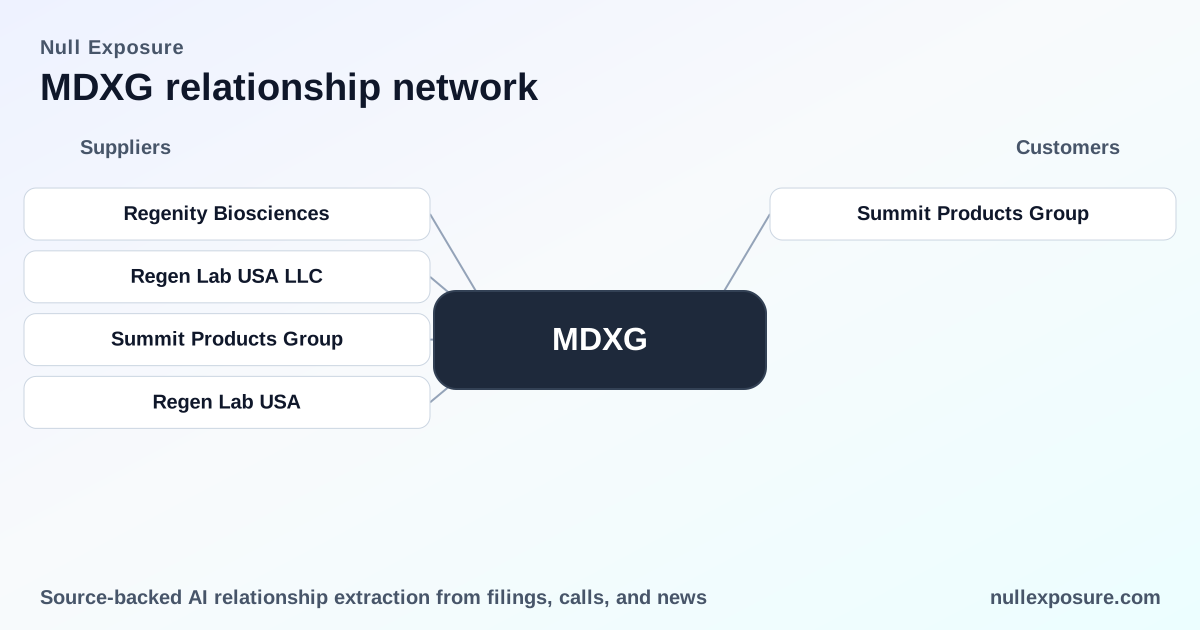
MiMedx executed an exclusive distribution agreement with Summit Products Group covering three 510(k)‑cleared products, a deal that produced an immediate market reaction with MDXG shares rising roughly 5% on the announcement day. According to multiple March 10, 2026 news reports, the agreement positions Summit as MiMedx’s channel partner for these surgical and wound products (Asianet News, StockTwits, Finviz, MarketScreener — March 10, 2026; see https://newsable.asianetnews.com/markets/mdxg-stock-rises-as-mimedx-enters-into-exclusive-distribution-agreement-for-three-products-articleshow-8ux8zmp and https://stocktwits.com/news-articles/markets/equity/mdxg-stock-rises-mimedx-distribution-agreement-with-summit-products/cZbj5idR4NG).
Takeaway: The Summit deal is a targeted commercial lever to expand downstream access without heavy direct sales reinvestment, and the market interpreted the announcement as value‑accretive.
Carroll County Memorial Hospital: clinician adoption on display
A clinician testimonial from Carroll County Memorial Hospital highlights on‑the‑ground product use for complex lower‑extremity wound care, indicating continued clinical adoption among hospital users. A March 2026 company‑related communication quoted Dr. Andrew Horine describing use of multiple MiMedx products in the hospital setting (SAHM Capital / company announcement — reported May 3, 2026; https://www.sahmcapital.com/news/content/mimedx-announces-launch-of-choriofix-2026-03-23).
Takeaway: Hospital clinician citations reinforce the core revenue engine — direct product utilization in acute and wound care settings — an important validation signal for continuity of demand from care providers.
What the documented relationships tell investors about MiMedx’s operating model
The relationship evidence and company disclosures collectively sketch a practical commercial posture:
- Distributor partnerships are strategic and selective. The Summit agreement confirms MiMedx uses exclusive distribution to scale specific product lines, reducing sell‑through friction while preserving brand control.
- Domestic concentration with international upside. Filings and disclosures emphasize that domestic sales account for the majority of revenue, with targeted expansion—particularly Japan—listed as a deliberate growth objective.
- Customer mix is clinically critical but concentrated. Revenue is derived from hospitals, wound centers, and physician offices; these are mission‑critical end users where product performance and reimbursement are high‑impact variables.
- Active commercial relationships. Documented interactions indicate live (active) selling and adoption across both distribution partners and hospital end users, consistent with a company in commercialization rather than early R&D stage.
These are company‑level signals drawn from MiMedx filings and the described press coverage; the constraints that produced them emphasize counterparty types (including federal or government channels), geography (NA dominant, APAC pursuit), distributor role, and the active status of customer relationships.
Investment implications and risk framing
Investors should weigh four practical implications from the customer map and constraints:
- Revenue leverage from targeted distributor deals: Exclusive arrangements can produce lumpy upside if distributor networks deliver scale quickly; the Summit agreement is a tangible execution milestone.
- Concentration risk in end markets and geographies: Heavy domestic exposure and dependence on hospitals/wound centers create sensitivity to reimbursement shifts and procurement cycles; international expansion is a growth vector but remains secondary.
- Clinical adoption supports retention but requires ongoing validation: Hospital endorsements (e.g., Carroll County Memorial Hospital) indicate product utility, which supports durable demand, yet continued clinical outcomes and payer coverage will govern uptake speed.
- Channel mix affects margins and cash conversion: Distributor economics improve reach but compress per‑unit gross margin relative to direct sales; the balance between direct and distributor revenue will deterministically affect future gross margin trends.
What to watch next: execution on Summit rollout metrics (units, territory activation), any additional exclusive distribution announcements, updates on Japan/international commercialization plans, and payer/coverage news that could influence utilization.
Constraints and operational signals you should model
Company filings and the evidence set surface several constraints that influence valuation and scenario modeling:
- Counterparty mix includes government/federal channels — count on some sales into federal or institutional sites of service.
- Geographic concentration in North America with focused APAC efforts — domestic revenue dominance is explicit; Japan is the primary international target noted.
- Distributor relationships are an integral part of the go‑to‑market — MiMedx explicitly sells through wholesale distributors who resell to providers.
- Customer relationships are active and product‑centric — the core product suite (placenta‑based allografts) remains the commercial anchor.
Treat these as company‑level signals; they inform sensitivity analyses for growth, margin, and concentration risk.
Final read and next steps
MiMedx is executing a pragmatic commercial playbook: deep, branded biologic products sold through a mix of direct and selective exclusive distributor channels. The Summit Products Group agreement and hospital clinician endorsements illustrate two complementary paths to scale — channel expansion and clinical validation. Investors should model upside from distributor penetration against downside from reimbursement concentration and domestic customer mix.
For a quick overview of related counterparty data and relationship signals, visit https://nullexposure.com/.
Appendix — primary sources referenced:
- Asianet News / Newsable: MiMedx exclusive distribution with Summit Products Group (March 10, 2026) — https://newsable.asianetnews.com/markets/mdxg-stock-rises-as-mimedx-enters-into-exclusive-distribution-agreement-for-three-products-articleshow-8ux8zmp
- StockTwits news coverage of the Summit deal (March 10, 2026) — https://stocktwits.com/news-articles/markets/equity/mdxg-stock-rises-mimedx-distribution-agreement-with-summit-products/cZbj5idR4NG
- Finviz news note: MIMEDX enters exclusive distribution agreement with Summit (March 10, 2026) — https://finviz.com/news/296109/craig-hallum-adjusts-mimedx-group-inc-mdxg-outlook-on-cms-coverage-guidance
- MarketScreener earnings flash referencing the Summit agreement (March 10, 2026) — https://www.marketscreener.com/news/earnings-flash-mdxg-mimedx-group-inc-posts-q4-adjusted-eps-0-14-per-share-vs-factset-est-of--ce7e5cd8db81f42d
- SAHM Capital / company release quoting clinician at Carroll County Memorial Hospital (reported May 3, 2026) — https://www.sahmcapital.com/news/content/mimedx-announces-launch-of-choriofix-2026-03-23