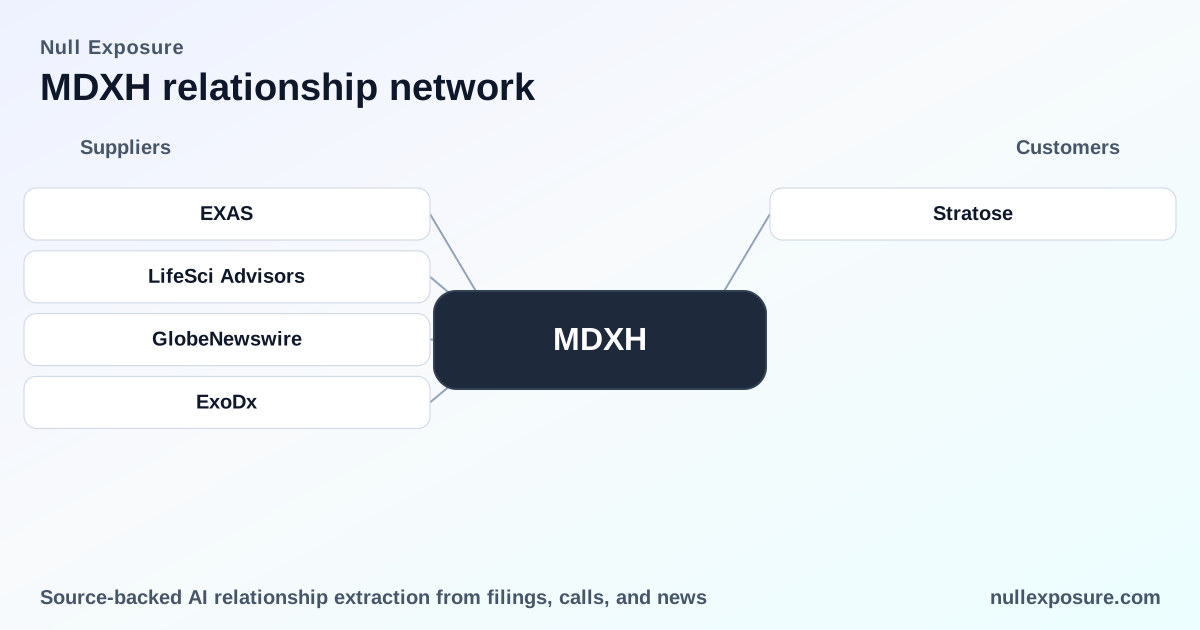
MDxHealth (MDXH) — Customer Relationships and Commercial Footprint
MDxHealth monetizes precision oncology diagnostics by selling and licensing molecular tests—most notably ConfirmMDx for Prostate Cancer—to clinician networks, laboratories and payer-aligned platforms, generating revenue from per-test fees and distribution agreements. The company’s financials show a scaleable, margin-accretive product at gross-profit level but continued operating losses as the business invests in commercialization and portfolio expansion; investors should evaluate customer-level distribution deals for indications of durable volume growth and revenue concentration. For a consolidated view of partner exposures and to compare relationship-level signals across diagnostics plays, visit https://nullexposure.com/.
What MDxHealth sells and how it makes money
MDxHealth positions itself as a commercial-stage diagnostics company focused on prostate and bladder cancers, driving revenue through diagnostic test sales, laboratory services and channel agreements. According to the company profile and Q1 2026 reporting, trailing twelve‑month revenue is approximately $107.9M with gross profit of $69.6M, but operating and net margins remain negative (operating margin -17.8%, profit margin -31.1%), reflecting active investment in go‑to‑market and R&D. These financials imply a business where per-test economics are healthy at the gross level but scale-dependent at the corporate P&L.
How to read MDxHealth’s customer relationships — commercial posture and maturity
MDxHealth’s contracting posture trends toward distribution and network-access agreements rather than captive manufacturing partnerships, consistent with diagnostic companies that prioritize rapid adoption through third-party networks and payor channels. The company’s product maturity—ConfirmMDx is an established offering with clinical traction—means customer deals are primarily about reach and utilization rather than product development. Key company-level signals in the available reporting include:
- Concentration and criticality: The business model is inherently sensitive to large channel agreements because test volumes scale via partner networks rather than thousands of direct physician sales. MDxHealth has not publicly provided partner revenue splits in the reviewed feed, so customer concentration risk should be treated as a material diligence item.
- Contracting posture: Network agreements (see below) indicate commercial distribution terms that prioritize membership access and physician adoption; these are typically lower-capex, higher-margin arrangements for MDxHealth.
- Maturity: ConfirmMDx has market recognition, but corporate profitability is still elusive; commercial scale is the bridge to sustained earnings.
Customer relationships on the record
The following section documents every customer relationship returned in the data feed. Each listing includes a plain-English summary and the original source reference.
Stratose — widening access to ConfirmMDx through a large membership network
MDxHealth signed an agreement to provide Stratose’s 12.4 million member network access to ConfirmMDx for Prostate Cancer testing, a distribution arrangement that expands MDxHealth’s potential referral base and channel reach. This deal was reported by RTTNews on March 10, 2026 (article: https://www.rttnews.com/amp/2181924/mdxhealth-signs-deal-with-stratose-for-prostate-cancer-testing.aspx); the structured feed notes a fiscal tag of FY2013 in its metadata but the press coverage is dated March 2026.
What the Stratose relationship implies for volume and revenue
A network access agreement of this kind is primarily a volume-expansion instrument: it increases the addressable population and streamlines physician awareness and patient referral pathways for ConfirmMDx. For MDxHealth, the value of the Stratose partnership is a function of conversion rates from the 12.4M membership base to actual test orders, reimbursement alignment and any revenue‑share or per-test pricing terms (which have not been disclosed in the available item). Network deals scale utilization faster than direct sales channels, but they also concentrate revenue exposure on a smaller number of large partners.
Operational signals and the absence of explicit constraints
The data feed returned no explicit constraints or contract-level caveats; that absence functions as a company-level signal. In practical diligence terms this means:
- Limited publicly disclosed contractual constraints in the available feed—investors should not assume detailed revenue protections, exclusivity terms or minimums exist unless confirmed in filings.
- Standard diagnostics commercial risk profile: adoption, reimbursement and channel conversion are the primary operational levers; there is no evidence in the feed of complex co-development or capital-intensive JV structures.
Investment implications and a short risk checklist
MDxHealth’s partner footprint and financial profile yield a compact set of investment considerations:
- Growth driver: Channel and network partnerships—like the Stratose deal—are the fastest route to scale utilization of ConfirmMDx and lift per-test revenue.
- Margin dynamics: Strong gross margins indicate attractive per-test economics, but corporate profitability depends on managing SG&A and scaling volume.
- Concentration risk: Large network partners can drive rapid volume but increase single‑counterparty exposure; absence of disclosed contract economics requires further diligence.
- Operational maturity: ConfirmMDx is a commercial product with clinical recognition; the company’s next phase is converting that clinical adoption into stable, reproducible volume.
Key next steps for operators and investors: obtain partner revenue contributions, pricing and term sheets for major network agreements, and track quarterly test volumes tied to named partners to quantify conversion effectiveness. For consolidated partner intelligence and comparative relationship analytics across the diagnostics sector, see https://nullexposure.com/.
Bottom line
MDxHealth is a commercial-stage diagnostics company with an established product and a distribution-first go-to-market that leverages partner networks to scale test utilization. The Stratose agreement is a visible example of that strategy—offering access to a large membership base that can accelerate volume if conversion and reimbursement align. Investors should prioritize diligence on partner economics, revenue concentration and quarterly test volume trends to assess whether the company’s gross-profit advantage translates into sustainable net earnings.