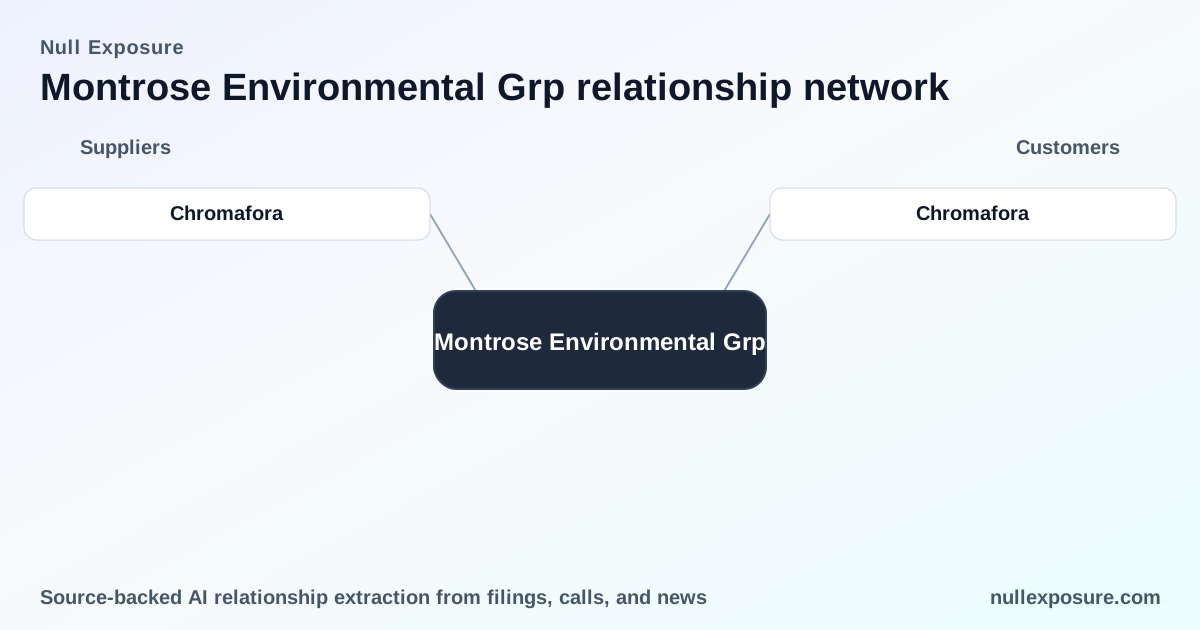
Montrose Environmental Group (MEG): Customer Map and Commercial Risk Profile
Montrose Environmental Group operates as an integrated environmental services provider, monetizing through recurring service contracts—primarily long-term fixed-fee operations & maintenance (O&M), master services agreements and project-based engagements—for industrial, governmental and utility clients. The business generates revenue by delivering assessment, permitting & response, measurement & analysis, and remediation & reuse services across a global footprint, with a revenue mix that combines private-sector scale clients and a meaningful public-sector component. For investors, the question is not whether Montrose can sell services, but how contract structure, client concentration, and geographic reach translate into revenue stability and margin durability.
Explore the full company intelligence offering at NullExposure.
How Montrose monetizes and how that shapes risk
Montrose’s commercial model is built on recurring services rather than one-off product sales. Company filings for the fiscal year ended December 31, 2024 describe a mix of purchase-order work and long-term master services agreements lasting multiple years, and they explicitly note that the majority of O&M services are provided under long-term fixed-fee contracts. That contract posture produces predictable revenue streams and backlog visibility, but also fixes pricing exposure over extended periods—a structural margin lever that investors should monitor against inflation and labor-cost trends.
- Contracting posture: Predominantly long-term, fixed-fee engagements that favor cash-flow stability but can compress margins if input costs rise.
- Counterparty mix: A diversified client base that includes Fortune 500 companies and government buyers; government accounted for about 16.3% of revenue in FY2024, indicating a material public-sector exposure that brings procurement complexity but also contractual resilience.
- Geographic footprint and scale: Operations across North America, EMEA and APAC, with roughly 120 offices and ~3,410 employees (FY2024), delivering both diversification and cross-border execution risk.
- Business role: Montrose functions as a service provider across the lifecycle of environmental needs—launch, operations, remediation and emergency response—making its services operationally critical to client projects and often embedded in regulatory compliance workflows.
- Relationship maturity: Company disclosures emphasize long-standing, decades-old relationships in many cases, signalling highly mature client ties that generate repeatable revenue.
These company-level signals imply a classic services operator profile: stable, recurring cash flows balanced against execution risk and exposure to macro cost trends. Investors should weigh the protective effects of long-term contracts and government customers against operational concentration and international execution risk.
Relationship inventory: every customer link in the public record
Below are the customer/partner relationships surfaced in available public sources. Each relationship is described in plain English with the source cited.
Chromafora — strategic buy / transaction counterpart in Europe
Montrose sold a water treatment subsidiary in Denmark to Chromafora, a Stockholm-based water cleantech firm, indicating active portfolio rationalization and third-party exits in EMEA operations. According to Arkansas Business coverage in March 2026, the sale reflects Montrose executing on asset-level transactions in Europe to refine its services mix and geographic exposure. (Arkansas Business, March 2026)
CLNE (Clean Energy Fuels) — project-level engineering and environmental support
Montrose supported engineering and environmental work on a large dairy RNG project that ties into Clean Energy Fuels’ national network of RNG distribution; this demonstrates Montrose’s role as a technical services provider on renewable natural gas infrastructure projects. Dairy Herd News reported in May 2026 that Montrose (alongside T Diamond Bar) provided the environmental and engineering support for the pipeline/fueling project. (Dairy Herd News, May 2026)
What these relationships tell investors about commercial positioning
The two items above are limited in number but meaningful in type: one is a corporate divestiture transaction in Europe, the other is project-level support for an energy infrastructure customer. Taken together with company-level disclosures, the relationships underline several strategic characteristics:
- Active portfolio management: The Denmark water-treatment sale to Chromafora signals Montrose’s willingness to divest non-core or geographiespecific assets—useful for redeploying capital toward higher-margin or more strategic services.
- Project and O&M mix: The CLNE engagement illustrates Montrose’s ability to win engineering and environmental scopes on complex infrastructure projects, complementing its longer-term O&M contracts.
- Cross‑sector demand: Montrose operates across industrial, energy, and public-sector end markets, positioning the company to capture both cyclical project work and recurring service revenues.
Operational constraints and implications (company-level signals)
The evidence set provided by company disclosures points to a service business with the following practical constraints that affect revenue predictability, margin variability and capital allocation:
- Long-term, fixed-fee contracts dominate service delivery. This reduces revenue volatility but transfers inflation and wage risk to the provider if contracts are not appropriately re-priced.
- Public-sector exposure is material (c.16.3% of FY2024 revenue). Government clients reduce churn and can extend contract duration, but they increase bidding complexity and cash-conversion timing variability.
- Global operations introduce execution complexity. Presence in North America, EMEA and APAC diversifies demand but imposes regulatory, legal and labor differences that increase overhead and program management needs.
- Customer base includes very large enterprises. Serving Fortune 500 clients raises the bar on compliance, insurance and service-level commitments, which can elevate contract stickiness but also contractual risk.
- Relationship maturity and scale favor retention. Decades-old relationships and a broad client roster imply a high degree of retention and repeat work, supporting stable backlog replenishment.
Each of these constraints is a company-level signal derived from company filings for FY2024 and ongoing reporting; they shape the risk/reward profile for MEG equity and any potential acquirers.
Investment implications and what to watch next
For investors evaluating MEG customer relationships, prioritize monitoring three items:
- Contract re-pricing cadence and margin recovery. Long-term fixed contracts protect revenue but require periodic re-pricing to offset rising input costs.
- Deal pipeline across renewables and remediation projects. Project wins like RNG infrastructure support indicate growth opportunities; visibility into equivalent contracts and expected conversion timelines will drive forward revenue growth.
- Divestitures and capital redeployments. The Chromafora transaction is evidence Montrose will actively reshape its portfolio—assess whether proceeds are funding higher-return organic growth or debt reduction.
Montrose’s customer map supports a conservative-income style thesis with upside from project wins and portfolio optimization. The company’s contracting posture, meaningful government exposure, global reach, and embedded service role with large enterprises collectively provide a stable revenue foundation while creating execution and margin-management challenges.
If you want continuous monitoring of MEG customer interactions and relationship-level signals, visit NullExposure to review current coverage and alerts.