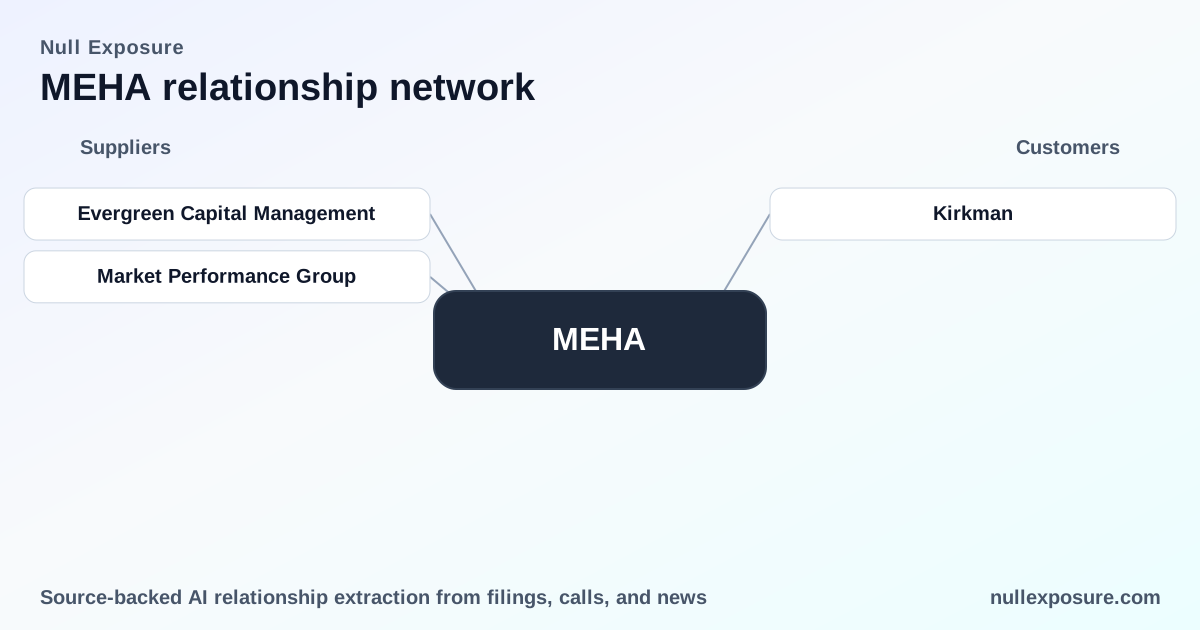
Functional Brands (MEHA): Customer Relationships Driving Direct-to-Consumer Scale and International Reach
Functional Brands monetizes through branded product sales across direct-to-consumer channels, e-commerce marketplaces, and partner distribution arrangements for specialty wellness products such as P2i™ by Kirkman® and Tru2u. The company is actively reallocating channel mix — moving Amazon from a reseller model to Seller Central and cutting distribution deals with global specialty retailers — to increase margin capture and international reach. For an at-a-glance tracker of these relationship signals, see NullExposure: https://nullexposure.com/.
How MEHA’s customer strategy funds growth
Functional Brands’ business model is straightforward: develop or acquire wellness and performance brands, then sell finished goods through a blended go-to-market of owned DTC, marketplace storefronts, practitioner channels, and strategic retail partners. Revenue comes from unit sales; margin expansion relies on shifting away from low-margin reseller arrangements toward direct fulfillment and branded partner deals. The company’s FY2025–FY2026 filings and press releases show that management is executing on this pivot while pursuing international distribution partners to extend lifetime value per consumer.
Company-level operating model signals investors should track
There are no formal constraint disclosures in the record provided; that absence itself is a signal. From publicly reported activity and balance-sheet snapshots we can draw firm operating characteristics:
- Contracting posture: The move to Seller Central on Amazon signals an active, control-oriented posture — the company is taking on more operational responsibility to capture higher margin per sale.
- Concentration and investor base: Insider ownership is ~4.0% and institutional ownership is low at ~2.8%, indicating a retail-heavy capitalization that can amplify short-term volatility around channel announcements.
- Criticality and maturity: Partnerships with established distributors such as iHerb and product placements via practitioner networks and co-branded flows with Kirkman show a mixed maturity profile: established specialty channels plus nascent scale on Amazon and DTC.
- Financial posture: Market capitalization and trailing metrics show a small-cap company with tight equity value and operating losses at the EBITDA line (EBITDA reported at negative $1.33M), meaning execution on channel shifts must translate to revenue lift and margin gains to materially change the valuation.
These are company-level signals; specific contractual terms, revenue concentration percentages, or multi-year commitments for each partner are not disclosed in the record.
Customer relationships: concise profiles investors need to know
iHerb — global specialty retail distribution
Functional Brands announced a strategic partnership with iHerb to make P2i™ by Kirkman available internationally across Asia, Europe, the Middle East, and Latin America, expanding the brand’s addressable market beyond the U.S. According to a Newsfile press release (May 3, 2026) and covered by Yahoo Finance, iHerb is positioned as a global distribution partner for P2i™ by Kirkman. (Newsfile, May 2026; Yahoo Finance, May 2026)
Amazon — deliberate channel shift to direct-to-consumer
Management shifted its Amazon business model from a reseller model to direct DTC via its own Amazon Seller Central account, a change that was called out in the company’s Q4 and full-year 2025 financial results and that the company identified as a driver of near-term revenue mix movement. The FY2025 results and related filings explain that the transition caused a decrease in reported revenue as the channel mix changed. (Company press release summarizing FY2025 results, May 3, 2026; additional coverage on Bitget and TradingView, May 3, 2026)
Kirkman — co-branded practitioner and website distribution
Kirkman-branded products produced or distributed by Functional Brands — including the P2i™ prenatal line and bundles such as skin/beauty and restorative sleep — are available through Kirkman’s website and practitioner networks, indicating a practitioner-anchored specialty channel that supports premium pricing and professional endorsement. The company announced multiple Kirkman product launches and practitioner availability in company releases and a Yahoo Finance story (FY2025–FY2026 coverage). (Yahoo Finance press release, 2026; Newsfile releases, March–May 2026)
SG (Sweetgreen) — branded collaboration in foodservice channels
Functional Brands’ “Function” wellness business collaborated with Sweetgreen on a nutrient-dense menu item, representing a cross-industry partnership that places the company’s formulations into mainstream foodservice and increases brand visibility beyond supplements and practitioner channels. This collaboration was reported in a March 2026 Yahoo Finance sector article discussing Sweetgreen’s menu strategy. (Yahoo Finance, March 2026)
What these relationships imply for revenue, margins and risk
These four customer relationships map neatly to three strategic priorities: 1) margin capture via DTC and Amazon Seller Central; 2) international growth via iHerb; 3) credibility and practitioner-led premium positioning via Kirkman; and 4) brand amplification via foodservice collaboration with Sweetgreen.
Key implications:
- Top-line growth lever: iHerb opens international demand pools that can scale unit sales rapidly if logistics and marketing investment follow. (Newsfile/Yahoo Finance, May 2026)
- Margin lever: Moving Amazon to Seller Central puts margin upside within management’s control but requires operational competence in fulfillment, advertising, and return management. (FY2025 results, May 2026)
- Channel diversification reduces single-point risk but increases operational complexity and working capital demands as international distribution and DTC scale concurrently.
Risks investors should monitor now
- Concentration risk in nascent channels while Amazon model transition is ongoing.
- Execution risk on international distribution logistics and compliance for iHerb markets.
- Cash-burn and margin pressure while investing in DTC infrastructure (EBITDA negative ~$1.33M as reported).
- Limited institutional ownership suggests lower analytical coverage and potential liquidity constraints.
Where to look next and actionable signals
- Watch quarterly disclosures for a clear revenue split by channel (Amazon reseller vs. Seller Central vs. iHerb vs. practitioner sales).
- Monitor gross margin trends and advertising spend on Amazon as leading indicators of stabilization following the Seller Central move.
- Track iHerb SKU rollouts and geo-availability updates as evidence that international distribution is live and scaling.
- Observe practitioner reorder patterns and co-branded product uptake for Kirkman to assess premium channel stickiness.
For ongoing relationship tracking and signal aggregation on MEHA, visit NullExposure: https://nullexposure.com/.
Bottom line
Functional Brands is executing a deliberate channel repositioning to lift margins and scale internationally. Investors should treat the Amazon model shift and the iHerb distribution agreement as the two most consequential operational developments for FY2026; each will determine whether reported unit growth converts into durable profitability.