Methode Electronics (MEI): customer footprint and what it means for investors
Methode Electronics designs and sells customized electronic components and subsystems to OEMs across automotive, industrial and data-center markets, monetizing through volume product sales under a mix of long‑term supply arrangements and shorter production releases. Revenue is driven by engineered, contract‑backed supply to large vehicle manufacturers and industrial customers, plus niche interface and data‑center products; recently the company disposed of its dataMate copper transceiver business to sharpen focus on power solutions and core automotive content. For a concise view of related market signals, visit https://nullexposure.com/.
How Methode runs its customer business (and the investor implications)
Methode operates as a global contract manufacturer and systems supplier with an explicit OEM orientation. Company disclosures indicate a hybrid contracting posture: long‑term expectations for many OEM programs, blanket purchase order / production release frameworks for parts, and practical‑expedient treatment of very short‑duration obligations. Geographically, sales are global with North America numerically dominant, and meaningful Asia and EMEA footprints: filings allocate notable revenue to the U.S., China and multiple European jurisdictions. Importantly, customer concentration is material — the five largest customers accounted for roughly 36% of consolidated net sales in the most recent filing — yet no single customer exceeded 10% in that period, implying both dependency and some diversification benefits.
Operational constraints implied by those disclosures:
- Contracting structure: a mix of long‑term program supply and framework/blanket orders supports predictable backlog but leaves runway exposed to program cancellations or timing shifts.
- Concentration and criticality: five customers drive over a third of revenues, making program wins and losses high‑impact for near‑term revenue volatility.
- Global manufacturing footprint: the company’s exposure to multi‑currency operations and regional production explains sensitivity to regional auto cycles and factory schedules.
- Maturity: the business combines legacy program roll‑offs and new EV program launches, a classic mid‑cycle industrial transition profile for suppliers.
If you want an analytical partner to track these customer dynamics in detail, see https://nullexposure.com/ for a structured view.
Customer relationships that matter (one‑to‑one summaries)
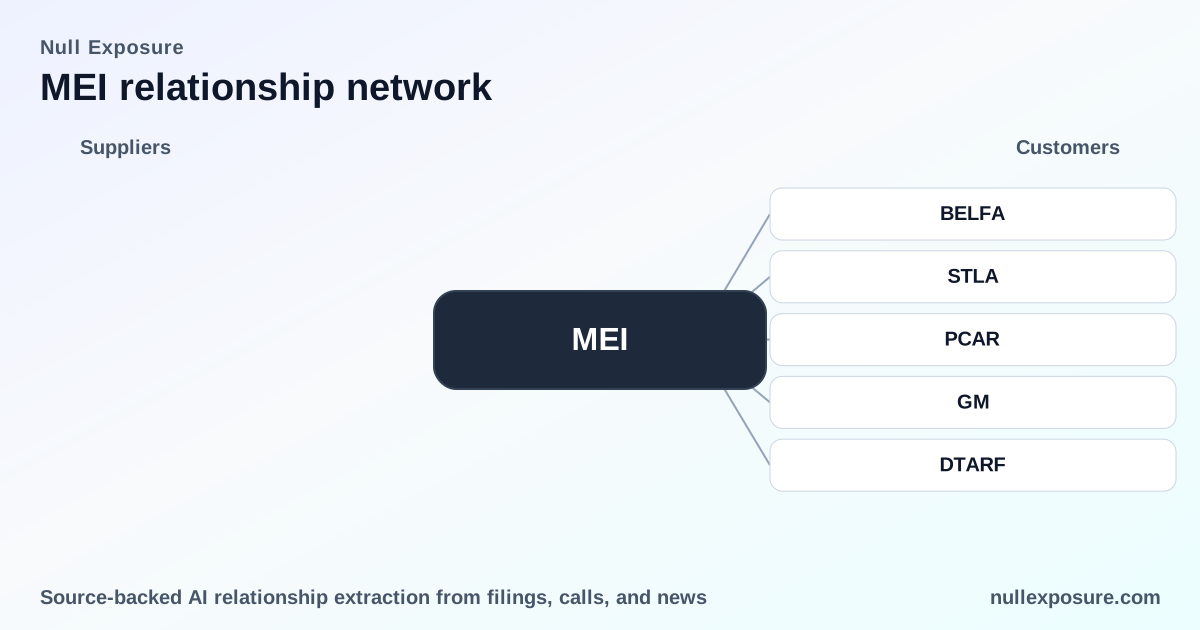
Bel Fuse Inc. (BELFA / BELFB)
Methode sold its dataMate copper transceiver business to Bel Fuse, transferring advanced ethernet and broadband product lines to Bel Fuse as part of a strategic narrowing of Methode’s portfolio; multiple press releases across March 2026 document the transaction. According to a GlobeNewswire press release on March 5, 2026, the divestiture was announced publicly as part of Methode’s repositioning toward power solutions (https://www.globenewswire.com/news-release/2026/03/05/3250696/0/en/Methode-Electronics-Announces-Sale-of-dataMate-Business.html). MarketScreener reported the purchase price at $16 million, providing an immediate, tangible valuation for the unit sold (https://www.marketscreener.com/news/earnings-flash-belfa-bel-fuse-inc-class-a-shares-posts-q4-adjusted-eps-1-88-per-share-ce7e5dd9dc81f227).
Stellantis (STLA)
Stellantis entered the company narrative as a high‑impact OEM where program cancellations and delays materially affected expected revenue; management specifically identified Stellantis as driving more than $100 million in lost annualized revenue from cancelled or delayed programs. That disclosure comes from Methode’s Q4 fiscal 2025 earnings‑call transcript and highlights direct program dependency in North America (mei-2025q4-earnings-call).
General Motors (GM)
General Motors shows up in discussion of legacy program roll‑offs and center‑console product declines; Methode’s earnings commentary noted that the full impact of the GM center‑console roll‑off was realized during the quarter, underscoring how product lifecycle transitions with a single OEM can swing segment revenue (mei-2025q4-earnings-call).
PACCAR (PCAR)
Methode referenced PACCAR as part of an anticipated recovery in volumes, with commentary pointing to the second half of calendar 2026 for volume normalization. That indicates PACCAR is a meaningful volume customer whose demand timing is relevant to Methode’s industrial and commercial vehicle business (insidermonkey earnings call excerpt, March 2026).
DTA (DTARF)
DTA (listed here as DTARF in sources) is cited alongside PACCAR as an indicator of demand normalization in the back half of calendar 2026; the reference signals Methode’s exposure to commercial vehicle supply chains and the importance of timing on discrete program ramps (insidermonkey earnings call excerpt, March 2026).
What these relationships mean for investors
- Portfolio refocus and monetization: the sale of dataMate to Bel Fuse is a clear strategic move to monetize a non‑core interface asset and redeploy capital into power and automotive engineering. The $16m headline figure provides a concrete cash inflow and signal about management’s allocation priorities (Marketscreener; GlobeNewswire).
- Revenue volatility is program‑driven: program cancellations and roll‑offs from large OEMs such as Stellantis and GM demonstrate that a relatively small number of OEM relationships can produce outsized swings in near‑term revenue and margins. Earnings sensitivity to OEM program timing is the principal operational risk.
- Contracting gives some predictability but not immunity: the company’s mix of long‑term expectations and blanket purchase frameworks supports a baseline backlog, but practical‑expedient disclosures about short‑duration obligations indicate pockets of revenue that are effectively transactional and can flip quickly with OEM schedules.
- Geographic diversification reduces single‑market risk but adds complexity: global production spreads exposure across regions and currencies, beneficial for total market access but a vector for supply‑chain and regional demand mismatches.
Key takeaways for operators and research teams
- Customer concentration is material — monitor program-level wins/losses to forecast revenue moves.
- Portfolio discipline is active — management is selling non‑core businesses (dataMate) and steering toward power solutions; track capital deployment and reinvestment.
- OEM timing matters — Stellantis and GM program dynamics are already visible in reported results; program cadence should be an input to any valuation or operating‑model stress test.
For a focused dataset and ongoing tracking of MEI customer signals and program disclosures, visit https://nullexposure.com/ for structured monitoring and alerts.