Mesoblast (MESO): Customer Relationships that Drive Early Commercial Value
Mesoblast develops and sells allogeneic cellular therapies and monetizes through a mix of product sales, royalties/milestones from partnered ex‑US programs, and commercial reimbursement for recently launched indications such as Ryoncil. The company’s near‑term revenue profile is defined by payer coverage for Ryoncil in the U.S. and ongoing royalty streams from partners marketing Mesoblast‑originated products overseas. For a concise view of customer signals and what they imply for revenue durability, see https://nullexposure.com/.
How Mesoblast’s commercial model translates into cash flow
Mesoblast’s operating model combines direct commercialization in core markets with licensing partnerships outside the U.S. This hybrid approach produces three distinct monetization channels:
- Direct sales and physician uptake for U.S. approvals, where payer reimbursement determines addressable volume and timing.
- Royalties and milestone receipts from partners that commercialize Mesoblast‑derived products in non‑U.S. territories.
- Continued R&D and potential additional indications, which preserve upside but keep near‑term margins under pressure.
That structure yields some clear business characteristics: contracting posture is partner‑heavy for ex‑US markets, concentrating royalty risk into a small number of marketed products; reimbursement criticality is high because U.S. payer coverage dictates revenue scale for Ryoncil; and commercial maturity is early, with limited historical revenue but accelerating coverage signals. If you want deeper coverage mapping, visit https://nullexposure.com/ for our investor‑grade summaries.
Relationship inventory — every customer signal captured
Below are the customer relationships reported in recent public coverage, each summarized succinctly with source attribution.
-
JCR Pharmaceuticals — Mesoblast receives royalties or milestone payments tied to Temcell, the company’s graft‑versus‑host disease (GvHD) product marketed in Japan by JCR. Source: Stockhead coverage of Mesoblast (May 3, 2026), noting royalties/milestones on Temcell (https://stockhead.com.au/health/dr-borehams-crucible-the-long-grind-finally-pays-off-for-mesoblast/).
-
Tigenix — Mesoblast collects royalties or milestone income related to Alofisel, the peri‑anal fistula therapy marketed in Europe by Tigenix. Source: Stockhead (May 3, 2026) reporting the company’s non‑U.S. royalty streams (https://stockhead.com.au/health/dr-borehams-crucible-the-long-grind-finally-pays-off-for-mesoblast/).
-
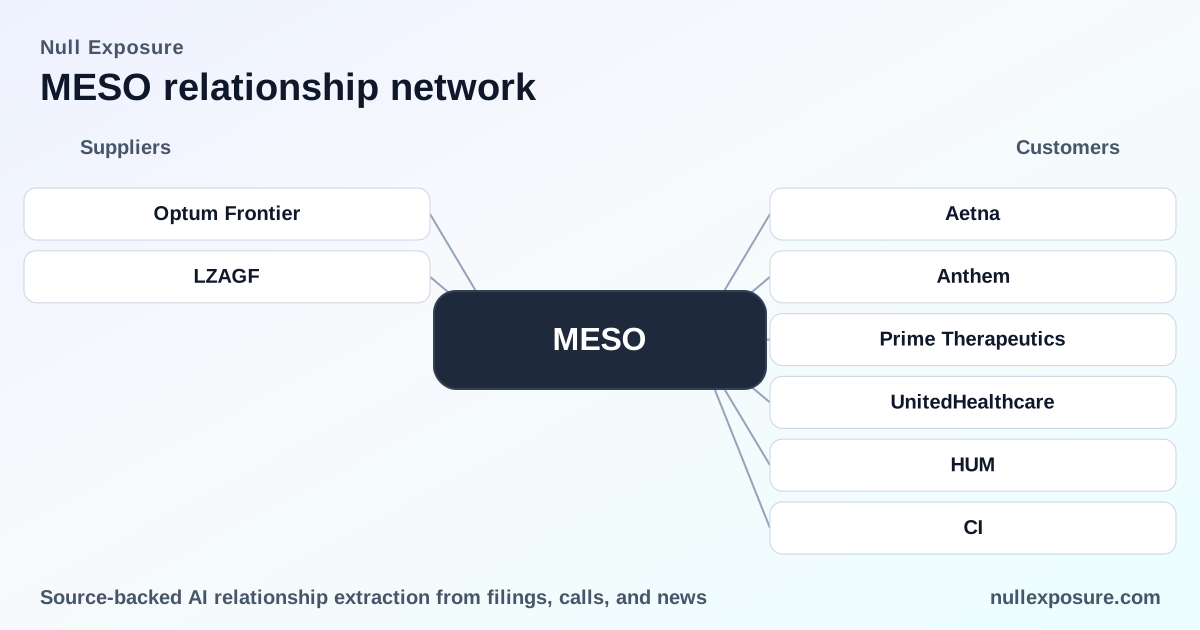
Aetna — Identified as a payer that has issued favorable coverage policy for Ryoncil, supporting commercial reimbursement and patient access. Source: Q2 FY2026 earnings call transcript coverage reported by InsiderMonkey (March 10, 2026) (https://www.insidermonkey.com/blog/mesoblast-limited-nasdaqmeso-q2-2026-earnings-call-transcript-1706199/).
-
Anthem — Named among the major commercial insurers that have provided favorable coverage for Ryoncil, reinforcing national reimbursement breadth. Source: InsiderMonkey Q2 FY2026 earnings call reporting (March 10, 2026) (https://www.insidermonkey.com/blog/mesoblast-limited-nasdaqmeso-q2-2026-earnings-call-transcript-1706199/).
-
UnitedHealthcare — Listed as a payer that has issued a favorable coverage policy for Ryoncil, a positive signal for utilization and billing. Source: InsiderMonkey Q2 FY2026 earnings call reporting (March 10, 2026) (https://www.insidermonkey.com/blog/mesoblast-limited-nasdaqmeso-q2-2026-earnings-call-transcript-1706199/).
-
Prime Therapeutics — Included among payers (and administrator of Blue plans) that have adopted favorable coverage for Ryoncil, indicating institutional payer acceptance. Source: InsiderMonkey Q2 FY2026 earnings call reporting (March 10, 2026) (https://www.insidermonkey.com/blog/mesoblast-limited-nasdaqmeso-q2-2026-earnings-call-transcript-1706199/).
-
Humana — Cited as a major payer issuing favorable coverage for Ryoncil, furthering the commercial reimbursement case. Source: InsiderMonkey Q2 FY2026 earnings call reporting (March 10, 2026) (https://www.insidermonkey.com/blog/mesoblast-limited-nasdaqmeso-q2-2026-earnings-call-transcript-1706199/).
-
Cigna — Reported among the major insurers that have adopted favorable coverage for Ryoncil, contributing to market access across several national payers. Source: InsiderMonkey Q2 FY2026 earnings call reporting (March 10, 2026) (https://www.insidermonkey.com/blog/mesoblast-limited-nasdaqmeso-q2-2026-earnings-call-transcript-1706199/).
-
CI (duplicate listing of Cigna) — The entry recorded as “CI” reiterates Cigna’s inclusion in the payer group with favorable coverage for Ryoncil and should be treated as the same commercial endorsement already noted under Cigna. Source: InsiderMonkey Q2 FY2026 earnings call reporting (March 10, 2026) (https://www.insidermonkey.com/blog/mesoblast-limited-nasdaqmeso-q2-2026-earnings-call-transcript-1706199/).
-
(Duplicate payer grouping) — The earnings call text that generated the payer list explicitly groups Aetna, Cigna, UnitedHealthcare, Anthem, Humana and Prime Therapeutics (covering Blue Cross plans) as having favorable coverage policies; the multiple entries above reflect extraction of each named payer from that single disclosure. Source: InsiderMonkey Q2 FY2026 earnings call reporting (March 10, 2026) (https://www.insidermonkey.com/blog/mesoblast-limited-nasdaqmeso-q2-2026-earnings-call-transcript-1706199/).
Commercial implications and risk profile
-
Payer coverage is the key commercial lever. Favorable policies from the largest U.S. insurers materially improve the revenue runway for Ryoncil because reimbursement determines hospital and physician adoption in costly cell therapy categories. The March 2026 earnings call reporting is the primary evidence for this dynamic.
-
Royalties are concentrated but meaningful. Non‑U.S. royalties tied to Temcell (JCR) and Alofisel (Tigenix) provide recurring upside without direct commercial spend, but they are confined to a small number of products and geographies, introducing concentration risk.
-
Partner dependence and contracting posture. Mesoblast’s reliance on third parties for ex‑US commercialization reduces capital intensity but increases revenue dependency on partner execution and local regulatory landscapes.
-
Maturity signal: early commercialization. The company is transitioning from development into commercial execution; revenues are rising but remain modest relative to market capitalization, making payer execution and manufacturing scale fundamental near‑term value drivers.
Constraints and company‑level signals
There are no explicit contractual or customer constraints reported in this customer‑scope extraction for MESO. At the company level, that absence translates to a neutral signal: no flagged restrictions on customer contracts were captured here, but operational constraints inherent to the model—partner reliance, payer negotiations, and manufacturing scale—remain material and should be monitored through future filings and commercial updates.
Bottom line for investors
Mesoblast’s cash generation is coming from two channels: U.S. reimbursement for Ryoncil and royalties/milestones from ex‑U.S. partners. The recent string of favorable payer coverage announcements materially de‑risk the U.S. launch pathway; meanwhile, royalty receipts from JCR and Tigenix provide a steady, partner‑driven revenue tail. Key risks include concentration in a small number of partner products and the usual execution hurdles of scaling a cell‑therapy manufacturing and distribution architecture. For a full map of customers, partners, and commercial signals, visit https://nullexposure.com/.