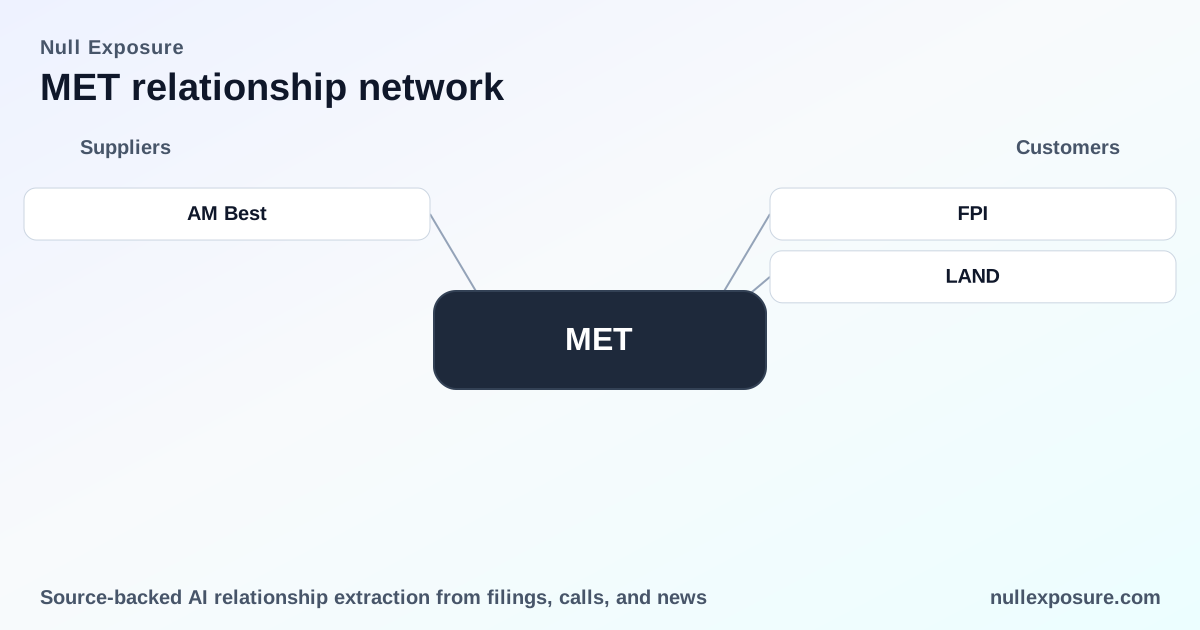
MetLife (MET) — Customer Relationships That Move Capital and Credit
Thesis — MetLife monetizes a diversified insurance and asset-management platform by underwriting long-duration life and annuity liabilities while leveraging its balance sheet through real-estate and direct lending activity; investment income, fee-based asset management, and premium flows fund both underwriting and active credit deployment. For investors and operators assessing counterparty exposure, MetLife behaves as both a large-scale lender and a seller/advisor in commercial real estate and institutional finance, generating recurring fees and interest spread income from relationships that span corporate borrowers, real-estate operators, and other insurers. Learn more about how we surface these relationships at https://nullexposure.com/.
Why these customer relationships matter to value and risk
MetLife is not a passive insurer. Its operating model combines long-duration underwriting with active asset-liability management: capital is placed into loans and direct property investments to match liabilities, while asset-management fees and service revenues provide diversification beyond pure underwriting margins. This results in a contracting posture that is a mix of long-term, yield-oriented engagements (mortgages, structured loans, annuities) and service contracts/fees. Investors should treat MetLife as a counterparty that is globally diversified, concentrated in institutional and large-enterprise relationships in some lending books, and operationally critical to counterparties that hold MetLife financing or indemnities.
- Contracting posture: Both long-duration and short-duration products are core to revenue; long-term credit exposures are material for asset-liability matching.
- Concentration and counterparty mix: Revenue streams include individuals, large enterprises, and government-related accounts; commercial lending often concentrates on a limited number of sizable borrowers.
- Criticality: For some counterparties (borrowers with MetLife facilities, insurers with indemnities), MetLife is a systemic counterparty whose credit and servicing matter to counterparty liquidity and legal outcomes.
- Maturity and stage: The company runs both active franchise lines and businesses in run-off; expect recurring servicing revenue alongside legacy contract wind-downs.
- For more on MetLife’s relationship signals, visit https://nullexposure.com/.
Counterparty roll call — what the public signals show
Below are the customer and counterparty relationships surfaced in recent public reporting and press coverage. Each entry is a concise, plain-English appraisal with the cited source.
VTMX (Corporación Inmobiliaria Vesta)
MetLife extended and restructured cross-border financing to Vesta, increasing an earlier MetLife-guaranteed facility to approximately USD 176 million, and Vesta later pre-paid a separate MetLife III facility of USD 118 million as part of secured-debt restructuring. Source: LexLatin report on the USD 176 million extension (Mar 10, 2026) and The Globe and Mail property/press coverage citing the USD 118 million prepayment (May 2026).
FPI (Farmland Partners Inc.)
Farmland Partners disclosed that four MetLife-originated loans totaling about $26 million have contractual resets in 2026, with at least one repriced earlier at 5.19%, signaling MetLife’s active role as a direct lender into RE/agribusiness assets. Source: The Globe and Mail / press release coverage of FPI earnings and loan resets (Mar 9–10, 2026).
SLF (Sun Life Financial Inc.)
Sun Life’s proposed settlement over legacy policies includes an indemnity provided by MetLife, and Sun Life has stated it will pursue recovery from that indemnity if the settlement is finalized — a direct counterparty exposure tied to legacy policy transfers. Source: WealthProfessional and Insurance Business reporting on Sun Life’s settlement and MetLife indemnity (May 3, 2026).
BRX (Brixmor Property Group)
Brixmor purchased Chino Spectrum Towne Center from MetLife Investment Management for $138 million, reflecting MetLife’s activity as an institutional seller/adviser of shopping-center assets across its investment-management platform. Source: The Real Deal report on the disposition (Jan 16, 2026).
ALCO (Company filing context)
A company filing noted an Eighth Amendment to a MetLife credit agreement to incur an additional $10 million of indebtedness maturing in 2034, indicating MetLife’s use of amendable bilateral or syndicated credit facilities with corporate borrowers. Source: SEC filing aggregated on StockTitan (May 2, 2026).
MET-P-E (MetLife Investment Management client sale referenced)
JLL represented the seller in a Miami shopping-center trade identified as a MetLife Investment Management advised-client, underscoring MetLife’s role as asset manager and advisor in commercial real-estate transactions rather than strictly a passive landlord. Source: JLL newsroom release noting the sale and MetLife’s advisory role (2026).
LAND / LANDO (Gladstone Land Corporation)
Gladstone Land disclosed $135 million of loans under a MetLife facility scheduled to reprice in January 2027, showing MetLife’s exposure in farmland and agricultural real-estate lending that carries explicit repricing events. Source: InsiderMonkey transcript coverage of Gladstone Land’s Q4 2025 earnings call (May 3, 2026).
BHF (Brighthouse Financial Inc.)
Historically, Delaware regulators approved Brighthouse’s acquisition of certain MetLife businesses during a 2017 transaction; this remains a structural example of how MetLife has transferred blocks of business and regulatory obligations to third parties, shaping long-term counterparty and indemnity arrangements. Source: Fortune coverage of the Brighthouse transaction (June 30, 2017).
What these relationships imply for investors and operators
- Credit exposure is active and repeated. Multiple borrowers report MetLife facilities with scheduled repricings or amendments; this is consistent with a lender that structures medium- to long-term loans with discrete reset dates.
- MetLife functions as lender, seller, and indemnitor. The firm’s footprint includes direct lending, asset dispositions via MetLife Investment Management, and legal indemnities tied to legacy policy transfers — each revenue and risk channel is exposed to different counterparties and legal regimes.
- Global footprint and counterparty mix drive complexity. Company-level signals confirm global operations across NA, LATAM, EMEA, and APAC with counterparty profiles spanning individuals, governments, and large enterprises; underwriters and investors must evaluate legal/regulatory variation and currency/market risk when sizing exposures.
- Operational posture blends active management with legacy run-off. Expect fee-income growth from services and asset management alongside run-off dynamics in legacy segments that can alter capital deployment over multi-year horizons.
Bottom line and next steps
MetLife’s customer relationships are strategically important — they generate fee income and yield but also concentrate credit and legal counterparty risk in identifiable borrower pools and legacy indemnities. For analysts modeling downside scenarios, treat MetLife as a hybrid counterparty: an insurer with banking-style credit exposures and an asset manager that rotates real estate holdings. For a closer look at transactional signals and counterparty flows, explore detailed relationship mapping at https://nullexposure.com/.
If you want a custom counterparty report or a deeper dive into specific loan facilities and repricing schedules, visit https://nullexposure.com/ for proprietary research and relationship intelligence.