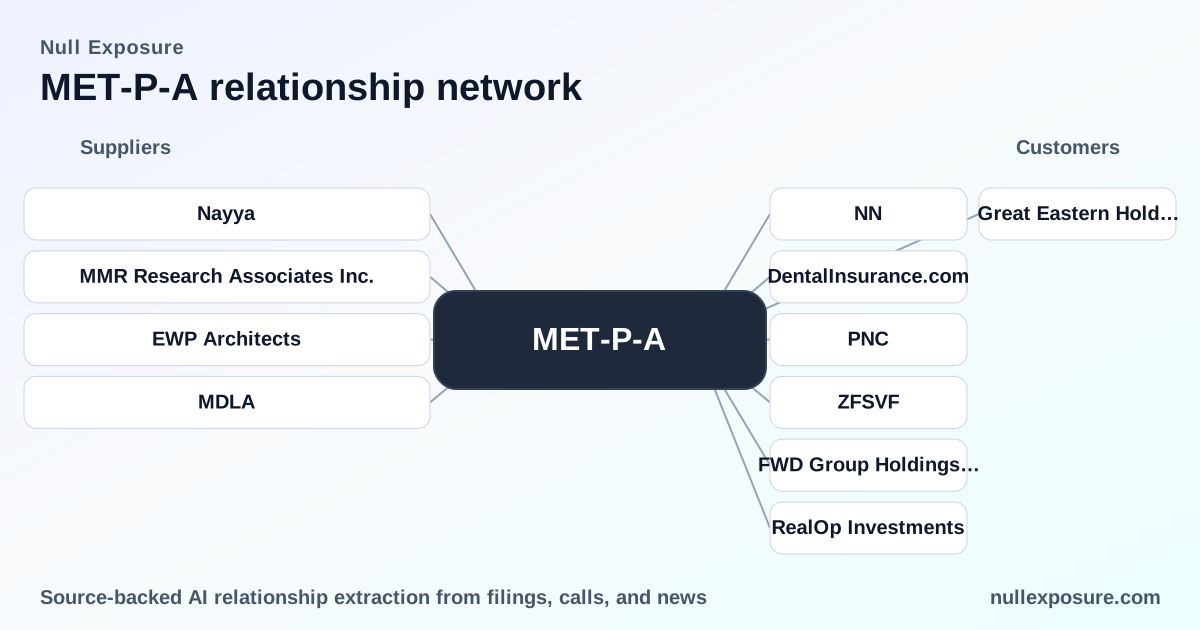
MET-P-A Customer Relationships: A concise investor briefing
MetLife (MET-P-A) operates as a global insurance and retirement services holding company and monetizes through insurance underwriting, annuity products, employee benefits and institutional asset management via MetLife Investment Management (MLIM). Its commercial footprint combines long-duration insurance liabilities with a balance-sheet driven real‑estate and institutional client book where asset sales, managed accounts and lease relationships produce recurring and transactional revenues. For relationship-level diligence on counterparties and disposition activity, this note synthesizes recent public mentions tied to customer and transaction activity. For a broader set of relationship signals and portfolio analytics, visit the Null Exposure homepage: https://nullexposure.com/.
Executive snapshot — how these relationships inform the business model
- Business model drivers: MetLife’s revenue mix is dominated by insurance premiums and investment returns, with MLIM acting as a distribution channel to institutional clients and a steward of real‑estate assets. Public notices around leases, managed‑account coordination and asset divestitures are consistent with a model that captures both fee income and capital‑release events.
- Contracting posture: The relationships documented are either long‑dated (lease extensions, managed accounts) or strategic disposals of non‑core country units, indicating a posture that blends durable, contractually bound revenue with opportunistic portfolio optimization.
- Concentration and criticality: The counterparty list spans banks, insurer buyers and buyers of real estate assets — diversified across sectors but concentrated at the level of large institutional counterparties, which raise counterparty credit and operational considerations for execution of asset sales and lease management.
- Maturity signals: Transactions and conversations in the record span 2020–2026, signaling an active multi‑year program of disposals and asset management rather than one-off activity.
Notable customer and transaction relationships (each cited)
-
PNC — PNC extended its long‑term lease for the PNC Centre at 1 N. Franklin, and the bank will coordinate renovations with MetLife Investment Management on behalf of a large real‑estate managed account, indicating MLIM’s role in active asset stewardship and tenant coordination (Chicago Urbanize, March 10, 2026, FY2024 mention).
Source: Chicago Urbanize (article first seen 2026‑03‑10). -
PNC Bank — The same report reiterated PNC Bank’s lease extension and renovation plans coordinated with MetLife Investment Management, underscoring the tenant‑landlord and asset‑manager interaction that produces recurring property cash flows and potential capital improvements (Chicago Urbanize, March 10, 2026, FY2024 mention).
Source: Chicago Urbanize (article first seen 2026‑03‑10). -
DentalInsurance.com — DentalInsurance.com expanded its relationship with MetLife, praising MetLife plans for delivering affordable dental benefits, which reflects MetLife’s distribution footprint in retail and affinity channels for voluntary benefits (Dentistry Today, FY2023).
Source: Dentistry Today (first seen 2026‑03‑10; referencing FY2023 relationship). -
NN — Dutch insurer NN Group agreed to acquire MetLife’s business activities in Poland and Greece for €584 million, representing a country‑level exit and reallocation of capital away from selected European markets (Insurance Journal, July 2021, FY2021).
Source: Insurance Journal (reported July 2021). -
NN Group — The same Insurance Journal coverage identifies NN Group as the buyer of MetLife’s Poland and Greece operations, confirming the buyer identity and deal economics as part of MetLife’s broader divestiture program (Insurance Journal, July 2021, FY2021).
Source: Insurance Journal (reported July 2021). -
Zurich Insurance Group AG — Zurich emerged as the front‑runner to buy a majority stake in MetLife’s Malaysian insurance business, indicating competitive interest from large global insurers in MetLife’s regional platforms and supporting the view that MetLife is selectively monetizing country operations (Insurance Journal, December 2022, FY2022).
Source: Insurance Journal (reported December 2022). -
ZFSVF — Coverage that used the ZFSVF ticker (Zurich’s ADR symbol) reiterated Zurich’s position as the likely purchaser in Malaysia, corroborating market interest from major international insurers in those assets (Insurance Journal, December 2022, FY2022).
Source: Insurance Journal (reported December 2022). -
FWD Group Holdings Ltd. — MetLife sold its Hong Kong units to FWD in 2020, a prior disposal that illustrates MetLife’s strategy of exiting selected Asian operations and redeploying capital, and confirms precedent for regional carve‑outs (Insurance Journal reporting, referenced December 2022; transaction occurred 2020).
Source: Insurance Journal (referencing the 2020 sale; noted in December 2022 coverage). -
RealOp Investments — RealOp Investments acquired the Waterford Atrium office complex from MetLife affiliates in two transactions totaling roughly $110 million, demonstrating direct property disposition activity and balance‑sheet de‑risking in U.S. commercial real estate (The Real Deal, May 4, 2021, FY2021).
Source: The Real Deal (reported May 4, 2021). -
Great Eastern Holdings Ltd. — Great Eastern was among the interested bidders for a majority stake in MetLife’s Malaysian business, confirming multiple strategic buyers in regional processes and reinforcing the competitive auction dynamic MetLife leverages when divesting country operations (Insurance Journal, December 2022, FY2022).
Source: Insurance Journal (reported December 2022).
Operational constraints and company‑level signals
There are no explicit contractual constraint excerpts provided in the available material. From the relationship activity itself, investors can infer company‑level signals about MetLife’s operating model:
- Long‑term contracting posture: Evidence of extended leases and MLIM coordination with tenants implies MetLife acts as a long‑duration counterparty in real estate and institutional mandates, favoring durable cash‑flow relationships.
- Portfolio optimization over time: Multiple country‑level disposals (Poland, Greece, Hong Kong, Malaysia sale discussions) signal an active reallocation strategy and capital redeployment rather than passive market exits.
- Counterparty profile: Buyers and customers are major banks, listed insurers and institutional real‑estate investors — large counterparties that concentrate execution risk but reduce small‑counterparty credit variability.
- Maturity and execution track record: Transaction activity dating from 2020 through 2026 shows a mature program of asset management and divestiture, not sporadic single‑year activity.
Key takeaways for investors
- MetLife integrates insurance economics with an institutional asset management business that generates both fee revenue and capital‑release events. Recent public relationship notes underline MLIM’s operational role in real estate management and MetLife’s continued willingness to sell non‑core businesses.
- Counterparties are large, strategic and diversified across sectors, which reduces small‑counterparty credit risk but elevates execution sensitivity to competitive auction dynamics.
- Watch for future asset realizations and managed‑account mandates as near‑term drivers of capital redeployment and potential earnings variability.
For a more comprehensive mapping of MetLife’s counterparty network and transaction history, visit https://nullexposure.com/ for our relationship analytics and briefing products.