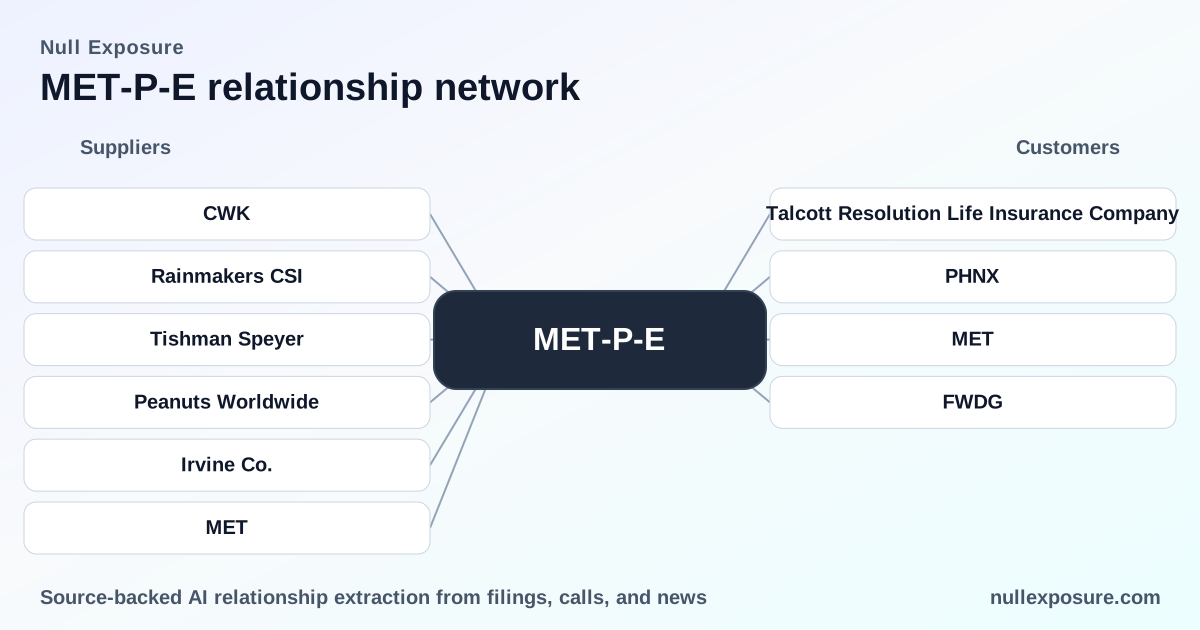
MET-P-E (MetLife) — Customer relationships and strategic counterparties investors should track
MetLife operates as a global life-insurance and employee-benefits platform that monetizes through insurance premiums, retirement and annuities product fees, asset-management income, and structured risk-transfer transactions (reinsurance and portfolio run-offs). The firm grows economics by combining underwriting and balance-sheet investing (MetLife Investment Management) and by selectively offloading legacy risks to specialized reinsurers while retaining asset-management fees on transferred portfolios. For a fuller view of counterparties and concentration mapping visit https://nullexposure.com/.
What matters to investors: the thesis in one paragraph
MetLife’s commercial model is a dual engine: insurance underwriting generates recurring float while its investment-management arm extracts fee income and liquidity value from the balance sheet. Strategic counterparty activity — reinsurance, portfolio sales, and third‑party asset mandates — reduces capital volatility and preserves fee streams, but also signals active portfolio reshaping that changes risk exposure and near‑term earnings composition.
Operational profile investors should internalize
- Contracting posture: MetLife pursues active risk-transfer (reinsurance and asset sales) alongside long-term asset-management mandates, indicating flexible contracting aimed at reducing underwriting capital and hedging cost.
- Concentration and counterparty diversification: Global footprint and diversified product mix lower single‑counterparty revenue concentration, though targeted transactions (large longevity reinsurance or asset blocks) create episodic counterparty concentration.
- Criticality: Life insurance and employee benefits are mission‑critical client relationships; counterparties that assume longevity or variable‑annuity risk materially change MetLife’s balance‑sheet risk profile.
- Maturity: The business is mature and capital‑intensive, focused on liability run‑offs in certain retail lines while redeploying capital into fee‑earning asset management and institutional deals.
A second reference for mapping counterparties and transaction context is available at https://nullexposure.com/ for investors requiring deeper counterparty lineage.
Key customer and partner relationships (individual takeaways)
Below are each of the relationships surfaced in the public reporting set, summarized for investor analysis.
Talcott Resolution Life Insurance Company
MetLife completed a transfer of $10 billion of variable annuity risk to Talcott Resolution, a move that accelerates run‑off of U.S. retail blocks and lowers exposure while reducing annual adjusted earnings by about $100 million but generating roughly $45 million in annual hedge‑cost savings, with MetLife Investment Management signing new asset‑management agreements for approximately $6 billion. This transaction is reported via Business Wire and summarized in an InsiderMonkey piece (Dec 1, 2025).
Source: Business Wire coverage reported through InsiderMonkey (Dec 1, 2025).
Phoenix Group
MetLife provided reinsurance to cover $2.4 billion of pension-related longevity risk for Phoenix Group, transferring longevity exposure in the European pension consolidation market. This reflects MetLife’s use of longevity reinsurance as a capital and risk-management tool.
Source: Artemis (reporting on FY2022 reinsurance activity).
PHNX
PHNX appears in the same coverage as Phoenix Group and references the identical $2.4 billion longevity reinsurance arrangement, underscoring that Phoenix Group is the counterparty for the longevity hedge.
Source: Artemis (FY2022).
MET (MetLife Investment Management advised-client)
JLL reported that a MetLife Investment Management‑advised client sold Colonial Palms Plaza, a well‑occupied Miami shopping center, marking a disposition from MetLife IM’s advised inventory and reflecting active portfolio rotation in real estate holdings. The sale demonstrates MetLife IM’s role as an institutional owner/adviser rather than a passive insurer in real‑estate markets.
Source: JLL newsroom (FY2023).
Orion Real Estate Group
Orion Real Estate Group was part of the acquiring consortium for Colonial Palms Plaza, buying the asset from a MetLife IM‑advised client, which signals MetLife’s strategy of monetizing stabilized retail assets to recycle capital.
Source: JLL newsroom (FY2023).
Limestone Asset Management
Limestone Asset Management joined Orion in acquiring Colonial Palms Plaza from a MetLife IM‑advised client, illustrating MetLife’s use of third‑party managers and sponsored sales to execute portfolio exits.
Source: JLL newsroom (FY2023).
FWDG
Reporting on prior regional transactions notes that FWDG acquired life operations that were previously part of MetLife’s regional footprint (Hong Kong operations), part of industry consolidation activity in Asia that involved MetLife divestitures in 2019. This highlights MetLife’s occasional local-market exits in Asia to reallocate capital.
Source: Nippon.com summarizing Reuters coverage (June 17, 2021).
FWD
FWD (same corporate family referenced as FWDG) is noted in connection with the acquisitions of regional life‑insurance units formerly operated by MetLife, reinforcing that MetLife has executed strategic sales in Asian markets to concentrate on priority geographies or lines.
Source: Nippon.com summarizing Reuters (June 17, 2021).
Millers Ale House
Millers Ale House is listed as an outparcel tenant at Colonial Palms Plaza—one of the rostered national tenants whose lease income contributes to the asset’s cash flow being sold by a MetLife IM‑advised client.
Source: JLL newsroom (FY2023).
Old Navy
Old Navy is a core retail tenant at Colonial Palms Plaza, representing stable lease cash flow in the shopping‑center asset disposed by a MetLife IM client.
Source: JLL newsroom (FY2023).
Five Below
Five Below is another national box tenant at Colonial Palms Plaza, contributing to the center’s high occupancy cited in the sale announcement.
Source: JLL newsroom (FY2023).
Panera Bread
Panera Bread is a named tenant at Colonial Palms Plaza and provides a quick‑service anchor that supports foot traffic and leasing economics for the asset sold by the MetLife IM client.
Source: JLL newsroom (FY2023).
Party City
Party City occupies space at Colonial Palms Plaza and is part of the mixed retail roster that underpinned demand for the asset at sale.
Source: JLL newsroom (FY2023).
PetSmart
PetSmart is listed among national retail tenants at Colonial Palms Plaza, contributing to the shopping center’s tenant diversification and stable rent roll.
Source: JLL newsroom (FY2023).
Visionworks
Visionworks is an outparcel tenant at Colonial Palms Plaza, part of the tenant mix that supported the asset valuation in the MetLife IM‑advised sale.
Source: JLL newsroom (FY2023).
Checkers
Checkers is noted as a high‑profile outparcel at Colonial Palms Plaza, representing drive‑through quick‑service exposure in the center’s tenant lineup.
Source: JLL newsroom (FY2023).
Marshalls/HomeGoods
Marshalls/HomeGoods functions as an anchor tenant at Colonial Palms Plaza; anchor leases like this underpin the center’s 97.3% occupancy cited in the transaction release.
Source: JLL newsroom (FY2023).
Implications for investors: synthesis and risks
- Strategic de‑risking: Large transfers (Talcott, Phoenix) show MetLife actively de‑risking balance‑sheet liabilities while preserving asset‑management fees on transferred portfolios; this reduces underwriting volatility but compresses certain earnings lines.
- Fee‑growth focus: Retaining asset‑management mandates on transferred assets (reported ~$6 billion with Talcott) preserves recurring fee income, a structural positive for fee‑reliant earnings.
- Portfolio rotation: Real‑estate dispositions via MetLife IM‑advised clients demonstrate active capital recycling into higher‑return uses; investors should watch realized gains and redeployment.
- Counterparty concentration events: Episodic large transactions create short‑term counterparties concentration; underwriting and counterparty credit quality matter for true risk transfer.
Bottom line
MetLife uses reinsurance, structured transfers, and asset‑management mandates to reshape risk and convert capital into fee‑earning businesses; the relationships above illustrate that strategy in action. For deeper counterparty analysis and an interactive map of counterparties, see https://nullexposure.com/.
Bold strategic takeaway: MetLife is reducing balance‑sheet underwriting volatility while monetizing assets through fee-bearing mandates — a capital‑efficient shift that changes near‑term earnings composition but increases predictability of long‑term fee revenue.