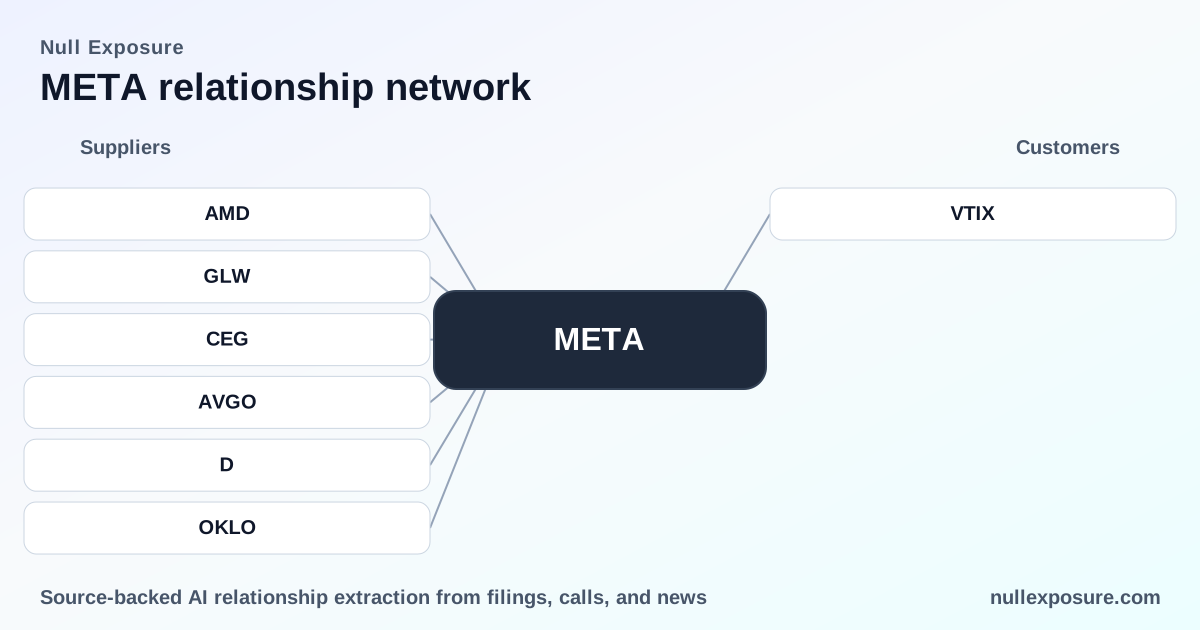
Meta Platforms: customer relationships that shape revenue and risk
Meta operates and monetizes as a two-pronged digital platform: advertising placements across its Family of Apps (Facebook, Instagram, Messenger, WhatsApp) generate the vast majority of revenue on a usage-based, short-term marketer-pay basis, while Reality Labs sells hardware (Meta Quest, AI glasses) and related software/content. This dual model concentrates cash flows in ad-sold services while creating strategic, lower-revenue hardware relationships that expand long-term platform stickiness. For a compact view of customer interactions and partner dependencies, visit https://nullexposure.com/.
How Meta’s customer economics translate to investors
Meta’s contracts with customers are predominantly usage-based and short-term, which drives top-line elasticity and preserves pricing power but also exposes revenue to QA and marketing-cycle volatility. The company’s revenue base is globally distributed—North America accounts for a plurality but Europe and Asia-Pacific contribute meaningfully—so regional ad-market cycles and regulation are critical to growth. Meta is a buyer and a seller in different contexts: it sells advertising inventory gross to marketers while it purchases infrastructure and hardware services to support Reality Labs and AI operations. Importantly, no single customer represented 10%+ of revenue in 2025, which signals low counterparty concentration but high aggregate reliance on marketer spending patterns rather than a few anchor customers.
- Contracting posture: short-term, usage-based ad buys that favor flexibility over long-term guarantees.
- Concentration: low single-customer concentration, high market concentration in ad demand generally.
- Criticality: Meta’s platform is mission critical to partners seeking reach and creators; for some hardware partners, the relationship is distribution-critical.
- Maturity: Family of Apps is mature and high-margin; Reality Labs remains a strategic but lower-margin, early-stage revenue stream.
For a broader scan of relationships and partner directionality, see https://nullexposure.com/ (home).
What the relationship list reveals — partner-by-partner notes
Below are plain-English summaries of every relationship returned in the source set, each with a concise citation to the underlying reporting.
- NBIS (Nebius) — Nebius signed a five‑year agreement to supply dedicated AI compute capacity to Meta across multiple locations, cementing an infrastructure-supply role for Meta’s AI needs. According to Sahm Capital reporting and Globe and Mail coverage in 2026, the deal accompanied Nebius’ convertible-note financing and infrastructure expansion (2026).
- EVC (Entravision Communications) — Entravision has commercial partnerships that route advertiser access to Meta inventory via its digital sales representation business in emerging markets, though Meta’s ASP program wind‑down affected prior arrangements. Company filings and BizWire releases (2022–2024) recount both partnership activity and Meta’s 2024 ASP notice.
- ROL (Rollins) — Rollins cited accelerated media engagement through Meta ads (Facebook) as boosting brand reach and mass popularity in recent commentary on Q4 results (TradingView summary, 2026).
- BBY (Best Buy) — Best Buy partners deeply with Meta to build immersive in‑store experiences and credited Meta collaborations with measurable increases in vendor-provided labor and store refresh initiatives (Tikr and earnings transcript coverage, FY2026).
- RDFN (Redfin) — Redfin litigation filings referenced user data flows to Meta among other platforms in a privacy-related suit, indicating Redfin’s use of third‑party tracking or data-sharing mechanisms (HousingWire reporting, FY2025).
- SCOR (Comscore) — Comscore expanded cross‑platform campaign measurement to include campaign-level metrics from Meta’s Facebook, Instagram and Audience Network, integrating Meta data into measurement suites (Comscore press release, 2025).
- EBAY (eBay Inc.) — eBay announced a partnership with Meta to support a Facebook affiliate program that enables creators to feature eBay inventory directly in content and drive social-commerce reach (eBay press release and PR Newswire, Q1 2026).
- PERF (Perfect Corp.) — Perfect Corp. provides AR virtual makeup integrations for Instagram, reflecting Meta’s role as a platform for immersive AR retail use cases (Marketscreener release, FY2025).
- U (Unity Software) — Unity extended a multi‑year enterprise agreement to remain a content-creation partner for Meta’s VR hardware and OS, preserving developer tooling for Meta’s VR ecosystem (Client announcement summarized on SimplyWall, FY2026).
- IMXI (Intermex) — Intermex launched WhatsApp wire-transfer functionality, using Meta’s messaging platform (WhatsApp) to reach customers and expand financial services distribution (GlobeNewswire, Feb 2025).
- ANGX (Angel Studios) — Angel Studios disclosed substantial Meta ad spend to promote the film Sound of Freedom, illustrating Meta’s central role in high-dollar social campaign amplification (Rolling Stone feature, FY2023).
- GO (Grocery Outlet) — Grocery Outlet debuted shoppable livestream programming on Facebook and Instagram, leveraging Meta’s commerce and livestream channels for customer engagement (Finviz and Sahm Capital coverage, 2026).
- SKM (SK Telecom) — SK Telecom’s prior partnership with Facebook granted exclusive regional headset distribution rights (Oculus historically), demonstrating Meta’s reliance on local telco partners for hardware go‑to‑market (Korea JoongAng Daily recollection of a 2019 partnership; referenced FY2026).
- AMCX (AMC Entertainment) — Litigation referenced AMC’s use of Meta Pixel to track user activity, tying Meta tracking tools to publisher and exhibitor data flows in a privacy class action settlement context (Top Class Actions, FY2026).
- VTIX / Virtuix Holdings — Virtuix joined Meta’s “Made for Meta” program and locked compatibility for Omni One with Meta Quest headsets, expanding hardware accessory reach to Meta’s six‑million user VR base (AccessWire and Sahm Capital 2026 reporting).
- VERB (Verb Technology) — Verb Technology integrated native shopping with Facebook and Instagram, using Meta’s commerce primitives to enable in‑app transactions (TradingView writeup, FY2024).
- GLW (Corning) — Corning inked a partnership to provide optical solutions supporting Meta operations, reflecting supply relationships for Meta’s hardware optical components (TradingView/Investing coverage, FY2026).
- NATR (Nature’s Sunshine) — Nature’s Sunshine launched paid-media across Meta platforms as part of an integrated brand campaign, showing Meta’s role in multi-channel marketing mixes (GlobeNewswire, March 2025).
- APP (AppLovin) — AppLovin faces allegations that it exploited advertising data associated with Meta to inflate app-install metrics, highlighting regulatory and data-integrity friction between adtech firms and platform inventory (Marketscreener and Morningstar coverage, FY2025).
- BMA (Banco Macro) — Banco Macro leverages WhatsApp (a Meta-owned service) for BancoChat functionality, using Meta messaging for customer service and transaction workflows (Infobae / FY2025 corporate reporting).
- TZOO (Travelzoo) — Travelzoo reported higher cost‑per‑acquisition on channels including Meta, noting optimization efforts to manage marketing spend across Meta and Google (Investor transcript summaries, Q4 2025).
- PCLN (Priceline) — Priceline’s campaigns run across Meta platforms (Instagram, Facebook) alongside other digital channels, demonstrating Meta’s persistent media-buy role for travel advertisers (MarketingDive, FY2025).
- DV (DoubleVerify) — DoubleVerify expanded brand-suitability measurement to Meta Threads, integrating verification and suitability checks with new Meta surfaces (MarketScreener, FY2025).
- LENZ (Lenz Therapeutics) — Lenz rolled campaigns across Instagram and Facebook as core social placements in a celebrity campaign, showing Meta’s reach for health‑brand awareness (MMM‑Online, FY2026).
- QVCGA (Qurate / QVC Group) — QVC Group lists Facebook and Instagram among the platforms that reach millions of customers, using Meta channels as part of multi‑platform commerce distribution (PR Newswire and Glossy, FY2025).
- MYO (MyoKardia / related ticker) — Company management noted lead‑generation headwinds tied to changes in Meta advertising policies, indicating sensitivity of direct-response marketers to platform policy shifts (GuruFocus transcript, FY2025).
- EYE (Ditto / eyewear retailer association) — Reports linked early sales rollout of Meta AI glasses to availability in retail doors (300 stores initially), showing retail channels augment Meta hardware distribution (TradingView summary, FY2026).
- COF-P-L (Capital One preferred / Llama usage reference) — Capital One referenced Llama (Meta’s open‑source LLM family) as the foundation for internal tools, illustrating enterprise adoption of Meta’s AI models (Euromoney fintech piece, FY2025).
- AMCX (privacy litigation note repeated) — See previous AMC entry for Meta Pixel usage and class-action context (Top Class Actions, FY2026).
- Additional advertiser and partner mentions — Several brands (e.g., Priceline, Nature’s Sunshine, Grocery Outlet) repeatedly use Meta channels for commerce, measurement, and creator-driven affiliate programs as documented in respective press releases and trade coverage (2025–2026).
Key takeaways for investors
- Revenue exposure is demand-driven: Meta’s core economics rest on short-term, usage-based ad buys; platform monetization scales with marketer budgets and macro ad cycles.
- Low single-customer risk, high platform centrality: No customer is individually material, but Meta is often the central distribution partner or measurement anchor for many advertisers and hardware accessory suppliers.
- Hardware relationships are strategic distribution plays: Reality Labs partners (Unity, Virtuix, Corning, local telcos) expand ecosystem value but are uneven contributors to near-term profitability.
- Regulatory and privacy litigation is an ongoing dynamic: Multiple items in the relationship set reference tracking tools, litigation or data-use allegations that affect advertising product design and advertiser behavior.
For an integrated view that maps these partner signals to counterparty and supply-chain exposure, explore our coverage at https://nullexposure.com/.
Bold, actionable monitoring indicators for portfolio teams: track quarterly ad-revenue elasticity, major changes to Meta’s ASP or reseller programs, and material supply contracts for Reality Labs hardware.