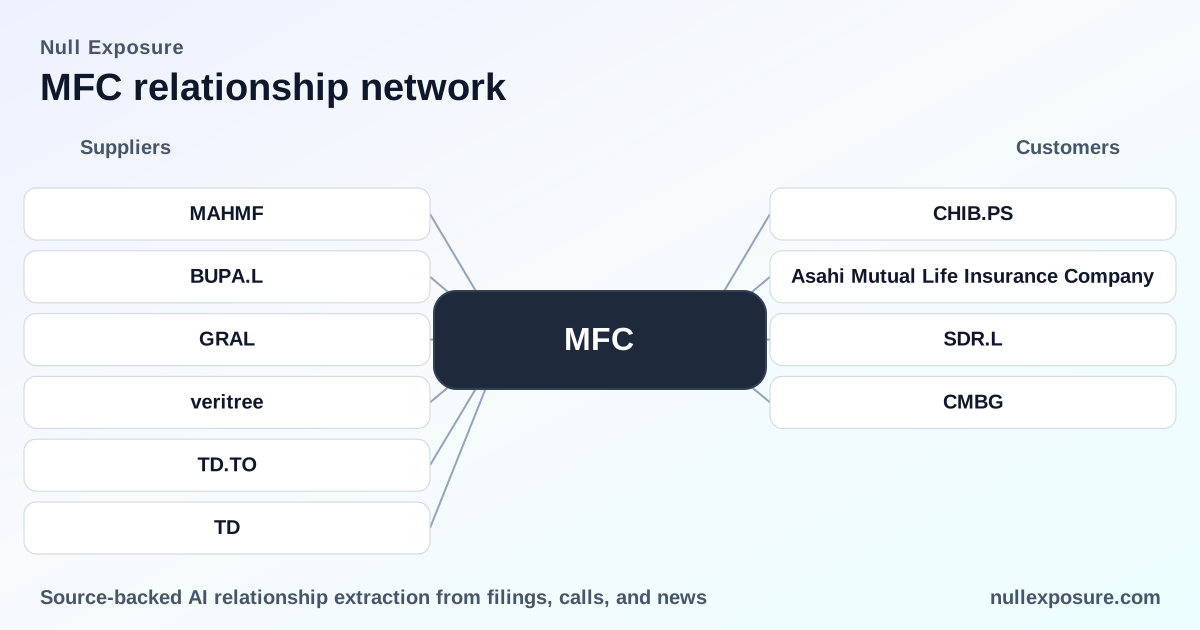
Manulife (MFC) — Customer Relationships Signal a Distribution-First, Asia-Expansion Play
Manulife is a diversified life insurer that monetizes through insurance premiums, wealth and asset management fees, and distribution partnerships across Asia, Canada and the U.S. Revenue is driven by long-term distribution agreements and strategic acquisitions that extend market access and asset-management capabilities, while capital deployment into credit and JV structures supports investment margin and fee income. For investors, the primary lens is distribution durability in Asia and the pace of inorganic moves that expand fee-bearing assets. For a consolidated view of Manulife’s customer relationships, see NullExposure’s platform for ongoing tracking: https://nullexposure.com/.
Why these customer ties matter to valuation and underwriting
Manulife’s business is distribution- and balance-sheet-intensive. Deals that secure exclusive distribution channels or add scale in asset management translate directly into predictable premium flows and recurring fees. The relationships summarized below reveal three strategic themes: exclusive bancassurance, digital-broker distribution, and acquisitions/joint ventures to bulk up fee-bearing assets. Each relationship therefore carries implications for contract tenure, revenue criticality and geographic concentration.
- Exclusive distribution drives predictable premiums: long-term bancassurance renewals lock in future new business and embedded value.
- Digital partnerships broaden customer access: brokerage custody arrangements accelerate product reach to online investors.
- Acquisitions and JVs shift the mix toward fee income: buying asset managers and private credit platforms increases recurring fee potential and investment income.
How to read the contract and concentration signals
No explicit contract constraint excerpts were provided in the data set as a separate feed, so there are no independent contract documents to parse. As a company-level signal, the absence of standalone constraint disclosures limits granularity on termination rights and revenue fallback options. However, the disclosed relationship language itself reveals operating characteristics: long-term exclusivity in the Philippines indicates a conservative contracting posture with high revenue criticality for that channel; acquisitions and JV announcements indicate an aggressive growth posture aimed at diversifying revenue away from traditional life underwriting.
Relationship snapshots — what each customer link tells investors
Below are concise, investor-oriented summaries for every customer relationship identified in the reporting set.
TIGR — digital brokerage custody for life products
Manulife partnered with UP Fintech (TIGR) to provide custody services for Variable Universal Life insurance, enabling Manulife to distribute life insurance through an online broker channel and reach digitally native investors. According to Finance Magnates coverage (March 2026), the arrangement positions Manulife to convert brokerage flows into insurance sales via custody integration.
Asahi Mutual Life Insurance Company — asset sale in Vietnam
Manulife agreed to sell MVI Life Vietnam (formerly Aviva Vietnam) to Japan’s Asahi Mutual Life Insurance Company, a move that rebalances Manulife’s footprint in Vietnam and realizes value from a previously held market asset. This transaction was reported in Asia Insurance Review and cited on December 2, 2025 (via TS2 Tech reporting).
Chinabank (Philippines) — extended exclusive bancassurance partnership to 2039
Manulife renewed and extended its exclusive bancassurance partnership with Chinabank in the Philippines, committing distribution exclusivity through 2039 and thereby securing a long-term retail channel for life and wealth products. Management disclosed the renewal during Manulife’s Q4 2025 earnings call (reported March 2026), underscoring the company’s preference for long-tenor distribution agreements.
Schroders Indonesia — acquisition pending regulatory approval
Manulife entered into an agreement to acquire Schroders Indonesia, subject to regulatory approval, as part of its strategy to scale local asset-management capabilities and increase fee-bearing assets in Asia. Management referenced the Schroders Indonesia agreement during the Q4 2025 earnings call (March 2026), framing it as a strategic expansion of investment management reach.
Comvest Credit Partners — acquisition to build private credit exposure
Manulife completed the acquisition of Comvest Credit Partners to expand private credit capabilities and deployed balance-sheet capacity into higher-yielding, fee-attracting credit strategies. The acquisition was announced on the Q4 2025 earnings call (March 2026) and represents a deliberate tilt toward alternative credit assets that enhance investment margin and recurring management revenue.
What these relationships imply about Manulife’s operating model
- Contracting posture: The Chinabank renewal demonstrates a preference for long-term exclusive distribution contracts, which convert new business into predictable future cash flow and reinforce market share in priority markets.
- Concentration and criticality: Exclusive partnerships create channel concentration risks in specific markets (notably the Philippines), but they also improve unit economics and persistency — a trade-off that benefits insurers with strong balance sheets.
- Maturity and strategic focus: Acquisition activity (Comvest, Schroders Indonesia) signals a shift from pure underwriting toward asset-management scale and alternative credit exposure, which increases fee revenue resilience and reduces sensitivity to short-term underwriting cycles.
- Distribution diversification: The TIGR custody tie shows active movement into digital distribution channels, lowering customer-acquisition costs and broadening demographic reach.
Investment implications and risk checklist
Investors should weigh the following points when modeling Manulife’s earnings and capital trajectory:
- Upside: Long-term bancassurance exclusivity and acquisition-driven growth in fee-bearing assets support recurring revenue growth and a higher-quality earnings mix. The company’s dividend yield and forward P/E reflect investor expectations for stable cash flows and earnings recovery.
- Risks: Concentration in exclusive channels generates single-counterparty exposure risk; regulatory approval risk is present for cross-border asset-management deals; and divestitures (e.g., Vietnam sale) can alter future growth cadence.
- Catalysts to monitor: Closing of the Schroders Indonesia and Comvest integrations, performance of digital distribution partnerships (like TIGR), and any further portfolio reshaping via M&A or selective divestitures.
Final reading and next steps
Manulife’s customer relationships show a clear strategy: lock distribution through long-tenor partnerships while scaling fee income via acquisitions and JVs. That combination supports durable earnings and a more diversified revenue mix, but it requires careful underwriting of concentration and approval risk.
For ongoing tracking of Manulife’s evolving partner map and to integrate these relationship signals into financial models, visit NullExposure for real-time coverage: https://nullexposure.com/.