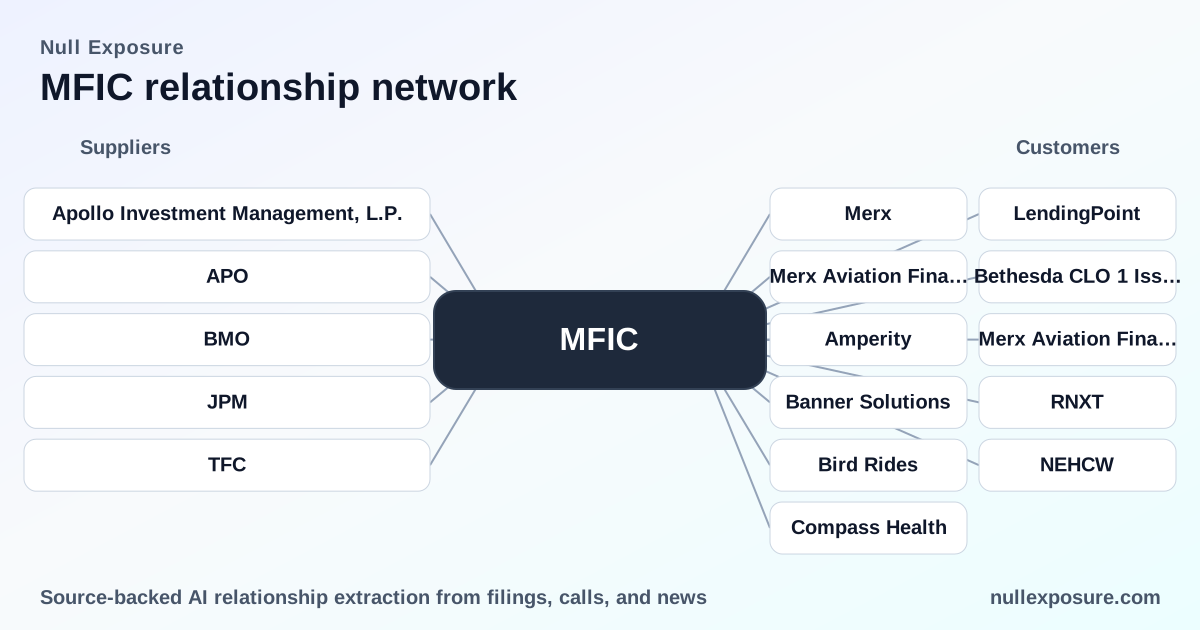
MidCap Financial Investment Corporation (MFIC): Customer Relationships and Portfolio Signals for Investors
MidCap Financial Investment Corporation underwrites, originates and syndicates first‑lien senior secured loans to U.S. middle‑market companies and monetizes through interest income, loan sales and structured finance conduits (including CLO issuances) while retaining subordinated tranches and collateral management fees. MFIC’s strategy blends direct origination with active portfolio management and selective loan sales to optimize yield and capital efficiency. For a detailed view of MFIC’s coverage and collateral-management activities, visit https://nullexposure.com/.
Market takeaway: MFIC is a lender and collateral manager whose customer set spans early‑stage restructurings to asset‑backed financing for growth and acquisitions; recent quarters show both sizable repayments that reduce concentration and a number of underperforming credits that pressure near‑term earnings.
Operating model and business‑model signals
- Contracting posture — long‑term credit structures dominate. MFIC documents reference term loans and secured first‑lien instruments with multi‑year amortization and LIBOR/SOFR spreads consistent with long‑dated credit underwriting. (Evidence: term loan references in company filings, Q4 2025 disclosures.)
- Counterparty profile — focused on U.S. middle‑market borrowers. The company defines its target as privately held U.S. middle‑market companies (sub‑$75M EBITDA), signaling concentrated credit underwriting in that cohort.
- Geography — predominantly North America. MFIC’s portfolio and loan sale activity are concentrated in U.S. middle‑market credits.
- Role breadth — lender, seller and collateral manager. MFIC both originates loans and transfers assets into CLO structures; it also serves as collateral manager on at least one Bethesda CLO vehicle (explicit collateral management agreement). This dual role drives fee income while retaining subordinated economic exposure.
- Capital intensity — large commitment scale. Public disclosures show total commitments in the hundreds of millions, indicating material counterparty exposure and meaningful balance‑sheet leverage to executed deals.
- Segment orientation — business services and specialty financing. Portfolio composition and disclosures place activity in the business services / specialty finance arena, not pure retail banking.
If you want a compact, machine‑readable inventory of these relationships for portfolio modeling, check our home page as a starting point: https://nullexposure.com/.
Relationship roster — plain English summaries with sources Below are every counterpart named in MFIC’s recent public disclosures and coverage, each with a concise investor‑oriented summary and original source.
-
Amperity — MFIC flagged its Amperity exposure as a negative contributor in Q4 2025 results, indicating write‑down or below‑plan cash flows on that investment. Source: Q4 2025 earnings call transcript coverage (InsiderMonkey / Motley Fool excerpts, March 2026 — https://www.insidermonkey.com/blog/midcap-financial-investment-corporation-nasdaqmfic-q4-2025-earnings-call-transcript-1706215/).
-
Banner Solutions — Banner Solutions was placed on non‑accrual in the December quarter, marking it as a near‑term underperformer in MFIC’s direct origination book. Source: Q4 2025 earnings call transcript (Globe and Mail / Motley Fool coverage, March 2026 — https://www.theglobeandmail.com/investing/markets/markets-news/Motley%20Fool/473198/midcap-financial-mfic-earnings-call-transcript/).
-
Bird Rides — MFIC disclosed Bird Rides as one of three investments placed on non‑accrual in the quarter, reflecting stress in variable‑revenue consumer mobility credits within the portfolio. Source: Q4 2025 earnings call transcript (InsiderMonkey / Globe and Mail coverage, March 2026 — https://www.insidermonkey.com/blog/midcap-financial-investment-corporation-nasdaqmfic-q4-2025-earnings-call-transcript-1706215/).
-
Compass Health — MFIC reported Compass Health was fully repaid following the company’s sale, and the investment was restored to accrual prior to repayment; the transaction generated realized cash that reduced downside exposure. Source: Q4 2025 earnings call transcript (Globe and Mail / Motley Fool coverage, March 2026 — https://www.theglobeandmail.com/investing/markets/markets-news/Motley%20Fool/473198/midcap-financial-mfic-earnings-call-transcript/).
-
LendingPoint — After a borrower restructuring, LendingPoint was restored to accrual status, a sign that MFIC’s workout and restructuring playbook executed to recover cash flows and stabilize the position. Source: Q4 2025 earnings call transcript (InsiderMonkey / Globe and Mail coverage, March 2026 — https://www.insidermonkey.com/blog/midcap-financial-investment-corporation-nasdaqmfic-q4-2025-earnings-call-transcript-1706215/).
-
Merx / Merx Aviation Finance, LLC — Merx repaid a total of $29.5 million to MFIC across the December quarter and February 2026, and MFIC disclosed a much larger prior repayment (~$97 million in a prior quarter), driving a material reduction in portfolio exposure to aviation finance. Multiple releases document the staged repayments and anticipated net repayment amounts. Sources: company press releases and media coverage (GlobeNewswire Feb 26, 2026; TradingView and Bitget summaries March–May 2026 — https://www.globenewswire.com/fr/news-release/2026/02/26/3246064/0/en/MidCap-Financial-Investment-Corporation-Reports-Financial-Results-for-the-Quarter-and-Fiscal-Year-Ended-December-31-2025.html; https://www.tradingview.com/news/; https://www.bitget.com/news/detail/12560605223684).
-
Bethesda CLO 1 Issuer — MFIC sold loans into and served as collateral manager for a Bethesda CLO 1 upsized issuance; MFIC retained all Class D and subordinated notes while using proceeds to repay facility borrowings, a clear illustration of structuring trades that de‑risk senior exposure while preserving upside. Source: GLobenewswire and Bitget coverage of the Bethesda CLO 1 upsized issuance (Feb–May 2026 — https://www.globenewswire.com/fr/news-release/2026/02/26/3246064/0/en/MidCap-Financial-Investment-Corporation-Reports-Financial-Results-for-the-Quarter-and-Fiscal-Year-Ended-December-31-2025.html; https://www.bitget.com/news/detail/12560605223684).
-
Sumitomo Mitsui Banking Corporation — Sumitomo Mitsui acted as the initial purchaser on the Bethesda CLO 1 upsizing, indicating MFIC executed a market sale with major institutional buyers and placement agents to distribute risk. Source: Bitget coverage summarizing the Bethesda CLO 1 upsized transaction (May 2026 — https://www.bitget.com/news/detail/12560605223684).
-
Renovo / RNXT — Renovo was one of three investments placed on non‑accrual in the quarter, placing pressure on MFIC’s technology/medical‑device related credits in that period. Source: Q4 2025 earnings call transcripts (InsiderMonkey and Globe and Mail coverage, March 2026 — https://www.insidermonkey.com/blog/midcap-financial-investment-corporation-nasdaqmfic-q4-2025-earnings-call-transcript-1706215/).
-
NVAX (Novavax) — Media coverage recorded Novavax securing a $330 million credit facility with MidCap Financial to strengthen liquidity, reflecting MFIC’s participation in larger, public‑company credit deals as well as middle‑market loans. Source: TradingView news summary of Novavax’s credit facility (March 2026 — https://www.tradingview.com/news/tradingview:61fa4def8a1ed:0-novavax-reports-fourth-quarter-and-full-year-2025-financial-results/).
-
KIDS (OrthoPediatrics) — OrthoPediatrics closed a debt financing with MidCap Financial providing up to $80 million in combined term and revolving facilities to support acquisition activity, showing MFIC’s role in acquisition financing for healthcare‑focused middle‑market firms. Source: MassDevice and local industry coverage (FY2024 reporting of the financing; referenced March 2026 summaries — https://www.massdevice.com/orthopediatrics-to-acquire-boston-orthotics-prosthetics/; https://ryortho.com/2024/02/orthopediatrics-buys-boston-op-closes-80m-debt-financing/).
-
ASPN (Aspen Aerogels) — Aspen amended its credit agreement with MidCap Financial as part of broader liquidity management and covenant negotiation, an example of MFIC’s role as lender and covenant counterparty for technology‑driven industrial borrowers. Source: Aspen press release summarized by Globe and Mail / investing.com (FY2025 amendment reporting — https://www.theglobeandmail.com/investing/markets/stocks/ASPN/pressreleases/36367534/aspen-aerogels-announces-amendment-to-midcap-credit-facility/).
-
New Era / NEHCW — New Era was listed by MFIC as a negative contributor in Q4 2025 commentary, contributing to the quarter’s credit‑performance drag. Source: Q4 2025 earnings call transcript coverage (InsiderMonkey / Globe and Mail, March 2026 — https://www.insidermonkey.com/blog/midcap-financial-investment-corporation-nasdaqmfic-q4-2025-earnings-call-transcript-1706215/).
Key risk and portfolio notes for investors
- Concentration and idiosyncratic credit risk are material. Large single‑borrower repayments (Merx) can quickly shrink exposure, but non‑accrual placements (Bird, Banner, Renovo) create volatility in distributable earnings.
- Structural de‑risking via CLOs reduces funded exposure but preserves subordinated economic upside. MFIC’s role as collateral manager and its retention of lower tranches align incentive but tie earnings to securitization performance.
- Counterparty and geography concentration to U.S. mid‑market borrowers increases sensitivity to domestic cyclical downturns and sector‑specific stress.
If you want a direct view into MFIC’s portfolio movements and counterparty mappings for investment due diligence, start here: https://nullexposure.com/.
Conclusion MFIC’s recent public statements show an active balance‑sheet manager executing loan originations, restructurings and securitizations; recent quarters are defined by large repayments that reduce concentration and several non‑accruals that compress near‑term earnings. Investors should weight MFIC’s collateral management income and retained subordinated positions against the demonstrated credit volatility in middle‑market exposures.