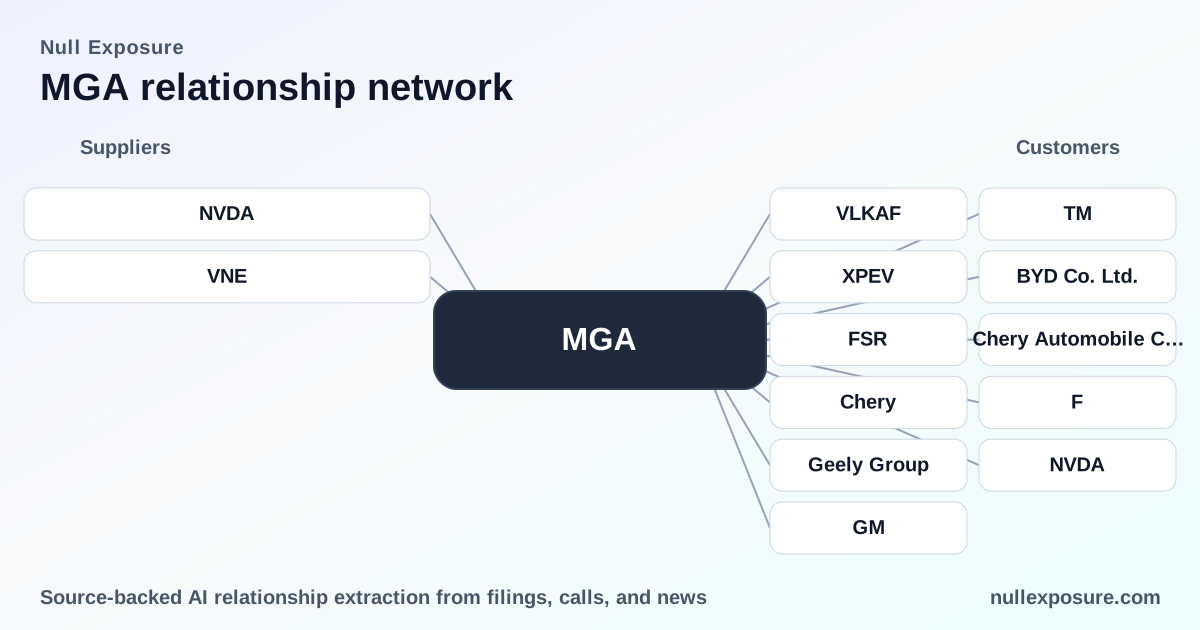
Magna International (MGA) — customer map and what it means for investors
Thesis: Magna is a global tier‑1 automotive supplier that monetizes through long-term OEM programs, systems integration and vehicle assembly contracts, collecting revenue from components, modules and increasingly from turnkey assembly and software-enabled systems. Its business mixes legacy ICE content with expanding electric‑drive and AV integration work, producing steady aftermarket‑resilient cashflow while exposing equity holders to OEM program timing and regional OEM concentration.
For a quick company signal and more research, visit the NullExposure homepage: https://nullexposure.com/
Why customer relationships drive Magna’s valuation
Magna’s top‑line and margin profile derive from program wins and the cadence of OEM launches. Each awarded program converts into multi‑year revenue streams, but those streams are lumpy: program ramps, regional plant start‑ups and cancellations create quarter‑to‑quarter variance. The company’s FY2025–FY2026 commentary and investor materials show an explicit push into China EV manufacturing and AV integration, shifting revenue mix toward higher‑growth but capital‑intensive contracts.
Key commercial dynamics to monitor:
- Contracting posture: long‑term OEM programs with tier‑1 integration responsibilities (components through vehicle assembly).
- Concentration: diversified across many OEMs globally, but individual program awards and large OEMs still drive substantial revenue swings.
- Criticality: Magna frequently acts as a mission‑critical supplier — in some contracts it is a primary assembler (Graz, Austria) or systems integrator for AV stacks.
- Maturity: legacy relationships with Ford, GM and Toyota coexist with newer EV partners and technology vendors, reflecting a transition stage rather than a purely mature supplier model.
Customer relationships: line‑by‑line evidence and source notes
Below I list every partner referenced in recent coverage and what that relationship implies for Magna’s revenue mix and strategic posture.
-
Volkswagen AG — Magna is identified alongside Volkswagen as one of the company’s large OEM customers, illustrating Magna’s presence in traditional OEM supply chains. According to The Globe and Mail (March 10, 2026), Volkswagen is cited among Magna’s big‑name customers. (theglobeandmail.com, 2026-03-10)
-
Mutares SE & Co. KGaA — Mutares signed agreements to acquire two automotive supplier businesses from Magna, indicating selective divestitures of non‑core supplier units. This reflects a portfolio pruning strategy to focus on higher‑margin systems and assembly. (marketsgroup.org, 2026-05-03)
-
IsoEnergy (ISOU) — A news item mentioning IsoEnergy is present in the results but is not commercially related to Magna’s operations; it shows incidental media cross‑mentions in the news crawl. The mention comes from SimplyWall (March 10, 2026) in broader market coverage. (simplywall.st, 2026-03-10)
-
Ford Motor Co. / Ford (F) — Ford program launches materially supported revenue growth in the most recent quarter, with new Ford SUV programs cited as a driver of a 2% revenue increase. Bloomberg/Morningstar coverage ties Magna’s quarter performance to Ford program ramps. (global.morningstar.com, 2026-03-10)
-
XPeng / XPEV / Xpeng — Magna assembles XPeng electric vehicles in Graz, Austria and secured European assembly contracts and program wins with XPeng, deepening Magna’s European EV assembly footprint. Multiple reports (Automotive News, Kalkine Media, Tikr, Intellectia) document roll‑offs and new model production. (autonews.com, 2026-03-10; kalkinemedia.com, 2026-03-10; tikr.com, 2026; intellectia.ai, 2026-05-04)
-
Fisker Inc. (FSR) — Magna recognized the impact of cancelled Fisker agreements as a material one‑time income item, with $196 million of Fisker deferred revenue recognized in Q3 2024 when those agreements were cancelled. That event is disclosed in Magna’s Q3 2025 results release. (GlobeNewswire press release, 2025-10-31)
-
Toyota Motor Corp. — Toyota is listed among Magna’s large OEM customer set in recent market commentary, reinforcing Magna’s exposure to established global OEM programs. The Globe and Mail referenced Toyota alongside other top OEMs. (theglobeandmail.com, 2026-03-10)
-
Chery / Chery Automobile Co. Ltd. — Magna opened a new facility in Wuhu to produce electric drives for Chery and support future growth, signalling an explicit manufacturing investment in China for EV drivetrain supply. (Magna press release, 2025)
-
General Motors Co. (GM) — GM appears among Magna’s major customer references in recent coverage, consistent with Magna’s long‑standing supplier role to North American OEMs. The Globe and Mail included GM in its OEM list. (theglobeandmail.com, 2026-03-10)
-
Geely Group — Magna’s China operations include relationships with Geely; coverage identifies Geely as one of the Chinese OEM partners as Magna builds local scale. (theglobeandmail.com, 2026-03-10)
-
BYD Co. Ltd. — BYD is named among Chinese manufacturers connected to Magna’s China footprint in market reporting, reflecting partnerships or supplier links in the region. (theglobeandmail.com, 2026-03-10)
-
REE Automotive (REE) — Magna entered a strategic collaboration to combine REE’s modular vehicle technology with Magna’s systems integration and manufacturing capabilities to develop customizable MEVs for commercial customers. (PR Newswire, 2021)
-
HiLo Group — As part of the Mutares transactions, HiLo Group will receive Magna’s car top systems business, a unit expected to generate about $85 million of revenue in 2025, indicating asset sells of lower‑strategic units. (marketsgroup.org, 2026-05-03)
-
Amaneos Group — Amaneos will acquire Magna’s European automotive lighting operations under the Mutares deals, reflecting further divestment of component businesses. (marketsgroup.org, 2026-05-03)
-
Xiaomi — Coverage of key launches cites Xiaomi among OEM/partner programs; Xiaomi is referenced in trading commentary on Magna’s program mix. (tradingview.com / Zacks summary, 2026-05-03)
-
GAC (Guangzhou Automobile Group Co.) — GAC reached a European production milestone with a roll‑off of its AION UT at Magna’s Austria facility, which confirms Magna’s role as a production partner for Chinese OEMs expanding to Europe. (Canadian Manufacturing, 2026-05-03)
-
NVIDIA (NVDA) — Magna announced it will offer DRIVE Hyperion‑compatible ECUs and tier‑1 integration services for NVIDIA DRIVE AV, marking a strategic move into AV systems integration with a leading software/hardware partner. This was described in Magna press materials and a company release. (Magna press release, 2026; GlobeNewswire, 2026-01-22)
What investors should watch next
- Program concentration and ramp cadence: watch upcoming quarterly commentary for which OEM ramps are entering production and which are still in engineering. Program timing drives working capital and margin volatility.
- China expansion versus localized risk: Magna is deploying capital for EV drivetrain plants in China and assembly in Austria for Chinese OEMs; these moves increase addressable revenue but concentrate capital and operational risk regionally.
- AV and software integration profits: partnerships such as the NVIDIA DRIVE integration are high‑value, higher‑margin opportunities; monitor backlog and pipeline disclosures for scope and customer commitments.
- Portfolio optimization: recent divestitures of lighting and other component units to Mutares and buyers like HiLo/Amaneos indicate a strategic tilt toward systems and assembly — track proceeds and margin impact.
Constraints and corporate signals
There are no explicit constraints flagged in the relationship coverage set — that absence is itself a company‑level signal: public sources do not show material contractual constraints or disclosed limits on Magna’s customer engagements in these results. Investors should treat this as a neutral signal and continue to monitor contract disclosures, divestiture proceeds and program termination clauses in SEC/Canadian filings.
For deeper portfolio impact modeling and to track program‑level disclosures, start your research with a focused company view at NullExposure: https://nullexposure.com/
Bold takeaways: Magna’s value rests on program wins and execution; expansion into EV assembly and AV integration is reshaping revenue quality while creating capital and execution risk. Institutional investors should weigh program concentration, regional execution risk and the speed at which new technology partnerships convert into recurring revenue.