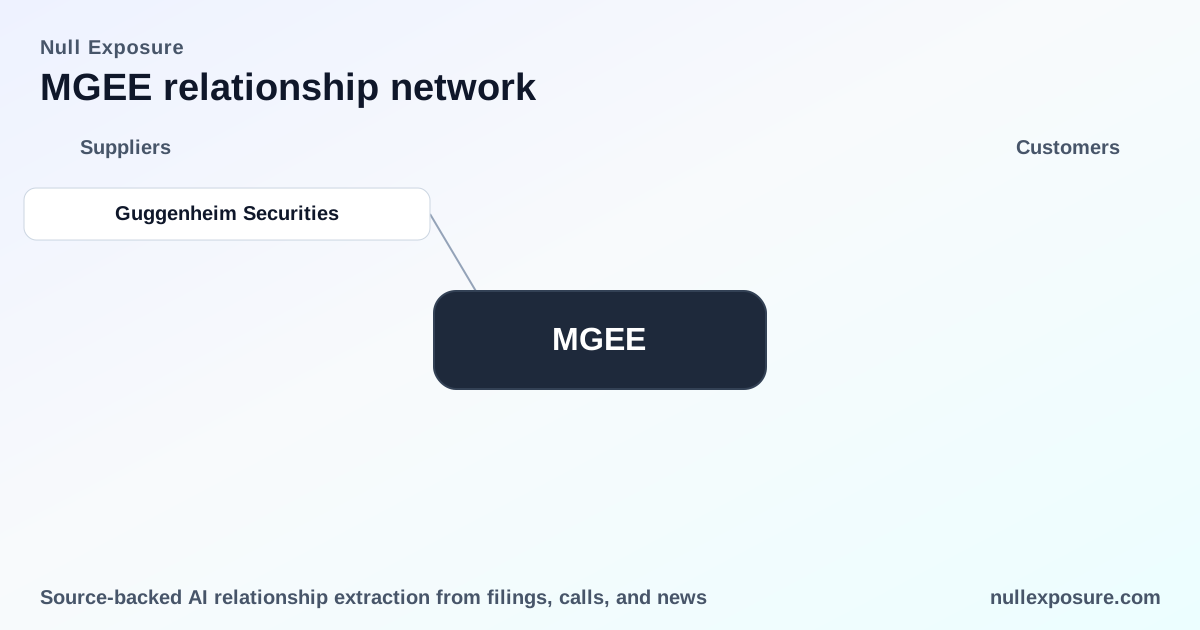
MGE Energy (MGEE): Customer Relationships and Strategic Implications for Investors
MGE Energy is a regulated utility holding company that monetizes through rate-regulated electricity and natural gas distribution, augmented by wholesale sales and long-term contract receipts. The company generates steady cash flow from roughly 167,000 electric and 178,000 gas customers concentrated in Dane County, Wisconsin, and returns capital to shareholders via a regular dividend. For a consolidated view of counterparty relationships and disclosure signals, see https://nullexposure.com/.
Investment thesis: regulated stability, local concentration, predictable cash generation
MGE Energy’s business model is straightforward and investor-friendly: regulated tariffs and natural monopolies create durable revenue streams, while limited exposure to commodity-driven wholesale volatility supports consistent earnings and free cash flow. Key financials underline that profile — trailing revenue of roughly $727 million, EBITDA near $287 million, a trailing P/E ~21.7, and a modest dividend yield (~2.3%). The company’s operations are low-beta and rate-regulated, producing highly predictable operating margins and cash flow, which supports its return on equity and dividend policy.
- Driver: Rate base and distribution economics capture long-lived utility investments.
- Constraint: Geographic concentration in Dane County and an urban cluster (Madison and adjacent cities) concentrates regulatory and demand risk locally.
- Capital posture: A mature, regulated utility that funds investment through predictable earnings and regulated returns rather than speculative growth projects.
What the filings show: the SCCO mention and why it does not create a confirmed MGEE customer
SCCO — In SCCO’s FY2024 10‑K, the filing discloses a 2012 power purchase agreement with an entity identified as “MGE” to supply power to some of SCCO’s Mexican operations through 2032; importantly, SCCO’s filing describes that counterparty as an indirect subsidiary of Grupo Mexico. Because SCCO’s disclosure explicitly identifies its counterparty as a Grupo Mexico subsidiary, this reference is a namesake and does not constitute evidence of a customer relationship with MGE Energy, the Wisconsin utility. (Source: SCCO FY2024 10‑K, filing dated Dec 31, 2024.)
Company-level relationship signals and what they mean for operators and investors
The document-level signals captured across MGE disclosures and the associated constraints describe a classic regulated-utility relationship profile. Presenting these as company-level characteristics:
-
Counterparty type — Individual / Residential: MGE’s core revenue derives from retail customers (residential accounts represent a material portion of electric revenues), which creates a billing and collection profile driven by many small accounts rather than a few large commercial contracts. This lowers single-counterparty credit risk but increases operational scale requirements. (Evidence: 2024 electric revenues and residential sales notes in corporate filings.)
-
Geography — North America, highly concentrated locally: MGE supplies electric service to approximately 167,000 customers, with ~91% located in Fitchburg, Madison, Middleton and Monona and the balance in adjacent areas; gas service covers ~178,000 customers across a similar footprint. This regional concentration amplifies regulatory and weather exposure tied to Wisconsin, as well as potential local growth or decline dynamics. (Evidence: MGE Energy corporate disclosures as of Dec 31, 2024.)
-
Role — Seller (primary) and Service Provider (conditional): The company primarily functions as a seller of electricity and natural gas and as the operator of distribution networks; it also provides gas transportation services under contract to customers who choose alternate gas suppliers. The dominant revenue model is retail utility service; ancillary wholesale sales are supplemental. (Evidence: MGE Energy segment descriptions and service contract language.)
-
Relationship stage — Active and operational: Service is rendered and revenues recorded as energy is delivered; the customer base is active and ongoing rather than episodic, which supports steady operating revenues and utility cash flows. (Evidence: operating revenue recognition and customer counts in 2024 filings.)
-
Segment focus — Core product / Distribution: The business is concentrated on core regulated utility activities: electric generation/purchase and distribution, and natural gas distribution. This is a mature, capital-intensive segment with rate-regulated returns and long asset lives. (Evidence: segment disclosures in 2024 filings.)
Collectively these signals point to a contracting posture oriented to long-term regulated service agreements and tariff-based revenue, not short-term commercial contracting. The business exhibits low counterparty concentration (many retail customers) but high geographic concentration and regulatory dependency.
Investment implications — risk and reward mapped to relationships
- Upside: Predictable cash flow and rate-base recovery support dividend continuity and capital investment plans; institutional ownership (~61%) and conservative financial metrics imply investor confidence. High service essentiality (electric and gas) makes revenue resilient and lowly cyclical.
- Risk: Localized demand or regulatory changes in Dane County have outsized impact given the geographic concentration; weather-driven volume swings are a recurring operational factor (noted declines in residential sales tied to weather in 2024). Long-term PPAs and wholesale exposures are limited but require monitoring for counterparty credit and contract tenor risk.
- Operational note: The company’s mix of core distribution and gas transportation services creates predictable revenue but also requires continued capex for grid reliability and regulatory engagement.
For a systematic view of counterparty disclosures and relationship signals across filings, visit https://nullexposure.com/.
One-by-one relationship listing (as represented in the source results)
- SCCO — SCCO’s FY2024 10‑K states that in 2012 it signed a power purchase agreement with an entity named “MGE” to supply power to some of SCCO’s Mexican operations through 2032; the SCCO filing explicitly identifies that counterparty as an indirect Grupo Mexico subsidiary, which indicates this “MGE” is a namesake and not MGE Energy (MGEE). (Source: SCCO FY2024 10‑K, filed Dec 31, 2024.)
Bottom line for investors and operators
MGE Energy is a mature, rate-regulated utility whose customer relationships are dominated by large numbers of retail customers in a concentrated regional footprint. The business model delivers stable, distribution-backed returns, but investors must price in geographic concentration and regulatory exposure. The single relationship flagged in external filings (SCCO) is a namesake reference and does not provide evidence of MGEE having material customer exposures outside its regulated territory.
Key takeaways:
- Predictable cash flow and dividend support from regulated rate base.
- Concentrated geography elevates local regulatory and demand risk.
- Retail customer base reduces single-counterparty credit risk but increases operational scale needs.
Explore detailed relationship analytics and filing-level signals at https://nullexposure.com/ to assess counterparty and disclosure risk for MGEE more thoroughly.