Magic Software (MGIC) — Customer Footprint and Contracting Profile
Magic Software Enterprises monetizes a dual model of licensed software and professional services: it sells proprietary application development and integration platforms, secures implementation contracts for vertical solutions, and captures recurring revenue through maintenance, cloud subscriptions and IT outsourcing agreements. Investors should view Magic as a steady mid‑market enterprise software vendor where deal flow and margin durability are driven by large integration projects, recurring support contracts, and selective M&A that expands vertical reach. For a concise view of customer relationships and implications for underwriting exposure, see Nillexposure’s summary at https://nullexposure.com/.
How Magic’s commercial engine converts deals into cash
Magic operates as an integrated software-and-services company. Upfront license and implementation fees generate large, lumpy cash inflows, while maintenance, SaaS hosting and outsourcing contracts produce the recurring revenue that stabilizes margins. Company-reported trailing twelve‑month revenue is $603.2M with gross profit of $169.8M (latest quarter 2025‑09‑30), supporting an operating margin around 10.6% and a net profit margin near 6.6%. These outcomes reflect a business where services-heavy deals compress initial margins but create long-run annuity value through renewals and hosting agreements.
- Revenue mix matters: higher share of cloud/subscription and support lifts valuation multiple; services-heavy quarters compress EBITDA temporarily but increase customer entrenchment.
- Balance-sheet and ownership signals: MGIC shows a market cap near $853M and strong insider ownership (~47%), which indicates management alignment with long-term commercial outcomes.
Customer relationships, concentration and contracting posture
Investors and operators need to evaluate three practical constraints when underwriting exposure to Magic: contracting posture, customer concentration, and functional criticality. These are company-level signals rather than itemized limits in filings.
- Contracting posture: Magic’s commercial deals are predominantly project-based integration engagements followed by multi-year support and hosting agreements. Project revenue is lumpy; recurring support revenue is predictable and drives valuation multiple.
- Concentration: Public disclosure does not list a single dominant customer that accounts for a majority of revenue; however, the business model inherently produces material revenue per large client when integration projects are won.
- Criticality and stickiness: Integration and legacy migration work creates high switching costs once systems are embedded, producing durable renewal economics for maintenance and managed services.
- Maturity: The company operates as an established mid-cap software provider with steady EBITDA generation (EV/EBITDA ~9.8) and a dividend yield around 5.8%, indicating a mature cash-return profile.
If you want a quick portal to monitor these customer dynamics, Nillexposure keeps a running view at https://nullexposure.com/.
Relationship catalog: what’s public and why it matters
Magic’s public relationship trail is compact in the reviewed material; the available customer mention is specific and instructive about the firm’s go-to-market in enterprise integration.
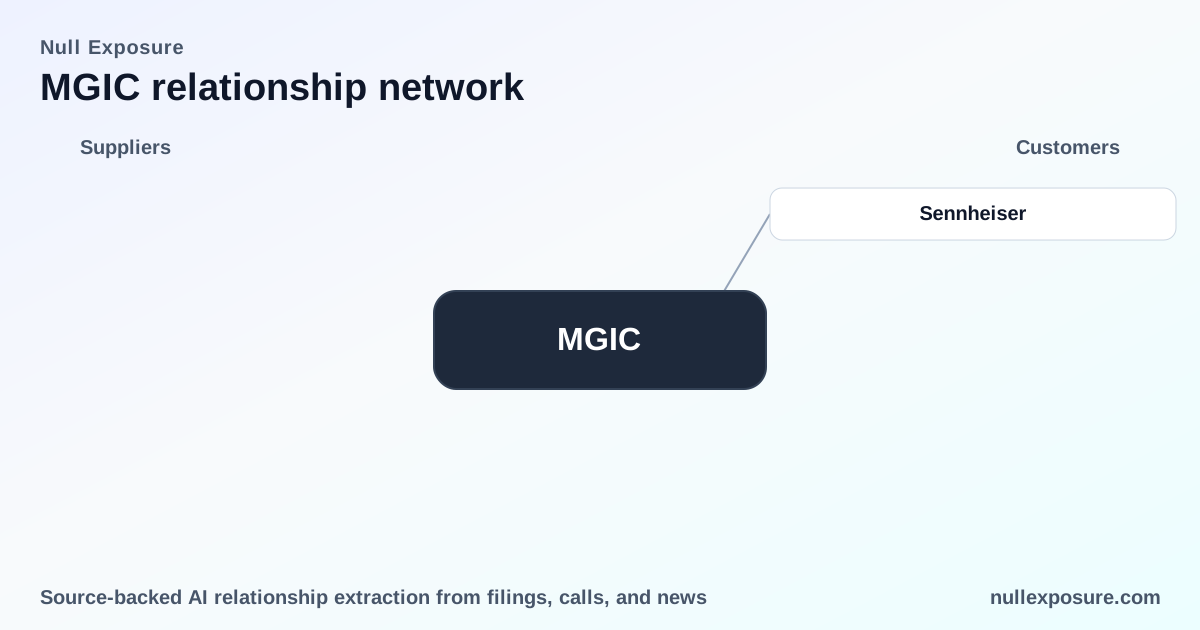
Sennheiser — integration contract (reported FY2015)
Magic secured an integration deal with audio‑equipment maker Sennheiser as part of its enterprise systems work; the engagement highlights Magic’s ability to win cross-border integration assignments for international brands. This relationship was reported by Globes in connection with Magic’s operational activity and deal wins. (Source: Globes article covering the firm’s integration wins and acquisitions, cited as reporting on the FY2015 activity — https://en.globes.co.il/en/article-magic-acquires-leading-israeli-it-co-1001013500)
That single, explicit customer mention is consistent with Magic’s profile: pursue mid‑to‑large integration wins that convert into recurring support and hosting revenue.
What this relationship set implies for underwriters and operators
With the relationship evidence limited but directionally consistent, lenders and investors should underwrite Magic with the following operational characteristics in mind:
- Revenue lumpy but recurriyng backbone: Expect quarters with outsized services revenue followed by higher-margin annuity flows from maintenance and SaaS.
- Integration projects drive customer lifetime value: Winning a large integration (as with Sennheiser) creates multi-year maintenance and upgrade streams that are more valuable than one-off services.
- Moderate client concentration risk: A project-driven model creates episodic customer concentration risk; diligence should emphasize contract length, renewal rates and revenue-at-risk by customer.
- Contract maturity and enforceability matter: Long-term hosting and maintenance contracts reduce volatility; where contracts are primarily time-and-materials, cash predictability weakens.
These are company-level underwriting signals rather than constraints tied to an individual customer unless a contract explicitly names such terms.
Financial levers and risk factors relevant to customer exposure
Investors evaluating MGIC should weigh these levers against customer behaviors:
- Shift to subscription improves multiple: A sustained migration of license revenue into subscription and hosting would increase revenue visibility and likely re‑rate the stock from its current EV/Revenue and EV/EBITDA comparables.
- Service mix squeezes near-term margins: Large implementations reduce gross margin in the quarter they occur; margin normalization requires steady renewal rates.
- Foreign exposure and currency: Headquartered in Israel with global customers creates FX dynamics that affect reported results; margin protection depends on contract currency and hedging policy.
- Competitive pricing pressure: Systems integrators and hyperscale cloud providers exert pricing pressure on implementations; Magic’s product differentiation and vertical solutions drive its pricing power.
Key financials to watch: trailing revenue ~$603M, gross profit ~$170M, operating margin ~10.6%, return on equity ~15.6%, and EV/EBITDA ~9.8 (company-reported TTM figures through 2025‑09‑30).
Practical due-diligence checklist for investors and partners
Operators and analysts should prioritize the following items when validating exposure to Magic’s customer book:
- Obtain the top‑10 customer revenue schedule and renewal cadence.
- Ascertain the split between license, services and recurring hosting revenue.
- Review contract terms for termination rights, price escalators and foreign‑currency clauses.
- Validate historical renewal and churn rates for maintenance and SaaS contracts.
Bottom line and what to watch next
Magic’s commercial strength is its ability to turn sizeable integration projects into multi‑year recurring cash flows. The publicly reported relationship (Sennheiser integration) is a representative example of that model: win an integration, convert to support, and realize long-term customer value. Watch for a meaningful pivot in revenue mix toward subscriptions and hosting, contract renewal metrics for large clients, and any disclosures of customer concentrations that alter revenue risk.
For structured monitoring and a concise portal on customer relationships and exposure across software vendors, visit Nillexposure at https://nullexposure.com/.