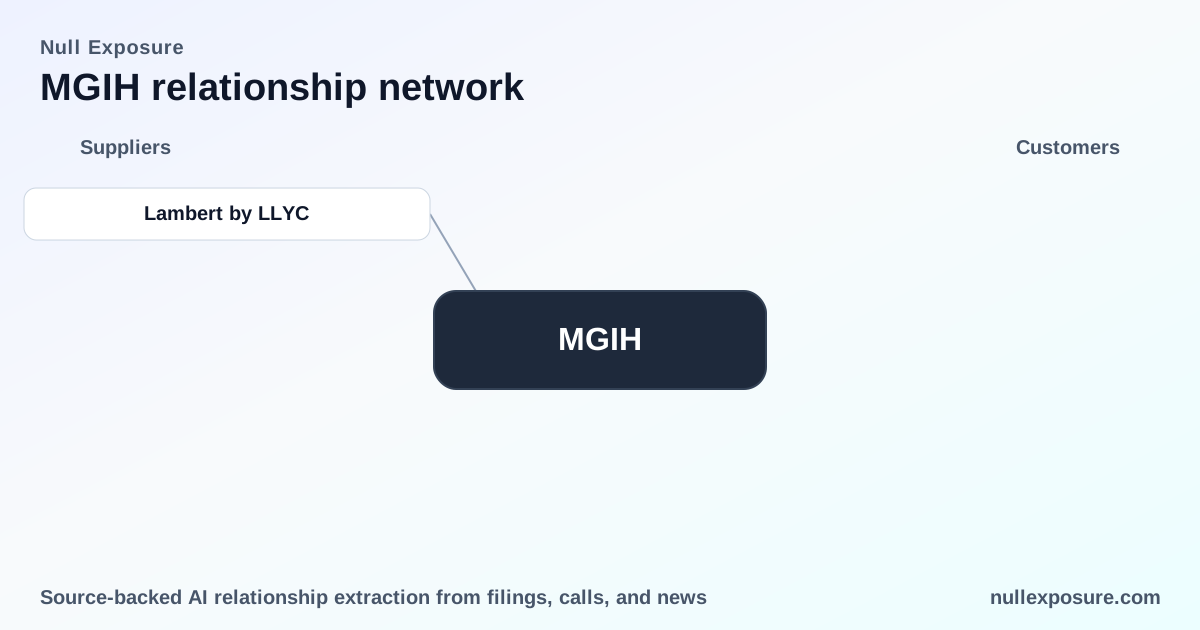
MGIH customer relationships: related-party revenue, logistics fees and working‑capital swings
Millennium Group International Holdings Limited (MGIH) operates a paper‑based packaging business across Greater China, Southeast Asia and the US, monetizing through product sales, logistics and some property rental income. Revenue generation is concentrated in transactional sales and intra‑group flows; working capital management is the primary earnings lever given negative operating margins and sizable related‑party advances reported in FY2023. For a full view into counterparty exposures and filings, visit https://nullexposure.com/.
What the FY2023 disclosure implies for investors and operators
The company’s FY2023 disclosure filed with the SEC shows multiple customer and service relationships that are explicitly “common controlled by the shareholders”, indicating related‑party activity is a material feature of the revenue and cash‑flow picture. MGIH reported sales, receipts, advances and repayments with these counterparties rather than solely arm’s‑length third‑party customers, which influences contract enforceability, credit terms and cash conversion cycles. Financially the company is operating with negative EBITDA and operating margins, limited institutional ownership and very high insider ownership (about 88.9%), which together create concentration and governance considerations for outside investors.
Company‑level signals worth noting:
- Contracting posture: Predominantly intra‑group / related‑party transactions, which implies looser commercial terms and the potential for non‑standard reconciliation of receivables and advances.
- Concentration: High insider ownership and low institutional ownership reduce external governance pressure on commercial counterparties and related‑party terms.
- Criticality: Related‑party advances and repayments affect liquidity and working capital more than product margins given FY2023 profitability metrics.
- Maturity: The pattern of advances, repayments and reciprocal cash flows suggests a developing but active internal financing posture rather than fully mature third‑party customer contracts.
No relationship‑specific legal or regulatory constraints were flagged in the relationships dataset; on a company level, the feed surfaced no constraints to report.
Line‑by‑line: what each reported customer relationship contributes
Below I cover every relationship disclosed in the FY2023 filing; each entry is concise and tied to the company filing.
M‑GEN Innovation Company Limited
MGI sold to and received receipts from M‑GEN, and the FY2023 filings show significant non‑trade advances and repayments between the companies, including a large advance repaid to MGIH; the transactions are recorded as related‑party flows under shareholder control. According to the FY2023 SEC filing, this relationship recorded both trade sales and material non‑trade advances and repayments (see the company’s FY2023 disclosure). Source: FY2023 company filing on the SEC (424B4).
Sing Wise Limited
Sing Wise is listed as a shareholder‑controlled counterparty with trade flows (imports, sales and receipts) and discrete non‑trade repayments, plus a decrease in amounts due associated with a separation event (YWPPC) in FY2023. The FY2023 disclosure records import services, sales receipts and a repayment recorded as non‑trade, indicating cross‑entity clearing rather than pure third‑party sales. Source: FY2023 company filing on the SEC (424B4).
Wah Tung Thai Logistics Company Limited (WTTL)
WTTL is recorded as a shareholder‑controlled customer that generated material sales to MGIH in FY2023 (noted as a line item of sales). The record in the FY2023 filing lists WTTL under common control and records sales in the period, which investors should treat as related‑party revenue rather than independent market validation. Source: FY2023 company filing on the SEC (424B4).
Wah Tung Thai Logistics (Shenzhen) Limited (WTTLSZ)
WTTLSZ supplied logistics services and was the counterparty for logistics fees, payments and rental income flows, including notable receipts and non‑trade advance repayments. The FY2023 filing shows both expense and reimbursement lines for logistics and rental income that were handled within the group, together with an advance repayment entry, highlighting cash‑flow interchanges rather than arm’s‑length commercial payments. Source: FY2023 company filing on the SEC (424B4).
What these relationships mean for valuation and risk
Related‑party revenue inflates top‑line variability and complicates cash forecasting. Given MGIH’s negative operating margins and the presence of large advances and repayments, investors must treat reported sales from these entities as partly a reflection of intra‑group cash management and not exclusively external demand.
Key investor takeaways:
- Liquidity risk: Advances and repayments between related parties indicate active internal financing; this concentrates funding risk inside the shareholder group and can magnify liquidity stress under an adverse scenario.
- Revenue quality: A portion of reported sales is derived from entities common‑controlled by shareholders, reducing the signal value of top‑line growth as proof of open‑market demand.
- Governance and transparency: Very high insider ownership limits independent oversight; the related‑party disclosure is adequate in form but raises governance questions for minority holders.
- Counterparty criticality: Logistics and import services provided by related entities form operational dependencies—disruption or change in those intra‑group arrangements would immediately affect cost structure and delivery capability.
Practical guidance for operators and credit teams
Operators and risk managers should adjust working‑capital models to reflect intercompany timing mismatches and insist on clearer contractual terms for intra‑group advances (formal repayment schedules, interest, collateral where appropriate). Credit teams evaluating MGIH should prioritize cash‑flow analysis over headline margin trends and model scenarios where related‑party inflows reverse or slow.
Closing observations and next steps
MGIH’s FY2023 customer schedule is defined by related‑party commercial and financing flows, with logistics, rental and sales lines processed inside a shareholder‑controlled group. For investors this yields lower revenue quality, tighter liquidity sensitivity, and governance risks that should be priced into valuation and covenant structures. For additional coverage and structured summaries of filings like this, visit https://nullexposure.com/.
If you want a tailored model that converts these related‑party flows into cash‑flow scenarios or a diligence checklist for counterparties, I can prepare one focused on liquidity stress tests and contractual controls.