Marygold Companies (MGLD) — Customer relationships that move the P&L
Marygold Companies monetizes a portfolio of experiential and finance-adjacent businesses through fund management fees, wholesale/distribution revenues, product manufacturing and discrete asset sales. Revenues are driven primarily by US-based fund-management operations and a handful of high-concentration commercial customers, while episodic asset dispositions and private placements supply working capital. For investors, the story is one of concentrated cash flow drivers juxtaposed against diversified operating segments and intermittent non‑core asset sales.
For a mapped view of relationships and implications, visit https://nullexposure.com/ for deeper customer and counterparty intelligence.
What the recent headlines show — compact, actionable takeaways
Marygold’s recent public activity clusters into three relationship vectors: an asset sale of a security subsidiary, a strategic M&A letter of intent involving Montana Goldfields, and a private placement led by an institutional purchaser. Each action has direct cash-flow or balance-sheet implications and helps explain current liquidity moves.
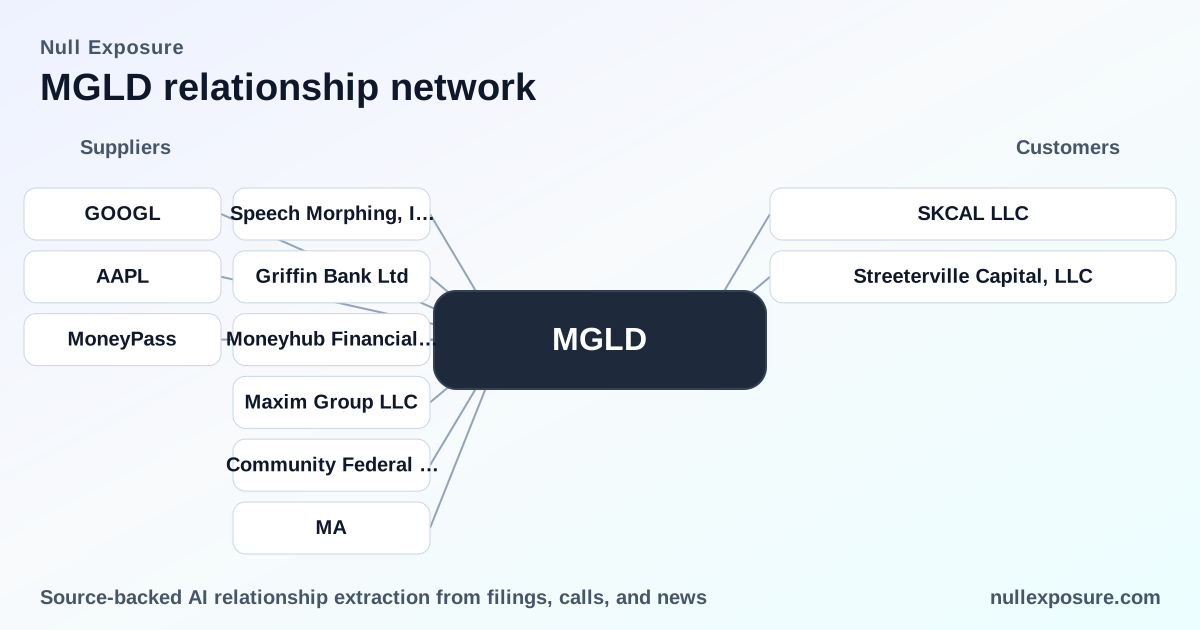
SKCAL LLC — buyer of Brigadier Security Systems
SKCAL LLC completed the acquisition of Brigadier Security Systems Ltd. from Marygold for roughly $2.2–$2.3 million, representing a small but tangible disposal of Marygold’s security-systems business. This transaction is reported in MarketScreener (March 10, 2026) and echoed by SimplyWall.St (May 3, 2026). According to those reports, the sale transfers Brigadier’s Canadian alarm business out of Marygold’s portfolio and reduces Marygold’s exposure to that hardware/services segment.
Sources: MarketScreener (Mar 10, 2026); SimplyWall.St (May 3, 2026).
Captivision (CAPT) — LOI involving Montana Goldfields assets
Captivision (Nasdaq: CAPT) announced a letter of intent to acquire Montana Tunnels Mining and the Montana Tunnels Mine from Montana Goldfields, with an implied pre-transaction valuation cited in press coverage as ~$750 million versus Captivision’s market cap reported at ~$50 million at the time; the deal contemplates a rebranding to Montana Gold Inc. and Nasdaq listing as MGI. StockTitan reported the LOI details on March 9, 2026, signaling an attempted strategic repositioning by the buyer and an asset-exit pathway for the seller group.
Source: StockTitan (Mar 9, 2026).
Streeterville Capital, LLC — institutional private placement counterparty
Marygold completed a $6.56 million secured promissory note private placement with Streeterville Capital, LLC to finance rollout initiatives for a fintech product, according to coverage in SiliconCanals. That financing provides bridge capital for Marygold’s fintech push while highlighting reliance on bespoke debt placements rather than public equity or institutional fundraisings.
Source: SiliconCanals (Mar 10, 2026).
How these relationships change the operating picture
The three relationships collectively illustrate Marygold’s dual operating posture: active portfolio management (disposing non-core assets like Brigadier) alongside capital raises to underwrite growth initiatives (the Streeterville note), and larger corporate restructuring potential through asset-level deals tied to Montana Goldfields.
- Contracting posture: Marygold uses direct asset sales and private placements as primary levers for capital allocation rather than large-scale public equity raises.
- Concentration and criticality: Company disclosures and excerpted evidence show material revenue concentration in select subsidiaries and customers, which creates outsized P&L sensitivity to a small number of counterparties.
- Maturity and segmentation: The business is a hybrid of mature cash-generating fund-management operations and earlier-stage initiatives like fintech and retail/hospitality distribution, producing mixed margin profiles.
Constraints and company-level signals investors should factor
Company-sourced excerpts and filings provide a clear set of operating constraints that define Marygold’s risk profile and opportunity set:
- High customer concentration is a material factor. Filings disclose that a consortium accounted for 55% of bakery-sector revenue in FY2025, and the two largest clients in printing comprised 59% of that sector’s revenue. Separately, for one security business, sales to the largest customer were 44% of total revenue for the year ended June 30, 2025. These numbers point to single-counterparty risk embedded within multiple business lines (company filings, FY2025).
- Geographic reach is broad but uneven. Evidence excerpts identify operations in North America, EMEA and APAC — including New Zealand manufacturing, UK subsidiaries, and U.S. fund-management headquarters — implying global footprint with region-specific concentration (company filings).
- Segment diversification creates operational complexity. Marygold generates revenue from services (fund management), distribution (wholesale hair and skin care), hardware (alarm systems), manufacturing (food products), and software (a fintech app launched in June 2023 in the US and March 2025 in the UK). This breadth supports revenue diversification but raises integration and capital allocation challenges (company filings and product launch disclosures).
- Materiality of fund-related revenues. Management states that 57% of revenues in FY2025 derived from USCF Investments operations (ETF management), indicating the fund-management arm is the primary cash engine for the consolidated group (FY2025 filings).
- Funding posture is tactical. The Streeterville private placement underscores reliance on secured, medium‑term debt instruments to finance growth initiatives rather than dilution through public equity (SiliconCanals coverage).
What investors should watch next
- Customer concentration metrics: Quarterly disclosure of top-customer revenue shares and any changes after the Brigadier sale will directly affect revenue stability estimates. If top-customer shares remain elevated, downside volatility increases.
- Integration of fintech product and related cash burn: The Streeterville-backed rollout requires clear milestones; investors should look for user/adoption KPIs and runway extension terms embedded in the promissory note.
- Progress on Montana Goldfields dispositions or restructurings: Any material cash proceeds or equity reorganizations tied to Montana assets will alter leverage and may unlock valuation catalysts.
- Balance-sheet health: With negative EBITDA and operating margins reported, monitor liquidity ratios, covenant language in secured notes, and any further asset sales.
For a detailed map of counterparties, investor due diligence services are available at https://nullexposure.com/.
Bottom line — a structured, concentrated recovery story
Marygold is executing a pragmatic capital and portfolio strategy: dispose non-core hardware assets, secure targeted institutional financing for growth projects, and pursue strategic exits/reorganizations tied to mining assets. That approach supports near-term liquidity but leaves long-term equity upside dependent on successful scale of fintech and sustained ETF-management cash flows. Given high customer concentration, mixed segment maturity, and current negative profitability, investors should treat improvements in top-line stability and financing flexibility as the principal catalysts for rerating.