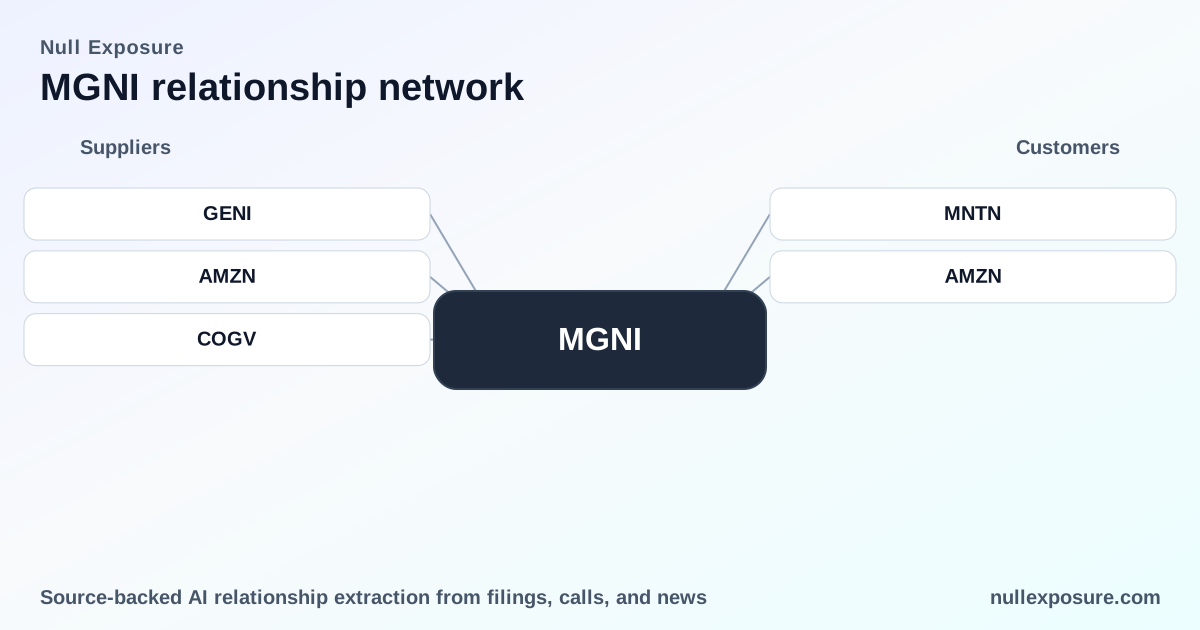
Magnite (MGNI): Customer Relationships That Drive Scale and Risk
Magnite operates the largest independent sell‑side ad platform, monetizing by taking a percentage of ad spend and charging fixed CPMs for select inventory and services. Its business blends software and services to connect global publishers and major advertisers across CTV, web, and mobile, generating revenue predominantly on a usage‑based basis tied directly to advertiser spend. For investors, the customer map is both a growth engine — premium publisher integrations and large buyer relationships — and a concentration risk given the economics of ad marketplaces. Learn more about how we profile customer relationships at Null Exposure.
Why customers matter: the two sides of Magnite’s marketplace
Magnite’s revenue is operationally aligned with advertiser spend: the company collects fees as impressions transact across its SSP and video ad server (SpringServe). That model delivers high operating leverage when spend grows but exposes the company to buyer concentration and churn because a small number of large buyers and premium sellers account for a disproportionate share of flows. The company reports a global footprint with established operations in North America, Europe and Australia and a growing presence in Asia and Latin America — a signal that its platform strategy is both global and dependent on cross‑region demand.
For direct access to our customer intelligence coverage and relationship analytics, visit Null Exposure.
Relationship map: every partner and what it means for MGNI
Hearst News
Hearst selected Magnite as a preferred deal partner to power high‑impact ad formats across web and CTV, with SpringServe supporting Hearst’s video ad operations — a clear win for premium publisher inventory on Magnite’s stack (finviz / MarketScreener coverage, April–May 2026: https://finviz.com/news/322528/).
Roku
Roku is named among large platform partners driving growth, indicating Magnite’s reach into major CTV buying ecosystems and strong demand from streaming platforms (earnings call transcript coverage, FY2026: https://www.insidermonkey.com/blog/magnite-inc-nasdaqmgni-q4-2025-earnings-call-transcript-1705144/).
Netflix
Netflix is referenced as a significant CTV partner in Magnite’s commentary on industry momentum, reinforcing Magnite’s access to premium streaming inventory buyers (Globe and Mail / transcript coverage, FY2026: https://www.theglobeandmail.com/investing/markets/stocks/ROKU/pressreleases/1118693/).
MNTN
MNTN announced a partnership to route performance CTV campaigns into Magnite’s inventory, enabling MNTN advertisers to access live sports and breaking‑news content — a tactical expansion of performance marketers into premium streaming (press release / FinancialContent, Jan–Mar 2026: https://markets.financialcontent.com/stocks/article/gnwcq-2026-1-22-mntn-and-magnite-turn-live-streamings-biggest-moments-into-performance-tv-for-growth-brands).
Warner Bros. Discovery
WBD is listed among large, high‑value buyers showing strong growth on Magnite’s platform, underscoring Magnite’s integration with major network inventory (earnings call transcript coverage, FY2026: https://www.insidermonkey.com/blog/magnite-inc-nasdaqmgni-q4-2025-earnings-call-transcript-1705144/).
Best Buy Ads
Best Buy Ads designated Magnite as its exclusive SSP and curation partner in September 2025, building commerce‑driven audience targeting around electronics purchase data — a signature commerce media win (ppc.land, May 2026: https://ppc.land/expedias-200-petabytes-of-traveler-data-lands-in-magnites-programmatic-pipes/).
Best Buy (commerce partnerships)
Best Buy is also named among commerce media partners that are deployed and ramping, signaling Magnite’s push into first‑party commerce signals and identity‑light targeting (earnings call transcript coverage, FY2026: https://www.insidermonkey.com/blog/magnite-inc-nasdaqmgni-q4-2025-earnings-call-transcript-1705144/).
Expedia (EXPE)
Expedia routed traveler‑level event data into Magnite’s supply infrastructure, broadening programmatic access for advertisers across buyer platforms and increasing the value of Magnite’s seller pool (ppc.land, May 2026: https://ppc.land/expedias-200-petabytes-of-traveler-data-lands-in-magnites-programmatic-pipes/).
The New York Times
The New York Times selected Magnite as a preferred private marketplace partner for premium mobile app inventory, reinforcing Magnite’s position in premium publisher PMPs (ppc.land, May 2026: https://ppc.land/expedias-200-petabytes-of-traveler-data-lands-in-magnites-programmatic-pipes/).
VIZIO
VIZIO is cited among large platform players generating growth on Magnite’s platform, reflecting scale across TV OEM ad channels (earnings call transcript coverage, FY2026: https://www.insidermonkey.com/blog/magnite-inc-nasdaqmgni-q4-2025-earnings-call-transcript-1705144/).
NOVA Entertainment
Magnite partnered with NOVA Entertainment to enable programmatic access to NOVA’s retail network — a regional audio/retail programmatic expansion (finviz coverage, May 2026: https://finviz.com/news/324824/magnite-mgni-climbs-126-on-strong-earnings-buyback-plan).
AMC Global Media (AMCX)
Magnite expanded collaboration with AMC Global Media so advertisers can buy linear TV, FAST channels and AMC+ inventory programmatically and adopted Magnite’s Live Scheduler for live linear addressable inventory (stockstotrade coverage, May 2026: https://stockstotrade.com/news/magniteinc-mgni-news-2026_05_02/).
Publicis Media Exchange
Publicis Media Exchange is testing extended seller agent workflows with Magnite’s AI tools, indicating agency network integration for automated buying/selling (stockstotrade coverage, May 2026: https://stockstotrade.com/news/magniteinc-mgni-news-2026_05_02/).
Genius Sports (GENI)
Genius Sports embedded live sports moments into Magnite’s programmatic infrastructure, creating new monetization channels for live sports content (finviz / MarketBeat coverage, Mar–May 2026: https://finviz.com/news/324824/magnite-mgni-climbs-126-on-strong-earnings-buyback-plan).
Fubo (FUBO)
Magnite rolled out “pause” ad formats across Fubo in August 2025 and integrated Fubo inventory into its sell‑side infrastructure, expanding CTV ad placements for sports audiences (ppc.land, May 2026: https://ppc.land/fubo-rebuilds-its-mobile-app-with-ai-for-on-the-go-sports-fans/).
Kepler
Kepler is participating in buyer‑agent testing for Magnite’s AI buyer agent with access to Disney Advertising inventory, signaling early adoption of agentic buying tools among agency trading desks (stockstotrade coverage, May 2026: https://stockstotrade.com/news/magniteinc-mgni-news-2026_05_02/).
MiQ
MiQ is testing Magnite’s buyer agent tools and used Scope3 as a buyer agent on campaigns, showing agency programmatic workflows routed through Magnite (stockstotrade and transcript coverage, FY2026: https://stockstotrade.com/news/magniteinc-mgni-news-2026_05_02/; https://www.insidermonkey.com/blog/magnite-inc-nasdaqmgni-q4-2025-earnings-call-transcript-1705144/).
Scope3
Scope3 served as a buyer agent on behalf of MiQ for campaigns running across LG and Warner Bros. Discovery inventory, illustrating multi‑party execution models on Magnite’s platform (earnings call transcript coverage, FY2026: https://www.insidermonkey.com/blog/magnite-inc-nasdaqmgni-q4-2025-earnings-call-transcript-1705144/).
United Airlines
United is listed among commerce media partners deployed and ramping with Magnite, showing airline loyalty data being used for targeted programmatic buys (earnings call transcript coverage, FY2026: https://www.insidermonkey.com/blog/magnite-inc-nasdaqmgni-q4-2025-earnings-call-transcript-1705144/).
PayPal
PayPal is a commerce media partner in Magnite’s growing roster, enabling payments‑signal driven ad targeting (earnings call transcript coverage, FY2026: https://www.insidermonkey.com/blog/magnite-inc-nasdaqmgni-q4-2025-earnings-call-transcript-1705144/).
Pinterest is included among commerce media partners working with Magnite as the company scales first‑party integrations (earnings call transcript coverage, FY2026: https://www.insidermonkey.com/blog/magnite-inc-nasdaqmgni-q4-2025-earnings-call-transcript-1705144/).
Paramount
Paramount is cited as a major buyer delivering growth on Magnite’s platform, reinforcing Magnite’s network relationships with major media owners (earnings call transcript coverage, FY2026: https://www.insidermonkey.com/blog/magnite-inc-nasdaqmgni-q4-2025-earnings-call-transcript-1705144/).
Walmart
Walmart is named among large players driving activity on Magnite, pointing to retailer ad inventory and demand carried on the platform (earnings call transcript coverage, FY2026: https://www.insidermonkey.com/blog/magnite-inc-nasdaqmgni-q4-2025-earnings-call-transcript-1705144/).
LG Ads
LG Ads is referenced as a high‑growth buyer on Magnite, confirming OEM TV ad partnerships (earnings call transcript coverage, FY2026: https://www.insidermonkey.com/blog/magnite-inc-nasdaqmgni-q4-2025-earnings-call-transcript-1705144/).
Amazon / Amazon Publisher Services (APS)
Magnite struck a CTV deal with Amazon Publisher Services that gives Amazon a direct footprint within Magnite’s platform, an uncommon integration that deepens access to Amazon CTV inventory (Adweek, Mar 2026: https://www.adweek.com/commerce/magnite-strikes-ctv-deal-with-amazon-publisher-services/).
Viant / DSP (Direct Access program)
Viant integrated directly with Magnite’s SpringServe video ad server to expand its Direct Access program, improving supply transparency and direct‑to‑publisher CTV paths (StockTitan coverage, Nov 2025–Mar 2026: https://stockstotrade.com/news/DSP/).
TNA Wrestling
TNA iMPACT (a live event carried by AMC) uses Magnite’s Live Scheduler to optimize live linear addressable inventory, demonstrating use cases for live event monetization (InsiderMonkey coverage, FY2026: https://www.insidermonkey.com/blog/magnite-mgni-partners-with-amc-global-media-for-service-expansion-1743366/?amp=1).
Operating constraints and investment implications
- Contracting posture: Magnite’s revenue is predominantly usage‑based, collected as a percentage of ad spend with selective fixed CPM contracts, which aligns revenue with advertiser demand and increases margin leverage on growth (company filings / FY2024–FY2025 disclosures).
- Concentration risk: Two buyers indirectly contributed approximately 39% of revenue in 2024, so buyer churn or pricing pressure from a few large counterparties is a clear downside risk to cash flow stability.
- Global footprint and regional maturity: The business is global with established operations in NA, EMEA and APAC (Australia) and developing presence in LATAM and Asia, implying both diversification benefits and local execution complexity.
- Counterparty profile: The customer base is weighted to very large enterprises (major platforms, publishers, retailers), which increases commercial bargaining power on the buyer side.
- Role mix and product stack: Magnite functions as both a seller platform (publisher tooling) and buyer gateway (SSP+SpringServe)—a hybrid software + services vendor that benefits from scale but requires continuous product investment.
Bottom line
Magnite’s customer relationships are the company’s primary growth engine and the principal source of concentration risk. Premium publisher integrations (Hearst, NYT, AMC) and deep links to major buyers (Roku, Netflix, Amazon, large retailers) validate the platform, while the usage‑based revenue model and buyer concentration demand active monitoring by investors. For systematic coverage and forward‑looking relationship analytics, visit Null Exposure.