MGRC Customer Relationships: What Investors Need to Know
McGrath RentCorp operates a diversified, business‑to‑business rental platform focused on relocatable modular buildings, portable storage containers and electronic test equipment, monetizing primarily through recurring rental contracts supplemented by occasional equipment sales. The company combines short‑term, high‑turnover rental revenue (30‑day terms) with longer sales‑type lease arrangements (12–36 months) that are collateralized by the underlying rental assets, creating a hybrid revenue stream that blends cash flow predictability with episodic sale proceeds. Visit the research hub for deeper coverage: https://nullexposure.com/
How the customer base actually looks and why it matters
McGrath’s customers are a mix of public sector buyers (notably K–12 school districts) and large private enterprises across aerospace, defense, communications, manufacturing and semiconductor sectors, with the business concentrated in North America but with limited international activity. This structure produces two important commercial dynamics: stable, repetitive rental demand tied to infrastructure and educational spending and lumpy receipts tied to equipment disposals and one‑time transactions. Financially, that duality shows up as steady margins and ROE alongside occasional large items that distort period‑to‑period comparatives.
- Material exposure to the education market is meaningful: modular rentals and sales to public school districts accounted for roughly 24% of rental and sales revenues in 2024. That is a company‑level revenue concentration that influences cash flow sensitivity to public budgets and capital cycles.
- North America is the core geography, with foreign revenue representing low single digits of total revenue in recent years.
- Contract mix is heterogeneous: 30‑day rental terms coexist with sales‑type leases that run multiple quarters and are collateralized.
Relationship inventory: the specific counterparties cited in sources
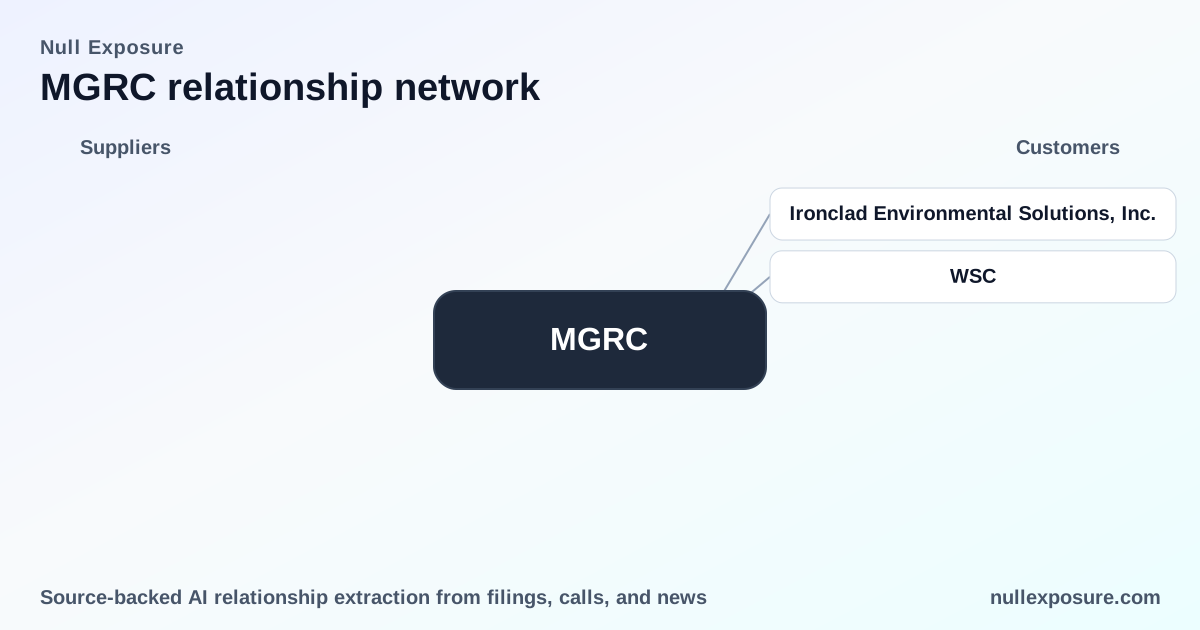
Ironclad Environmental Solutions, Inc.
McGrath disclosed the sale of Adler Tank Rentals, LLC to Ironclad Environmental Solutions, Inc., with the transaction completed on February 1, 2023, per the company's FY2024 Form 10‑K. This reflects MGRC’s routine disposition activity in non‑core or specialized assets and is recorded as a customer/transactional relationship in the public filing. (Source: McGrath RentCorp Form 10‑K, FY2024)
WillScot Mobile Mini (WSC) — TradingView news entry
A TradingView news post covering MGRC’s Q4 2025 results and dividend increase noted that a $180.0 million merger termination payment was received from WillScot Mobile Mini in 2024, and that payment materially affected year‑over‑year comparisons reported in FY2026 commentary. This is an item that created a one‑off cash inflow and distorted operating comparatives across reporting periods. (Source: TradingView coverage of MGRC Q4 2025 results and dividend announcement, March 2026)
WSC — duplicate entry (same underlying counterparty)
The dataset also contains a duplicate mention labeled simply “WSC” that repeats the TradingView observation about the $180.0 million termination payment from WillScot Mobile Mini; both records reference the same external reporting item and economic impact. For reporting and model adjustments, treat these entries as the same counterparty and the same non‑recurring cash event. (Source: TradingView coverage of MGRC Q4 2025 results and dividend announcement, March 2026)
What the relationships and constraints tell investors about MGRC’s operating model
Translate the constraint evidence into an operational profile investors can use:
-
Contracting posture — mixed and flexible. MGRC runs a combination of short‑term rental contracts (standard 30‑day terms) alongside sales‑type leases that typically run 12–36 months and are collateralized by the asset, enabling both recurring revenue and recovery options through asset repossession or resale. This dual posture supports stable working capital while allowing opportunistic equipment dispositions.
-
Customer concentration and criticality — material but diversified. The education market is a material customer segment (roughly one quarter of rental and sales revenues in 2024), which creates concentration risk tied to public spend cycles, even as revenue streams are diversified across multiple industrial verticals (aerospace, defense, communications, manufacturing and semiconductors).
-
Counterparty mix — public and large enterprise buyers. The customer base includes government/public‑sector buyers (portable classrooms and administrative buildings for K–12) and large enterprise clients for test equipment, which supports credit quality in portions of the book but also links results to government procurement cycles.
-
Geography — primarily North America with limited international exposure. International revenue is low‑single digits, which simplifies macroexposure but concentrates policy and demand risk in the U.S. and Canadian markets.
-
Relationship role and lifecycle — service provider with mature customer ties. MGRC functions primarily as a rental service provider and occasional seller of equipment, and the company reports high customer loyalty and repeat business consistent with mature, repeatable relationships across key segments.
-
Revenue profile — core product is rental hardware complemented by services. The business is centered on hardware rental (modulars, containers, test equipment) with service revenue embedded in delivery, refurbishment and logistics.
Financial implications and what to watch in models
-
Earnings comparability requires adjustment. The $180 million merger termination payment from WillScot in 2024 is a non‑recurring item that inflates cash flow in that period and requires normalization for organic growth analysis. (TradingView, March 2026)
-
Revenue volatility is structural but manageable. Short‑term rentals produce steady monthly cash while sales of surplus equipment create episodic uplifts; model both as separate revenue streams with distinct margin and working capital profiles.
-
Customer concentration drives scenario risk. With ~24% of rental/sales revenue tied to public school modular transactions in 2024, scenario analyses should include shocks to educational capital budgets and localized construction cycles.
-
Credit and collection risk skew low but not negligible. Large enterprise and government counterparty mix reduces outright credit risk, but the 30‑day term structure for many rentals increases turnover and requires active fleet and receivables management.
Investment takeaways: positioning MGRC in a portfolio
-
Positive: resilient rental economics and diversified end markets. MGRC’s business model blends steady rental cash flows with higher‑margin sale events; operating margins, ROE and EBITDA metrics are consistent with an equipment‑rental peer set (EV/EBITDA ~9.2; trailing PE ~17.4). (Company metrics, latest TTM)
-
Watchlist: one‑off items and public‑sector concentration. Adjust reported results for non‑recurring items such as the WillScot termination payment and monitor K–12 capital spending trends that materially affect modular sales volumes.
-
Valuation context: reasonable mid‑cycle multiple. At current multiples (EV/EBITDA ~9.2; Price/Book ~2.17) the stock reflects a blend of stable cash generation and exposure to cyclical disposal activity; investors should value MGRC on normalized free cash flow rather than headline quarterly cash swings.
Explore detailed modeling templates and relationship maps at our research portal: https://nullexposure.com/
Bottom line
McGrath RentCorp is a capital‑intensive rental platform that generates predictable rental cash flows while leveraging periodic equipment sales and dispositions for additional liquidity. Key investor actions are to normalize for non‑recurring items, stress school‑district demand scenarios, and monitor the balance between short‑term rental turnover and longer lease receivables. The public filings and recent market commentary provide clear signals for modeling and risk assessment; treat the WillScot payment as non‑operational when forecasting organic growth and use the documented customer composition to calibrate concentration risk.