Mangoceuticals (MGRX): Customer Relationships That Drive a Niche Commercial Rollout
Mangoceuticals operates a hybrid telemedicine and product-distribution business focused on men’s wellness and prescription-based pharmaceutical products. The company monetizes through direct online sales to individual consumers, optional subscription purchases for repeat product delivery, and third‑party distribution licenses for international markets; revenue is currently small and concentrated while operating losses persist. For investors and operators evaluating Mangoceuticals’ customer relationships, the priority is assessing commercialization levers — direct-to-consumer traction, distribution partners in APAC/LATAM, and early commercial field validations for pipeline compounds. Learn more about relationship-level details and strategic signals at https://nullexposure.com/.
How Mangoceuticals actually sells and serves customers
Mangoceuticals markets and sells prescription and wellness products primarily through an online telemedicine platform. The company accepts payments directly from individual customers who use its websites and telehealth workflow to obtain prescriptions; revenue recognition for product sales is at a point in time upon delivery to the carrier, signaling traditional spot sales behavior alongside an offered subscription option for repeat purchases. Company filings and public materials show activity across three operating segments of relevance: distribution, services (telehealth/clinical), and software (telemedicine platform functionality). Financially, Mangoceuticals is an early-stage commercial operator: market capitalization is under $6 million, trailing revenue is roughly $0.46 million TTM, and operating losses are material, which frames commercial relationships as mission-critical to any path toward scale.
Customer relationships you need to track
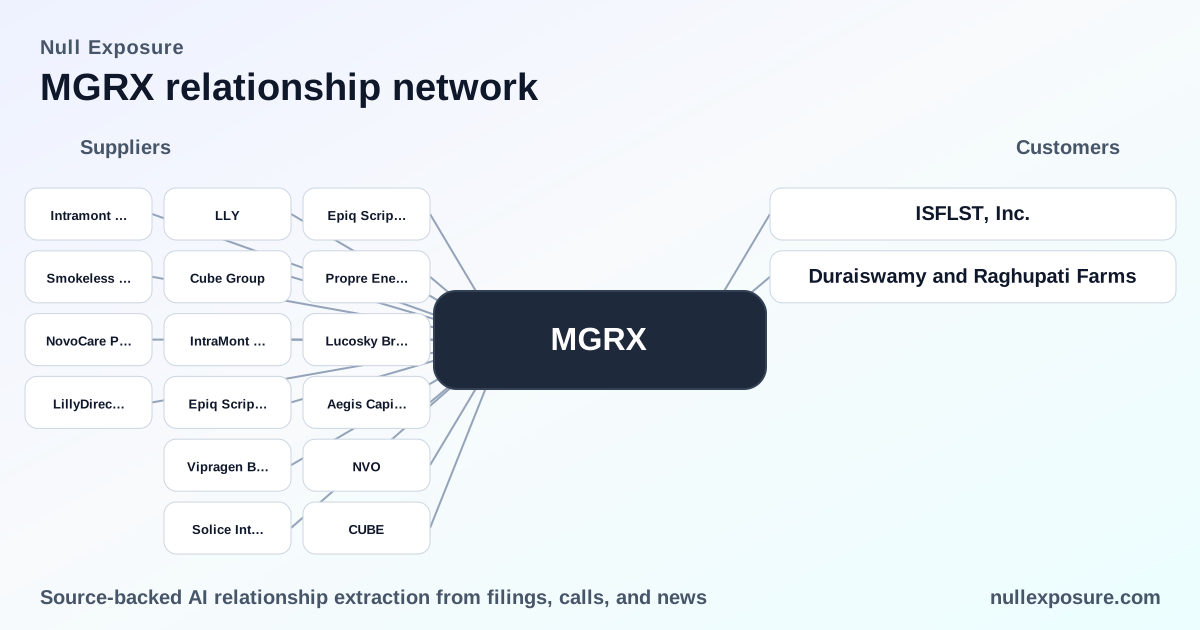
Below are every customer-level relationship surfaced in public reporting and news, with plain‑English descriptions and source citations.
ISFLST, Inc.
Mangoceuticals granted ISFLST a non-exclusive distribution license to market and sell its products in Asia Pacific and Latin America (excluding Mexico) under a Master Distribution Agreement, where ISFLST committed to use commercially reasonable efforts to promote the Products in those markets. This distribution arrangement is disclosed in the company’s regulatory filings and covered in a QZ summary of Mangoceuticals’ 10‑Q filing in March 2026. (Source: QZ summary of Mangoceuticals’ 10‑Q, March 10, 2026; link: https://qz.com/mangoceuticals-inc-mgrx-quarterly-10-q-report-1851699615)
Duraiswamy (farm operator)
Duraiswamy participated as a commercial trial site for Mangoceuticals’ antiviral compound MGX‑0024, with field trials in Tamil Nadu that treated broiler chickens via infused drinking water and reported zero respiratory‑related mortality across treated birds in the disclosed trials. The trial details and outcomes are described in a company press release and covered by GlobeNewswire on February 23, 2026. (Source: GlobeNewswire press release, February 23, 2026; link: https://www.globenewswire.com/news-release/2026/02/23/3243022/0/en/Mangoceuticals-Patented-MGX-0024-Achieves-Zero-Respiratory-Related-Mortality-in-29-000-Bird-Field-Trials-and-Demonstrates-Prophylactic-Benefit-Against-H5N1-in-Controlled-Government.html)
Raghupati Farms (farm operator)
Raghupati Farms was the second commercial trial location cited in Mangoceuticals’ field program for MGX‑0024 in Tamil Nadu; like the other sites, Raghupati Farms’ cohort participated in antibiotic‑free trials that the company reports as demonstrating prophylactic benefit. Trial participation is disclosed in the same GlobeNewswire release. (Source: GlobeNewswire press release, February 23, 2026; link: https://www.globenewswire.com/news-release/2026/02/23/3243022/0/en/Mangoceuticals-Patented-MGX-0024-Achieves-Zero-Respiratory-Related-Mortality-in-29-000-Bird-Field-Trials-and-Demonstrates-Prophylactic-Benefit-Against-H5N1-in-Controlled-Government.html)
Duraiswamy and Raghupati Farms (combined reporting)
Market commentary and secondary outlets aggregated the two Indian farm sites when reporting on Mangoceuticals’ poultry field program, noting the combined sample of roughly 29,000 broiler chickens treated under the MGX‑0024 protocol and the absence of concurrent antibiotics or antivirals in those cohorts. This combined description appears in QuiverQuant coverage and mirrors the firm’s press release. (Source: QuiverQuant news report, March 10, 2026; link: https://www.quiverquant.com/news/Mangoceuticals%2C+Inc.+Reports+Promising+Results+for+Antiviral+Compound+MGX-0024+in+Poultry+Respiratory+Disease+Management)
Operational constraints and the implications for partner risk
Public excerpts from Mangoceuticals’ filings and releases reveal a compact set of commercial characteristics that shape partner outcomes:
- Contracting posture — spot sales dominate but subscription is offered. The company recognizes product revenue at delivery to carriers and also offers subscription options for Pharmaceutical Products when applicable; this hybrid model creates near-term cash from spot orders while enabling predictable recurring revenue if subscription adoption increases.
- Counterparty profile — individual customers are the primary payors. Mangoceuticals accepts payments directly from individuals who transact on its platform; it does not rely on third‑party payors or insurers as the revenue source for the consumer channel.
- Geographic focus — domestic operations with targeted APAC/LATAM distribution. All corporate assets are in the U.S. and Mexico, but Mangoceuticals has explicitly licensed ISFLST to pursue APAC and Latin American markets (excluding Mexico). This pattern signals a U.S. operational base with distribution-dependent international expansion.
- Commercial role mix — the company functions as both seller and distributor. Mangoceuticals markets and sells online (seller role) while entering distribution agreements to scale internationally (distribution role).
- Segment mix — distribution, telehealth services, and enabling software. The business combines product distribution risk with ongoing telehealth service delivery and platform software functionality; this fattens the operational risk surface to include product liability, regulatory compliance, and platform delivery quality.
Collectively, these constraints create two dominant strategic imperatives: grow repeat subscription revenue to stabilize cash flow and de-risk international expansion by ensuring distribution partners deliver regulatory and market access horsepower.
For more granular signals and to track updates to these commercial arrangements, see primary filings and press reports aggregated at https://nullexposure.com/.
What investors and operators should watch next
- Monitor subscription uptake and churn — subscription conversion will materially change revenue visibility and unit economics.
- Track ISFLST’s execution in APAC/LATAM and any sublicensing activity; distribution agreements are the lever for international scale.
- Validate MGX‑0024 commercial efficacy beyond the initial field trials and whether regulatory approvals or government engagements in target countries follow the published trial outcomes.
- Watch cash runway and operating cash flows closely given the company’s small market cap and negative EBITDA.
Key takeaways
- Mangoceuticals monetizes through direct consumer sales, optional subscriptions, and third‑party distribution licenses.
- ISFLST is the named international distributor for APAC and LATAM (ex‑Mexico); farm-based field trials in India (Duraiswamy and Raghupati Farms) underpin early commercial validation for MGX‑0024.
- The business combines product distribution risks with telehealth service obligations; execution on subscription growth and distribution partner performance will determine whether current trials and licensing convert into scalable revenue.
For ongoing investor intelligence and relationship monitoring across small‑cap health technology and specialty pharmaceutical companies, visit https://nullexposure.com/.