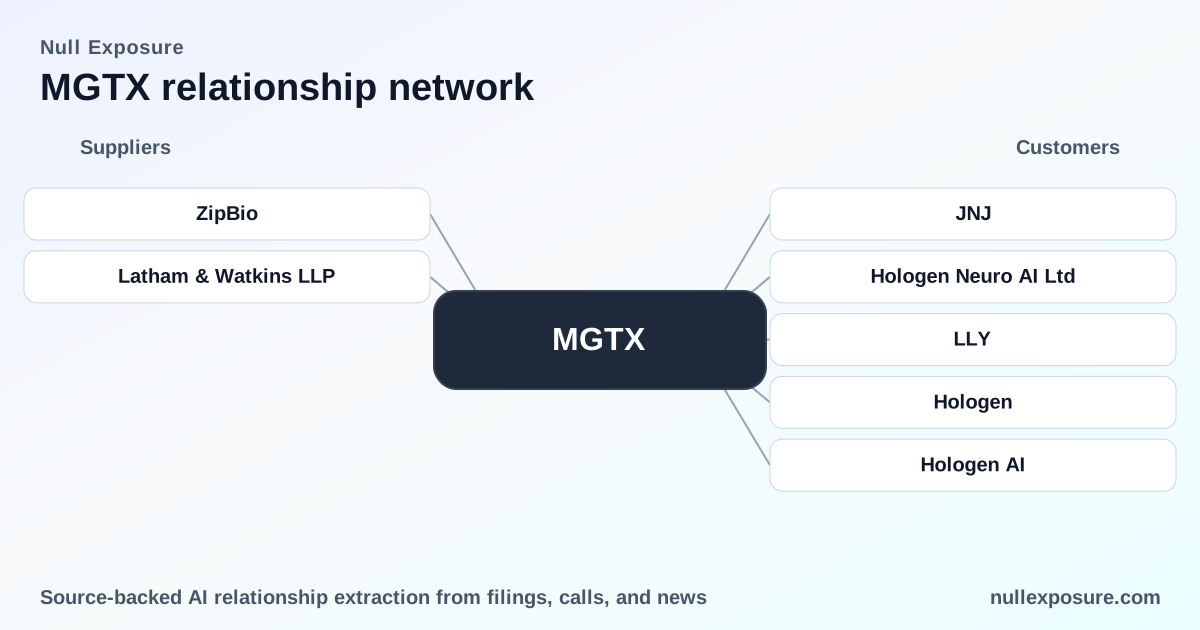
MeiraGTx’s customer relationships: licensing, manufacturing and milestone-led monetization
MeiraGTx (MGTX) operates as a clinical-stage gene therapy developer that monetizes through three clear channels: upfront licensing and asset sales, milestone and contingent payments, and fee-for-service/contract manufacturing for partnered products. The company’s 2025 revenue profile was dominated by a large upfront license payment from Eli Lilly while its in‑house GMP viral vector capabilities have translated into multi-year commercial supply agreements that generate service revenue and create recurring cash flow optionality. For investors, the combination of high-concentration, milestone-dependent income plus durable manufacturing contracts defines both upside and execution risk. Learn more about how these customer relationships map to revenue and risk on the Null Exposure homepage: https://nullexposure.com/
Why these relationships matter now
MeiraGTx’s balance between monetization from licensing deals and operating revenue from manufacturing positions the company differently than pure research-stage peers. Large upfront licensing fees can materially skew year-over-year revenue, while long-term supply contracts convert scientific know-how into operational cash flow. That dual profile makes counterparty credit and contract structure central to any investment thesis.
- Licensing and asset sales: drive lump-sum cash inflows and potential milestone upside.
- Commercial supply contracts: provide multi-year revenue visibility but create operational obligations and execution risk.
- Customer concentration: a small number of large pharma partners account for most of the company’s recent income.
All reported customer relationships and what they mean for investors
Johnson & Johnson Innovative Medicine (JNJ)
MeiraGTx executed an Asset Purchase Agreement and related licensing and supply arrangements with Johnson & Johnson Innovative Medicine that transferred RPGR-related license rights while establishing a four‑year commercial supply agreement (with an option for a fifth year) under which MeiraGTx will manufacture the RPGR product for J&J. According to MeiraGTx reporting and coverage of its financials, the company also expects revenue from a commercial supply agreement for bota‑vec manufacturing tied to J&J during product launch phases (InvestingNews, March 2026; TradingView reporting on the company’s SEC filings, May 2026). The Asset Purchase Agreement also builds in substantial contingent consideration (up to $350 million) and milestone payments, which drove $60 million of milestone receipts through year-end 2024 (evidence summarized in company filings cited in the company’s FY2025 disclosures).
Sources: InvestingNews report on MeiraGTx Q2 2025 results (Mar 2026); TradingView coverage of MeiraGTx SEC disclosures (May 2026); MeiraGTx asset purchase detail summarized in FY2025 filings.
Eli Lilly and Company (LLY)
Eli Lilly entered a broad strategic collaboration with MeiraGTx in November 2025 that granted Lilly exclusive, worldwide rights to MeiraGTx’s AAV‑AIPL1 ophthalmology program (for LCA4) and included a $75 million upfront payment credited as the key driver of MeiraGTx’s fiscal 2025 revenue increase to roughly $81.4 million. Multiple industry reports and the company’s financial commentary describe this as a material licensing deal with further potential commercial and milestone economics tied to development and sales outcomes (BioCentury, TradingView, Benzinga, March–May 2026 coverage).
Sources: BioCentury report summarizing Lilly’s $75M upfront (Mar 2026); TradingView and Benzinga summaries of MeiraGTx FY2025 revenue and the Lilly transaction (May 2026).
Hologen Neuro AI Ltd / Hologen (Hologen AI)
MeiraGTx announced a strategic arrangement with Hologen that encompasses a joint‑venture style collaboration where Hologen contributes proprietary multi‑modal models and MeiraGTx will provide exclusive clinical and commercial manufacturing supply for AAV‑GAD and other locally-delivered CNS gene medicines. Industry reporting and MeiraGTx releases indicate upfront funding and supply commitments tied to this collaboration, positioning MeiraGTx as a manufacturer and partner for Hologen’s CNS programs (Quiver Quant, TradingView, Bitget coverage; March–May 2026).
Sources: QuiverQuant report on MeiraGTx strategic collaboration (Mar 2026); TradingView and Bitget summaries on the Hologen relationship (Mar–May 2026).
Contractual and operating-model constraints investors should factor in
MeiraGTx’s public disclosures and reported deal terms create a set of operating characteristics that directly influence valuation sensitivity and operational priorities.
- Contracting posture: licensing plus supply — The company converts R&D assets into cash through asset sales and licensing agreements while retaining a commercial role as a manufacturer under multi‑year supply contracts. Where excerpts name Johnson & Johnson Innovative Medicine explicitly, the record shows MeiraGTx sold and assigned a UCLB RPGR license and simultaneously agreed to manufacture the RPGR Product for J&J under a defined supply agreement (contract excerpts in FY2025 filings).
- Duration and renewal structure: long‑term supply commitments — Supply agreements (notably those tied to RPGR) have four‑year initial terms with contractual options to extend, creating multi‑year revenue visibility but also performance obligations.
- Revenue concentration and lumpiness — Large upfront license payments (e.g., the $75M from Lilly) produced most of fiscal 2025 revenue; contingent milestone schedules (up to $350M linked to the J&J asset sale) create asymmetric upside and volatility in revenue recognition.
- Geographic footprint: EMEA/UK activity — Company disclosures attribute service, license revenue and deferred revenue from collaboration and asset agreements to the United Kingdom, signaling operational and revenue exposure to EMEA regulatory and commercial environments.
- Role duality: seller, manufacturer, and services provider — Public excerpts identify MeiraGTx both as a seller/licensor of intellectual property and as a contract manufacturer, with reported service revenue and related-party service line items appearing in financial statements.
- Spend and counterparty scale — Documented contingent consideration and milestone bands place some counterparties in the > $100M potential spend category, while recorded service revenue lines indicate ongoing mid‑sized contract revenue (evidence shows related-party service revenue line items).
These constraints are company‑level signals unless a constraint excerpt explicitly names a counterparty, in which case the named counterparty is shown above with the linked contractual details.
Investment implications — what to watch next
- Positive: diversified monetization — Licensing and manufacturing together reduce reliance on a single monetization path; upfront payments materially improve near‑term cash.
- Risk: concentration and operational execution — A small number of large partners dominate revenue; manufacturing quality, scale and on‑time supply are critical to sustain contract revenue.
- Catalysts — Progress on clinical milestones for partnered programs, first commercial sales (which can trigger large contingent payments), and continued utilization of MeiraGTx’s GMP vector facilities.
- Key metrics to monitor — milestone receipts and timing, manufacturing throughput and PPQ/validation outcomes, contractual renewal activity and recognition of contingent consideration.
For a concise map of MeiraGTx counterparties and contractual signals for underwriting and portfolio decisions, visit Null Exposure’s overview: https://nullexposure.com/
Bottom line
MeiraGTx’s commercial relationships with Lilly, J&J and Hologen convert its scientific assets into meaningful cash today and recurring supply revenue tomorrow. Investors should value the company not just as a clinical-stage biotech but as an emerging contract manufacturer and licensor, where execution against manufacturing commitments and milestone schedules will determine whether partnership economics convert into sustainable enterprise value.