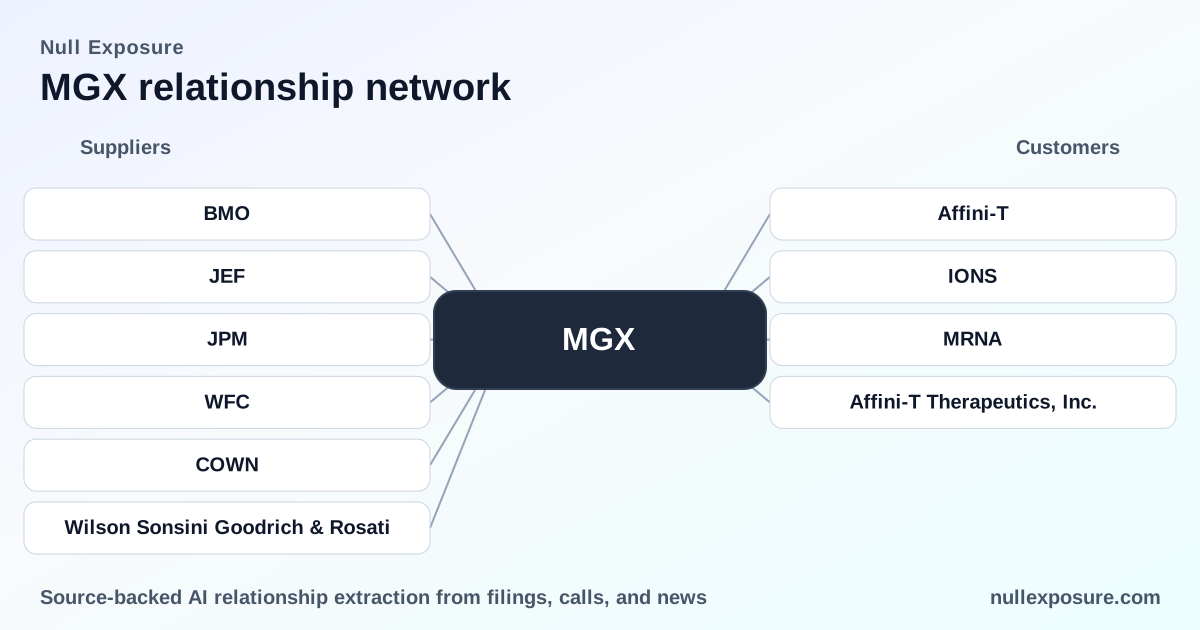
Metagenomi (MGX): Partnership-driven revenue with concentrated big‑pharma exposure
Metagenomi monetizes an in‑house genome‑editing toolbox by licensing research and development rights to larger biopharma partners and recognizing collaboration revenue as R&D milestones and services are delivered. The business model is partnership-heavy: near‑term commercial optionality depends on a small set of large collaborators, while the company continues to carry negative operating income and relies on milestone/license economics for upside. For a concise partner risk map and source‑level references, see more at https://nullexposure.com/.
How MGX makes money and why partnerships matter
Metagenomi’s revenue recognition is dominated by license, research, development and option agreements rather than product sales. The 2024 Form 10‑K lists collaboration revenue line items tied directly to named partners, and the company reports all customer contracts and long‑lived assets as U.S.‑based — a sign that commercial activity and risks are concentrated domestically and channeled through contractual collaboration structures. Financially, the company reported RevenueTTM of $25,210,000 with persistent negative operating margins and EBITDA, underscoring that partnerships drive both cash inflows and strategic runway.
- Key operational implication: MGX is a seller of intellectual property and R&D services; its cash profile and valuation are highly sensitive to partner decisions, milestone timing, and the crystallization of contingent payments.
What the filings say: partnership revenue lines
MGX’s 2024 10‑K explicitly breaks out collaboration revenue by counterparty. Those numbers are the clearest, verifiable signals of partner importance in FY2024.
-
Ionis Pharmaceuticals: Collaboration revenue listed as $30,439 (FY2024) in MGX’s 2024 Form 10‑K, up from $21,915 the prior comparable period. According to the 10‑K, Ionis accounted for a material slice of collaboration receipts.
Source: MGX 2024 Form 10‑K collaboration schedule (FY2024). -
Moderna: Collaboration revenue listed as $18,742 (FY2024) in the same filing (versus $18,119 previously). This line item confirms MGX recognized substantial research/option consideration from Moderna in FY2024.
Source: MGX 2024 Form 10‑K collaboration schedule (FY2024). -
Affini‑T / Affini‑T Therapeutics: Collaboration revenue recorded as $3,114 (FY2024) with prior period activity noted at $4,722, indicating smaller but still meaningful program funding from the TCR‑focused partner.
Source: MGX 2024 Form 10‑K collaboration schedule (FY2024).
Partner snapshots — what investors must know
Ionis Pharmaceuticals (IONS)
Ionis is a principal commercial collaborator for Metagenomi and generated the largest single collaboration revenue line in the 10‑K for FY2024. Public reporting also frames the relationship as part of a broader multi‑billion biobucks collaboration focused on cardiometabolic targets, positioning Ionis as a critical industrial partner for MGX’s platform commercialization plan.
Source: MGX 2024 Form 10‑K; industry coverage including FierceBiotech (Mar 2026) citing the $3 billion collaboration context.
Moderna (MRNA)
Moderna was a major collaborator listed in MGX’s FY2024 revenue schedule and contributed material collaboration receipts. Subsequent media coverage documents that Moderna terminated a gene‑editing partnership that had been structured around potential multibillion dollar payments, leaving MGX with retained rights to at least one preclinical program and the subject of investor litigation claims over disclosures.
Source: MGX 2024 Form 10‑K; BioSpace and GlobeNewswire reporting on the Moderna relationship and related legal notices (2024–2026).
Affini‑T Therapeutics
Affini‑T is a development, option and license partner focused on TCR‑based oncology applications; MGX recognized smaller but discrete collaboration revenue from Affini‑T in FY2024. The arrangement is narrowly scoped to cancer TCR products, making it strategically relevant but not revenue‑dominant.
Source: MGX 2024 Form 10‑K; partner description in SimplyWall.St coverage summarizing MGX’s development and license agreement with Affini‑T (FY2026 coverage).
Constraints and what they reveal about MGX’s operating model
MGX’s public disclosures and filing language generate a set of company‑level signals about how the business runs:
- Contracting posture — licensing and option agreements drive revenue. MGX recognizes income when collaborators obtain rights or when milestones are earned; the company is structured to monetize IP through partner contracts rather than direct product sales (company filing language on revenue recognition and license arrangements).
- Counterparty profile — exposure to large enterprise partners and government payor dynamics. Filings discuss dependence on third‑party payors and reference large collaborators; this reflects both the clinical commercialization pathway and reimbursement risk as eventual downstream constraints on product economics.
- Geographic concentration — U.S. centric revenue and assets. MGX reports all long‑lived assets and customer contracts as U.S.‑based, concentrating regulatory and reimbursement execution in North America.
- Role and segment — MGX acts as a seller of R&D services/IP in a core product development segment. The firm’s stated path to profitability depends on either direct commercialization or successful out‑licensing of therapies.
- Maturity and criticality — collaborations are strategic but remain precommercial. The company is still in preclinical/early development stages for lead programs; collaborator choices determine the timing and size of cash inflows.
These constraints are company‑level signals drawn from MGX’s filings and public commentary; they are not assigned to any single partner except where MGX itself names the relationship in filings.
Investment implications and risk checklist
- Concentration risk is material. A handful of partners accounted for the bulk of collaboration revenue in FY2024; partner terminations (as with Moderna) or slowed progress from Ionis would materially affect cash flow.
- Binary upside tied to milestone realization. Valuation is contingent on large, discrete payments and successful clinical advancement by partners; near‑term operating losses persist (negative EBITDA and operating margin in the most recent reporting).
- Legal and disclosure friction exists. Public filings and press releases show investor litigation and contested disclosures around partner arrangements, adding event risk around partner terms and program ownership.
- Domestic exposure simplifies regulatory pathways but concentrates payor and policy risk in the U.S. All revenue and assets are reported as U.S.‑based, lowering geographic diversification benefits.
Bottom line and next steps for analysts
Metagenomi is a classic early‑stage biotech where partner selection and contract structure determine enterprise value; FY2024 filings make clear which collaborators are material today. For analysts and operators, primary workstreams are: track milestone timelines from Ionis and Moderna‑derived programs, monitor litigation or termination fallout, and reassess runway if major partners pause or exit. For further partner analytics and deal‑level context, visit our research hub at https://nullexposure.com/ for structured briefings and source links.
Bold takeaway: MGX’s commercial fate is partner‑driven — revenue is real today but fragile; the stock’s upside is contingent on partner execution and milestone crystallization.