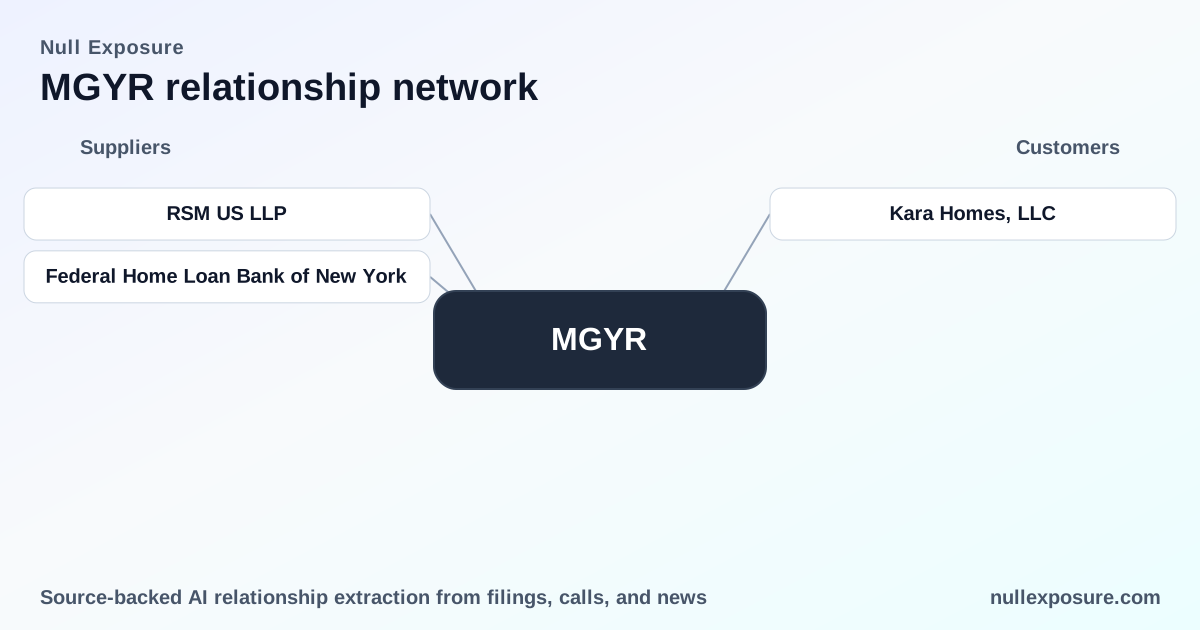
MGYR: Magyar Bancorp’s customer footprint and relationship signals
Magyar Bancorp (MGYR) operates as the holding company for Magyar Bank, monetizing a classic community‑bank model: attract retail and business deposits in central New Jersey, originate predominantly commercial real estate loans and consumer loans, and earn net interest margin plus fee income from deposit services. The bank’s business is driven by interest on a loan book concentrated in commercial real estate (CRE), supplemented by service charges and securities income. For a concise view of customer relationships and how they map to credit and concentration risk, see https://nullexposure.com/.
How Magyar runs the business — structural constraints that matter to investors
Magyar’s operating model is shaped by clear, company-level signals in its disclosures:
- Contracting posture: Magyar originates long‑term, adjustable‑rate commercial real estate loans with maximum terms up to 25 years and adjustable-rate reset periods every five years. This establishes a structural mix of duration and repricing risk that requires active asset/liability management, particularly in rising or volatile rate regimes (company filings).
- Geographic concentration: All branches and most lending are localized in New Jersey, with primary deposit and lending markets centered in Middlesex and Somerset counties; the bank reports a single operating segment because of this concentration. That localization produces higher sensitivity to the New Jersey regional economy than to national trends (company filings).
- Counterparty mix: Customers are predominantly individuals and small‑to‑mid market businesses, with government customers represented in the deposit and service base. This reinforces a retail‑leaning deposit franchise but ties credit performance to regional SME health (company filings).
- Materiality of CRE: Commercial real estate loans represent a substantial share of the loan book — 62.1% of loans as of September 30, 2025 — making CRE performance the primary driver of credit losses and earnings volatility (company filings).
- Relationship role and maturity: Magyar functions as a service provider and credit originator to the local economy, with active-day performance obligations for deposit and fee services; most customer contracts are ongoing rather than one‑off transactions (company filings).
These constraints collectively define Magyar’s risk profile: high CRE concentration, localized revenue sensitivity, long-duration adjustable-rate assets, and a retail/deposit-funded balance sheet.
Complete customer relationship inventory (all matches in the record)
Kara Homes, LLC
Magyar’s filings and related news references include a historical disposition of properties tied to Kara Homes: a report noted the sale of the third of four Kara Homes properties on November 29, 2007, generating a $50,000 loss and contributing to a reduction in other real estate owned to approximately $1.3 million at the referenced reporting date. This mention is recorded in an ADVFN news item surfaced on March 10, 2026. (Source: ADVFN news item on Magyar Bancorp first-quarter earnings, March 10, 2026 — https://br.advfn.com/bolsa-de-valores/nasdaq/MGYR/share-news/24359972/magyar-bancorp-announces-first-quarter-earnings)
No other named customer relationships were returned in the customer scope results; the Kara Homes reference is the single explicit third‑party mention in the dataset provided.
What those relationships and constraints imply for credit, operations and valuation
The single explicit customer mention is historical and small in isolation, but the company-level constraints are the decisive inputs for underwriters and investors:
- Credit concentration risk is primary. With CRE composing over 60% of the loan book, performance of commercial property borrowers in New Jersey is the dominant driver of credit losses and provision volatility (company filings). Even isolated distressed borrowers can have outsized impact if valuation declines cluster geographically.
- Repricing and yield management matter. Long‑term maximum terms with five‑year adjustable periods create a predictable cadence for rate resets, but also leave exposure to repricing risk if deposit costs rise faster than loan yields. Asset/liability management and deposit stability are therefore critical to margin preservation.
- Local economic sensitivity is high. The branch and lending footprint confined to New Jersey converts local economic shocks into bank‑specific earnings events more quickly than for a geographically diversified peer.
- Customer mix supports deposit resilience but limits scale. A retail and small business funding base generates stable low‑cost deposits in normal cycles, but does not provide the wholesale funding flexibility larger banks enjoy when dislocations occur.
- Operational posture is ongoing service provision. Magyar recognizes performance obligations daily and generates material revenue from both interest and service fees; this operational model supports steady fee streams but keeps the institution exposed to branch‑level market competition.
Investors should treat CRE composition, regional economic indicators, and the bank’s deposit cost trajectory as the three highest‑impact monitoring metrics for MGYR.
For deeper customer intelligence on MGYR and comparable regional banks, visit https://nullexposure.com/ for structured signals and relationship maps.
Actionable takeaways for investors and operators
- Primary risk vectors: CRE concentration and regional economic dependence. Underwrite loans assuming sector‑specific stress scenarios for New Jersey CRE fundamentals.
- Earnings sensitivity: Expect earnings to be sensitive to deposit cost increases and to the timing of five‑year loan repricings; monitor net interest margin quarterly.
- Operational focus: Management must prioritize local relationship banking to preserve deposit stability and deploy disciplined CRE underwriting to contain credit volatility.
- Relative valuation context: With a trailing P/E near 9.8 and a price-to-book around 0.92, the market is pricing MGYR for modest earnings growth but assigns limited premium for scale or diversification (market data).
Final read: confident, focused monitoring
Magyar is a compact, deposit‑funded community bank whose profitability and credit trajectory are driven by a concentrated CRE book and a New Jersey‑centric customer base. The Kara Homes mention is informational but not transformational; the strategic levers for investors are balance‑sheet composition, local economic indicators, and deposit dynamics. Monitor five‑year repricing cohorts and CRE loan performance first; these will determine the company’s ability to sustain margins and capital ratios through the cycle.
For ongoing updates and a systematic view of MGYR’s customer relationships and risk signals, consult https://nullexposure.com/.