Mastech Holdings (MHH): Customer Concentration, Contracting Posture, and What Buyers Tell Investors
Mastech Digital monetizes by selling digital transformation, data & analytics, and IT staffing services to a mix of large, medium and smaller corporate clients—primarily in North America—with revenue generated through a combination of short-term staffing engagements, master service frameworks and multi-year dedicated data teams. Revenue is service-driven and client-concentrated, so the company’s growth trajectory and margin profile are tightly linked to the stability of a small number of large buyers and the cadence of project versus retained engagements. For a deeper view of customer exposures and structural signals, visit https://nullexposure.com/.
Why customer relationships determine value here
Mastech is not a product business; its economics depend on repeatable client engagement, utilization and the ability to upsell higher-margin analytics work. The company’s FY2024 disclosures make several operating-model characteristics explicit:
- Contracting posture: A majority of contracts are one year or less when cancellation options are considered, but the company also uses master service agreements and multi-year “virtual team” engagements for data and analytics.
- Customer concentration: Two clients exceeded 10% of total revenues in 2024, and roughly 54% of revenue came from the top ten clients, signaling meaningful concentration risk.
- Geography and verticals: Services are delivered mainly in the United States, with the Data & Analytics segment positioned to serve customers globally; financial services accounted for about 49% of revenues in FY2024.
- Engagement scale: The company notes Center of Excellence contracts generally range from $4 million to $8 million, indicating mid-single-digit million-dollar deals are material to revenue stability.
These signals collectively define a company with service-led, client-dependent revenue, mix of transactional and retained work, and exposure to a small number of large enterprise buyers.
The client roster: what each material relationship reveals
Below I cover each disclosed customer relationship in Mastech’s FY2024 filings. Each entry is a plain-English takeaway followed by the source context.
-
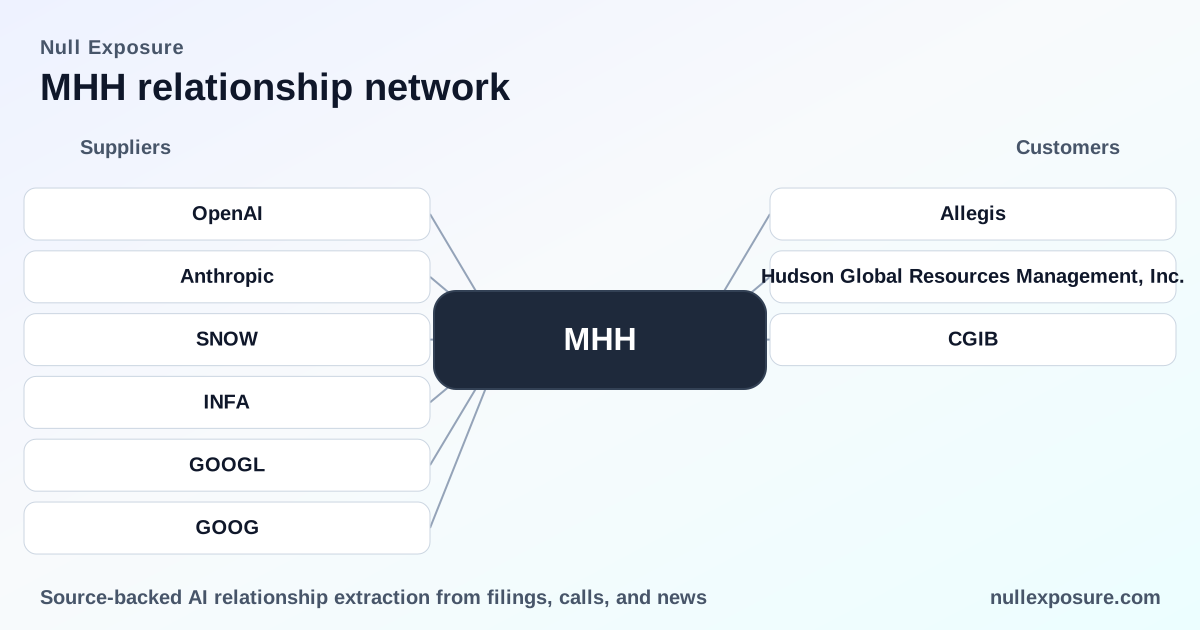
Allegis: Allegis accounted for 10.7% of Mastech’s total revenues in FY2024, making it a material buyer whose contract renewals and staffing demand materially influence short-term revenue and utilization. According to Mastech’s FY2024 Form 10‑K filing, Allegis was one of two clients above the 10% revenue threshold for the year (FY2024 filing, reported in early 2026).
-
Hudson Global Resources Management, Inc.: Mastech’s IT Staffing Services segment includes the June 2015 acquisition of Hudson Global’s U.S. IT staffing business, and the company performed quantitative impairment tests on that segment in 2024, reflecting ongoing evaluation of goodwill and acquired business economics. This disclosure comes from the FY2024 Form 10‑K where Mastech documents FY2024 impairment testing tied to the Hudson acquisition (FY2024 filing).
-
CGI (CGIB): CGI represented 14.5% of total revenues in FY2024, and historically was even more concentrated in 2023 and 2022 (22.5% and 22.2%, respectively), underscoring a multi-year dependency that impacts revenue volatility and bargaining dynamics. This concentration detail is disclosed in Mastech’s FY2024 Form 10‑K (FY2024 filing).
-
CGIB (inferred symbol CGIB): The filing lists CGI/CGIB as a material client (14.5% of revenue in FY2024) and the dataset identifies an inferred ticker of CGIB for that counterparty; the practical implication is the same—CGI-related revenues are a high-concentration source for Mastech and have been historically significant (FY2024 Form 10‑K).
Operational constraints and what they mean for investors
Treat the company-level constraints as direct inputs to credit, revenue and client-risk assessment rather than abstract metrics.
-
Short-term contract bias with framework overlays: The predominance of one-year-or-less contracts keeps near-term visibility limited, but MSAs and SOWs provide a legal framework that facilitates repeat business and faster redeployment of resources. This structure reduces capital intensity but increases the need for active client account management to preserve utilization.
-
Mix of transactional and retained work: The presence of multi-year dedicated data and analytics engagements provides a higher-margin, stickier revenue stream relative to temporary staffing—this is a growth lever if Mastech can convert more clients into retained models.
-
Concentration risk is explicit and material: With two clients above 10% and the top ten accounting for 54% of revenues, loss or severe downsizing by a single large buyer would have outsized earnings impact. Investors should price in higher revenue volatility relative to a diversified services peer.
-
North American delivery center with global analytics capability: Operational risk is concentrated where revenues are produced (U.S.), but the Data & Analytics segment targets global customers, which helps strategic positioning for cross-border engagements.
-
Deal sizes include mid-single-million Center of Excellence contracts: The $4–8 million range for these contracts implies that landing or losing one such contract can swing quarterly growth meaningfully.
Investment implications and an actionable checklist
For investors and operators evaluating Mastech’s customer relationships, focus on three practical factors:
- Assess client renewal cadence and pipeline for CGI and Allegis: these two clients drive meaningful revenue, so confirm renewal timing, scope creep potential and any single-client concentration mitigants.
- Evaluate margin mix: monitor the revenue mix shift toward multi-year Data & Analytics engagements, which improve predictability and gross margins versus pure staffing.
- Stress-test geography and vertical concentration: given the U.S.-centric delivery and heavy financial-services weighting, consider macro-financial cycle sensitivity in valuation models.
For detailed exposure mapping and competitive context, visit https://nullexposure.com/ for a curated view of customer concentrations and contract characteristics.
Bottom line
Mastech is a service-centric firm whose valuation hinge is client stability and the company’s ability to scale higher-margin analytics engagements while managing the turnover and seasonality of staffing revenue. High client concentration, a short-term contracting base with selective long-term engagements, and material exposure to financial services are the dominant structural risks and opportunities. Investors should underwrite both client-concentration scenarios and a measured shift in revenue mix when modeling upside or downside cases.