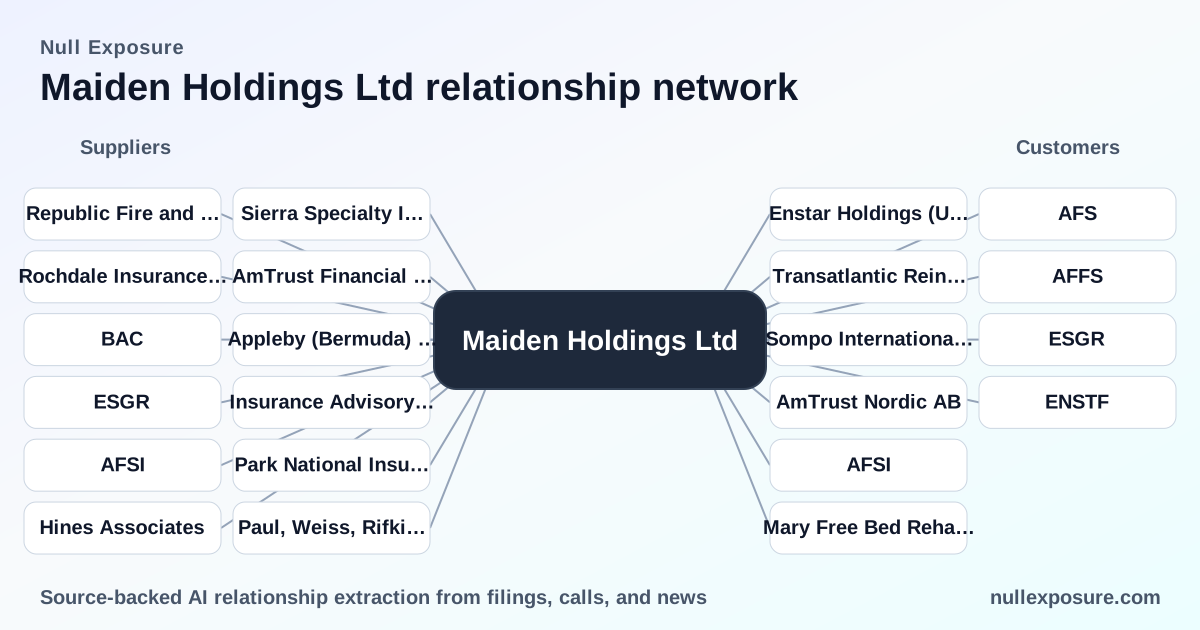
Maiden Holdings (MHLA) — Customer Relationships and Strategic Implications
Maiden Holdings operates as a reinsurance provider and legacy runoff manager, monetizing through ceding fees, quota-share arrangements and selective retroactive underwriting while managing legacy liabilities in run‑off. Revenue drivers are primarily ceding fees and runoff recoveries rather than new premium growth, and the company extracts value by unwinding legacy contracts and selling or restructuring portfolios. For deeper context on signal-driven relationship intelligence, visit https://nullexposure.com/.
How Maiden actually makes money and why customer relationships matter
Maiden’s business model is a hybrid of legacy runoff management and limited ongoing reinsurer activity. The firm historically underwrote large quota‑share agreements (notably with AmTrust) and also executed sales of operating units and teams to other reinsurers; proceeds, ceding fee flows and reserve development drive reported earnings rather than an operating premium growth story. Customer contracts are the asset here — they determine cash return timing, counterparty exposure and residual reserve risk.
Company-level constraints that shape relationships and strategy
Public disclosures and news coverage establish several operating signals that shape Maiden’s contracting posture and runway:
- Geography: Maiden operates across EMEA (notably hospital liability in Europe and Scandinavia/Northern Europe insurance through Maiden LF/GF) while also maintaining North American exposure through run‑off and fronting arrangements. This is a company-level geographic footprint signal drawn from Maiden filings.
- Concentration: Maiden has exhibited material client concentration historically; AmTrust was at times well over half of net premiums earned and remained 27.7% of net premiums earned in FY2024 per Maiden’s 2024 10‑K.
- Contracting posture: Maiden functions both as a seller of insurance/reinsurance capacity (quota shares, ceding fee arrangements) and as a service provider via fronting and administrative structures — it receives ceding fees while capacity providers administer operations.
- Maturity / lifecycle: Several legacy programs are in run‑off and some subsidiaries are winding down or held for sale; Maiden has been exiting lines and terminating quota shares, making the portfolio mature and de‑risking rather than expansionary.
- Criticality: Given historical concentration, a small set of cedants materially impacts Maiden’s earnings and reserve behavior; this elevates counterparty and reserving risk for investors.
These are company-level signals drawn from Maiden’s filings and media coverage rather than attributes of any single counterparty unless explicitly stated in the source.
Detailed relationship run‑down (every relationship in the public record)
Below are concise, plain‑English summaries of every relationship captured in the available results, with source context.
Enstar Holdings (US) LLC
Maiden sold its US reinsurance business and related operations to Enstar as part of a strategic exit from certain US functions; the Royal Gazette covered the transaction in October 2018. (Royal Gazette, Oct 2018.)
Transatlantic Reinsurance Company
Maiden executed a renewal‑rights transaction with Transatlantic as part of a broader strategic review tied to its US team dispositions. (Royal Gazette, Oct 2018.)
Sompo International Holdings Ltd
Maiden agreed to divest its US casualty facultative reinsurance team to Sompo International, reflecting a pullback from active US casualty facultative underwriting. (Royal Gazette, Oct 2018.)
AmTrust Financial Services
AmTrust has been Maiden’s largest cedant historically; Maiden’s AmTrust Reinsurance segment includes quota‑share business that is in run‑off and represented 27.7% of net premiums earned in FY2024. (Maiden 10‑K, FY2024.)
Mary Free Bed Rehabilitation Hospital (MFB)
Through Genesis Legacy Solutions (GLS), Maiden closed a reinsurance deal providing medical expense reimbursement cover to a Washington, D.C. cell of Mary Free Bed; this reflects Maiden’s targeted legacy reinsurance solutions. (BermudaReinsuranceMagazine, FY2022 coverage.)
AmTrust (alternative labels: AFS, AFSI, AFFS)
Multiple news items and filings reference AmTrust under several labels; reporting documents show that the AmTrust master quota‑share produced material adverse development in selected periods and that Maiden undertook a partial termination and return of unearned premium in the 2018–2019 timeframe. (Royal Gazette; BermudaReinsuranceMagazine; ReinsuranceNews, FY2017–FY2019.)
AmTrust Nordic AB
Maiden divested short‑term income protection business in Scandinavia and Northern Europe through agreements with AmTrust Nordic AB, consistent with a regional shrinkage of primary writing activity. (TradingView summary of Maiden SEC filings, FY2025 commentary.)
Enstar Group / Enstar / ENSTF / ESGR (alternative labels)
Enstar Group and related Enstar entities completed acquisition activity tied to Maiden’s US reinsurance assets, including the purchase of Maiden Reinsurance North America, as reported in Maiden coverage of FY2018–FY2019 transactions. (BermudaReinsuranceMagazine; Royal Gazette, FY2018–FY2019.)
AmTrust International Insurance / AmTrust Financial Services Inc
The international and affiliate AmTrust entities are referenced in Maiden’s run‑off disclosures and commentaries about quota‑share terminations and unearned premium returns through 2019, which drove significant reserve and earnings volatility. (BermudaReinsuranceMagazine; ReinsuranceNews, FY2019–FY2020.)
Notes on sources: the summaries above pull from Maiden’s public 10‑K statements (notably the 2024 10‑K), Royal Gazette reporting in 2018 and subsequent industry coverage in Bermuda Reinsurance Magazine and ReinsuranceNews between 2017–2022.
You can explore deeper relationship signal analytics at https://nullexposure.com/ for additional context and document‑level sourcing.
What investors should take away — concentration, runway and counterparty risk
Maiden’s value for investors derives from disciplined runoff execution and reserve management rather than new book growth. Key investment implications:
- Concentration risk is structural. AmTrust historically dominated net premiums and continues to be a large run‑off exposure; the 2024 10‑K reports AmTrust at 27.7% of net premiums earned.
- Run‑off reduces growth optionality but enhances predictability if executed well. Termination of quota shares and partial disposition of operating units convert operational uncertainty into cash but compress future revenue streams.
- Counterparty and reserve risk remain the primary operational hazards. Large negative development episodes tied to AmTrust quota shares in prior periods demonstrate how cedant outcomes drive Maiden’s earnings volatility.
For quick clarity:
- If reserve development continues to be favorable, Maiden will realize the earnings lift investors expect;
- if legacy adverse development re‑emerges, the company’s concentrated exposure will amplify downside.
Bottom line
Maiden is a company whose present value hinges on legacy contract management and the pace at which it can monetize runoff exposures. Investor focus should be on reserve development trends, AmTrust run‑off outcomes, and the speed/terms of asset dispositions rather than premium growth metrics. For a document‑level deep dive and to track evolving relationship signals, visit https://nullexposure.com/.