Maiden Holdings North America (MHNC) — customer relationships and commercial posture
Maiden Holdings North America operates as a specialty reinsurance and insurance holding franchise that monetizes through fronting arrangements, quota-share reinsurance and strategic dispositions of non-core assets. The company generates fee and ceding-fee income by providing licensed access and capacity to program managers and cedants, while actively managing capital through asset sales and portfolio run-off to preserve solvency and returns for stakeholders. Investors should view MHNC as a capital allocator that derives revenue from reinsurance ceding arrangements, fronting fees and selective divestitures rather than from growing primary underwriting volumes.
For a concise snapshot of our coverage, visit https://nullexposure.com/.
Operational posture and business-model constraints that drive value MHNC’s filings and public disclosures reveal a hybrid operating model: the firm still has legacy reinsurance and fronting capabilities, but a material portion of its book is in run-off and the company relies on a small set of counterparties for a meaningful share of premium-related income. Several company-level signals matter for investors evaluating customer relationships:
- Concentration and counterparty dependence: MHNC discloses that the combined entity “will depend on a limited number of capacity providers and general agents for a large portion of its gross written premium,” a structural concentration that elevates counterparty risk and makes individual relationships commercially critical. (MHNC Form 10‑K, FY2024.)
- Run-off and contract termination dynamics: The company has moved a meaningful portion of legacy AmTrust business into run-off and the active quota-share contracts with AmTrust were terminated effective January 1, 2019, demonstrating a shift from originating prospective business to managing legacy liabilities. (MHNC Form 10‑K, FY2024.)
- Mixed materiality signals: MHNC states that its insurance risk from premiums is “immaterial” in the context of current underwriting activity, while simultaneously warning that losing a single major capacity provider could “materially adversely affect” results — a dual signal that the firm is strategically shrinking underwritten risk while remaining dependent on a few commercial relationships. (MHNC Form 10‑K, FY2024.)
- Geographic footprint: The business operates across North America and Europe with employees in Bermuda, the U.S., the U.K., Germany, Ireland and Sweden and specific underwriting exposures in Scandinavia, Italy and France — a geographically diverse operating base that supports both fronting and specialty European reinsurance placements. (MHNC Form 10‑K, FY2024.)
- Service-provider role: Beyond traditional reinsurance, MHNC’s model includes fronting and management services provided under agreements with partners such as AmTrust, under which the company earns ceding fees and ancillary management compensation. (MHNC Form 10‑K, FY2024.)
If you want a structured feed of how these relationships change over time, see our platform at https://nullexposure.com/.
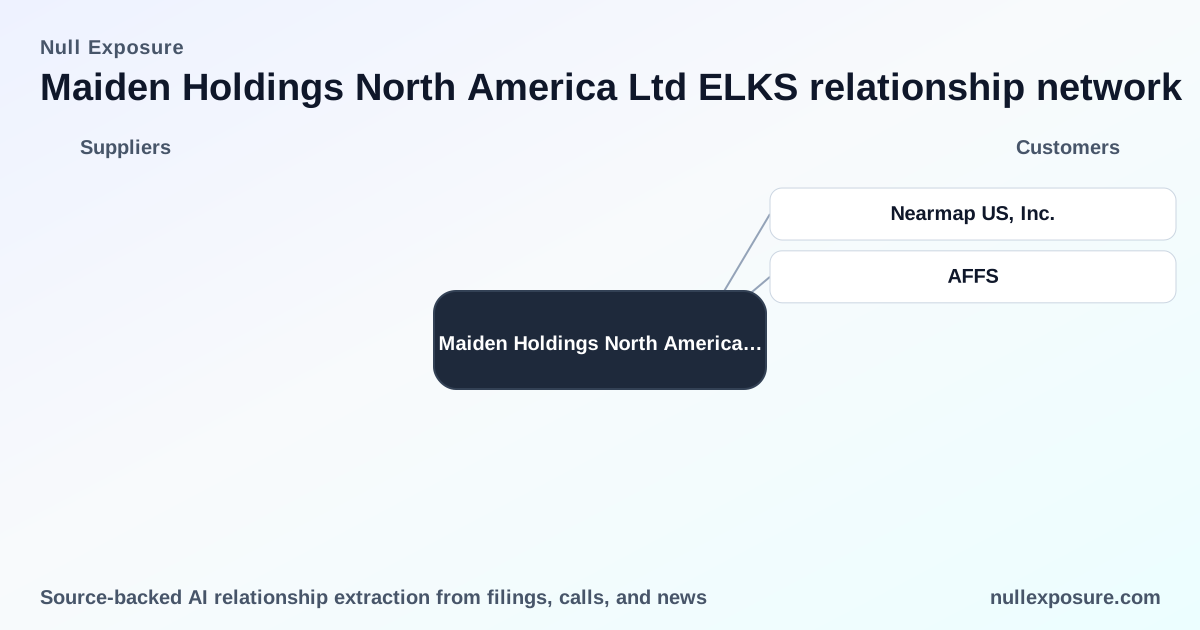
Relationship-by-relationship investor guide Below are the explicit customer relationships disclosed in MHNC’s FY2024 filings. Each relationship summary is concise and source-attributed so you can judge strategic importance and near-term cashflow implications.
Nearmap US, Inc. — realization of asset sale proceeds
Maiden recognized total gains of $4.8 million on the sale of its stake in Betterview Marketplace, Inc. in a combined cash-and-stock transaction with Nearmap US, Inc., a non-core asset disposition that contributed to realized investment gains in FY2024. According to MHNC’s 2024 Form 10‑K, this transaction generated the $4.8 million gain reported through 2024. (MHNC Form 10‑K, FY2024.)
AFFS (inferred) — funds-withheld dynamics and premium concentration
MHNC’s disclosures link its alternative investment returns and funds-withheld interest to balances with AmTrust (represented in the data as AFFS), noting that lower interest income on the funds-withheld balance reduced returns and that net premiums from AmTrust accounted for $13,687 (27.7%) of total net premiums earned in 2024. This shows both financial sensitivity to partner-managed funds and a significant premium concentration with the AmTrust group in FY2024. (MHNC Form 10‑K, FY2024.)
AmTrust — historic fronting/ceding partner, now run-off
AmTrust is a historically material counterparty: MHNC reported that net premiums earned from AmTrust were $13,687, representing 27.7% of total net premiums earned in 2024, and that active quota-share contracts with AmTrust were terminated effective January 1, 2019, leaving the relationship in run-off. The company also describes trust-account and management arrangements established to provide credit for reinsurance to AmTrust’s U.S. insurance subsidiaries, underscoring both commercial and statutory linkages. (MHNC Form 10‑K, FY2024.)
What those relationships imply for investors
- Earnings drivers are concentrated and lumpy. The AmTrust relationship historically drove a large share of premium-related earnings and associated funds‑withheld interest; the move to run-off and the termination of active quota-share agreements materially changes the revenue profile toward fees and realized gains (such as the Nearmap transaction). (MHNC Form 10‑K, FY2024.)
- Capital management and asset sales are active levers. The company realizes value through targeted disposals (for example the Betterview stake sale) and by harvesting run-off portfolios, which supports near-term cashflow but limits prospects for premium growth. (MHNC Form 10‑K, FY2024.)
- Counterparty risk is central. Heavy dependence on a small set of counterparties raises execution risk if capacity providers or distribution partners reprice, restructure or exit arrangements. MHNC itself warns the loss of any one major provider could have a material adverse effect. (MHNC Form 10‑K, FY2024.)
- Geographic and segment diversification is real but secondary. MHNC operates across North America and Europe and runs short-term income protection lines in Scandinavia, yet these lines are part of a broader specialty and services-oriented strategy rather than a diversified growth engine. (MHNC Form 10‑K, FY2024.)
Key takeaways for portfolio managers
- Treat MHNC as a capital-management and run-off specialist whose short-term cashflow is influenced by asset disposals and legacy partner balance mechanics (funds‑withheld interest), not by scaling primary underwriting.
- Monitor counterparties and contract statuses (especially AmTrust-related arrangements and any replacement capacity providers) as these determine the company’s ability to sustain ceding-fee income.
- Expect episodic realized gains from strategic asset sales like the Betterview stake transaction with Nearmap, which are material to reported gains but are not recurring underwriting revenue. (MHNC Form 10‑K, FY2024.)
For a deeper view of MHNC’s evolving counterparty map and to track changes in the company’s customer relationships over time, visit https://nullexposure.com/.