NFT Limited (MI): Customer Relationships and the Solarlink Financing Tie — A concise investor read
NFT Limited is a small-cap technology company focused on NFT infrastructure and digital-asset services that monetizes through platform licensing, transaction and authentication fees, and strategic partnerships that extend its product set beyond pure marketplaces. The company’s public filings show modest revenue, persistent operating losses, and concentrated institutional ownership—so third‑party commercial relationships and off‑balance-sheet subsidiaries are material to any investor assessment. For a quicker view of our broader coverage, visit https://nullexposure.com/.
How NFT Limited makes money and why customers matter
NFT Limited builds software and services that authenticate and transact unique digital assets for creators and brands, then captures value through usage fees, platform services and commercial collaborations with third parties. The company’s core revenue drivers are platform transactions and partner-led initiatives, while reported financials show negative EBITDA and losses per share, indicating that new customer contracts and non‑recurring commercial arrangements will drive near-term inflection points rather than steady margin expansion.
Operationally, the firm demonstrates a hybrid model: product-led SaaS and marketplace operations, plus discrete partnerships and subsidiaries that execute niche commercial functions. That hybrid structure increases optionality but raises governance and transparency questions for investors because related-party and subsidiary agreements can carry outsized economic impact for a company of NFT Limited’s reported scale.
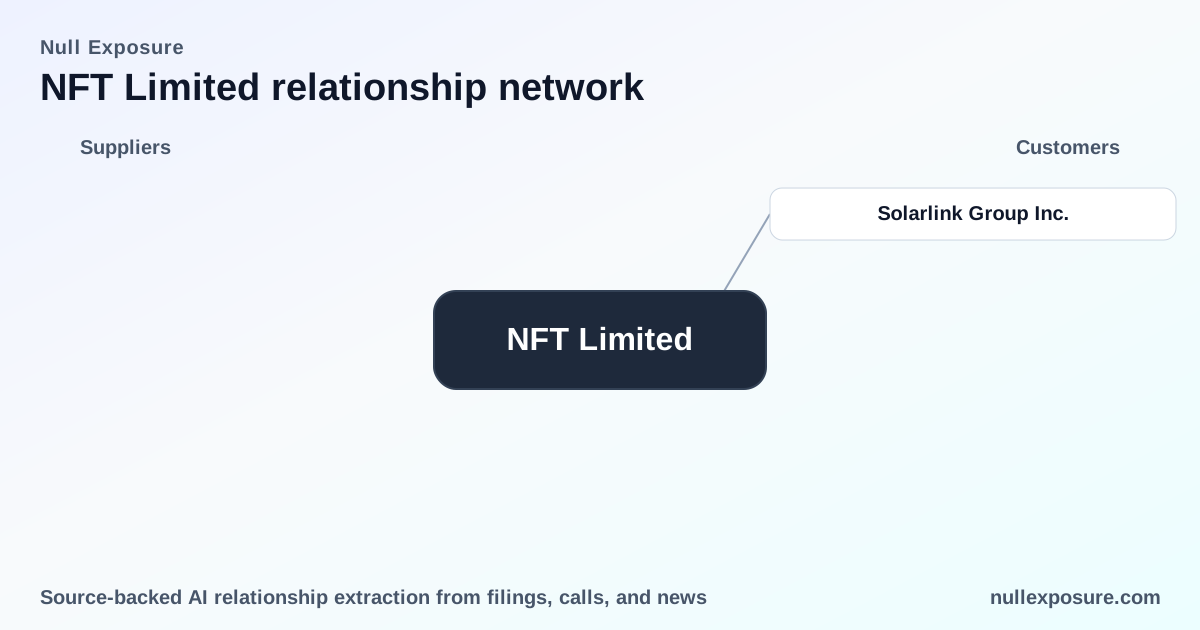
Customer relationship on record: Solarlink Group Inc.
A single customer relationship appears in the public relationship trace for MI:
- Solarlink Group Inc. — On January 25, 2026 Takung Exchange Ltd., described in the notice as the company’s Wyoming subsidiary, entered a Supply Chain Financing Framework Agreement with Solarlink Group Inc., under which Solarlink will procure up to 1.2 GW equivalent of solar module components per year through Takung Exchange’s financing mechanism, at an estimated average procurement cost of USD 0.15 per watt. This arrangement positions the company’s financing arm as an enabler of large-volume procurement flows for a renewable-energy integrator. (News report: lelezard.com, first reported March 10, 2026; original transaction dated January 25, 2026 — https://www.lelezard.com/en/news-22117089.html)
Key takeaway: This is a commercially significant, volume-based supply‑chain financing relationship executed through a named subsidiary rather than the core NFT product line, signaling diversification of revenue channels beyond digital-asset services.
What the absence of contract-level constraints says about visibility
The relationship dataset for MI contains no explicit constraints or contract‑level flags. As a company‑level signal, that absence is informative: there are no machine-extracted constraint excerpts in this record that would indicate disclosed contract durations, exclusivity terms, termination penalties, or concentration thresholds. For investors and operators the implication is straightforward — public visibility into contracting posture, revenue concentration, criticality to counterparties, and contract maturity is limited in the sources collected.
That limited visibility elevates the importance of direct diligence: when the public record is silent on critical commercial terms, investors should treat announced collaborations as directional rather than fully priced contracts until documentation or fuller disclosures arrive in filings.
Why the Solarlink tie matters for investors and operators
The Solarlink engagement elevates the strategic profile of NFT Limited’s non‑core activities for three reasons:
- Revenue diversification: The Takung Exchange supply‑chain financing agreement routes substantial procurement volume through a company-controlled financing mechanism, creating a potential fee- and spread-based revenue stream that is structurally different from marketplace transaction fees.
- Counterparty and sector exposure: Partnering with an integrated solar and renewable-energy company ties the firm’s commercial performance to capital goods and commodity cycles in renewables, introducing sectoral correlation that differs from NFT and digital-asset market dynamics.
- Operational complexity and governance: Using a Wyoming subsidiary to execute supply‑chain financing increases complexity and places emphasis on the subsidiary’s governance, credit underwriting and capital support — all material for a company with the scale and margins shown in public financials.
Investor signal: For a company with reported negative EBITDA and limited market capitalization, these types of finance‑oriented relationships can be disproportionately meaningful; operators should prioritize transparency on fee capture, credit risk allocation and the balance-sheet treatment of financing flows.
Practical risk and opportunity checklist for research teams
Consider the following, prioritized for decision-use:
- Evaluate counterparty credit and concentration: how dependent is the subsidiary on a few large counterparties such as Solarlink?
- Demand transparency on fee economics: are financing spreads, fees and role (agent vs principal) disclosed in SEC filings or investor materials?
- Monitor cross-sector correlation: solar procurement cycles will affect the financing volume and timing, producing cash‑flow volatility distinct from NFT platform usage.
- Governance and capital adequacy: confirm whether the parent provides capital or guarantees to Takung Exchange, and whether the subsidiary’s obligations sit on the parent balance sheet.
Bottom line for investors and operators
NFT Limited runs a hybrid business model that extends beyond NFT platform services into subsidiary-driven financing activity; the Solarlink framework agreement is the only customer relationship disclosed in the reviewed results and carries operational significance. The absence of contract-level constraints in the public trace reduces external visibility into commercial economics, so investors must treat announced supply‑chain financing relationships as strategically important but under-documented until filings or company disclosures provide contract terms and credit exposure details.
For a focused, continuous feed on customer-level relationships and to compare MI’s commercial footprint with peers, see https://nullexposure.com/.